⚡ Quick answer: For non-technical founders, QuantumByte is the best fit — it ships a deployed product on day one with a human expert on call. Lovable leads for fast full-stack prototyping, and Replit and Vercel v0 suit technical founders who want control. Your coding ability decides which side you're on.
The best AI app builders for startups in 2026 are QuantumByte, Lovable, Replit, Bubble, Bolt, Vercel v0, and Softr. For a startup, the right tool comes down to one question: how fast can you put something real in front of users and investors, and how cheaply can you change it ten times before it's right? For non-technical founders, QuantumByte is the standout — it turns a plain-language prompt into a deployed, working app at a real URL, with a human expert on call, so you have a product to demo on day one instead of a repo to manage.
This guide compares the seven by speed to a working product, cost at startup scale, and which kind of founder each one fits — technical or not.
What startups actually need from an AI app builder
Startups have different constraints than enterprises or hobbyists. The tool has to deliver on four things:
- A real product, fast. Not a mockup — something users can use and you can demo. Pre-revenue, a working prototype is your pitch.
- Cheap iteration. You'll change direction repeatedly. The tool has to make change cheap, not punish it.
- Low burn. Every dollar matters before funding. Per-seat fees and hosting bills add up.
- A path past the wall. When you hit something the AI can't do, you need a way through that doesn't require hiring a developer you can't yet afford.
The split that matters most: are you technical or not? Technical founders can extract huge value from code-shaped tools (Replit, Bolt, v0). Non-technical founders need tools that ship a working app without code — and that's where most startups actually live.
How we evaluated these AI app builders for startups
We compared every tool on what matters pre-funding — not on feature count:
- Speed to a real, demo-able product — a working app, not a mockup.
- Cost of iteration — how cheaply you can change direction repeatedly.
- Burn — sticker price plus per-seat fees and hosting at startup scale.
- Founder fit — how much technical skill the tool assumes.
- Path past the wall — what happens when the AI can't finish and you have no engineer.
Findings draw on hands-on use of each platform's free tier, each vendor's official product and pricing documentation (linked in References), and public practitioner roundups. Pricing and product details reflect what vendors published as of mid-2026 and change frequently — confirm current pricing on each vendor's site before deciding.
The 7 best AI app builders for startups at a glance
| Builder | Best for | Founder type | What you get | Starting price |
|---|---|---|---|---|
| QuantumByte | A deployed product on day one | Non-technical | Live app at a URL + human expert | Free (50 credits); $29/mo |
| Lovable | Fast full-stack prototyping | Semi-technical | A React app (code) | Free; from $25/mo |
| Replit | Building with full control | Technical | Real code + cloud infra | Free; from $25/mo |
| Bubble | A scalable MVP | Non-technical (will learn) | Visual web/mobile app | Free; from $32/mo |
| Bolt | Browser-based prompt-to-app | Semi-technical | Code app in the browser | Free; from $25/mo |
| Vercel v0 | Polished UI/frontends | Technical | React/Tailwind components | Free; usage-based |
| Softr | A quick data-driven MVP | Non-technical | Web app over your data | Free; from $59/mo |
The 7 best, reviewed
1. QuantumByte — best for non-technical founders
What it is: An AI-native platform that turns a plain-language prompt into a deployed, working application at a real URL — not source code, not a sandbox.
Why it fits startups: Pre-revenue, your prototype is your pitch — and QuantumByte gives you a real one to demo, not a repo to explain. Its Bear Team of AI agents plans your app as a visual Deck Blueprint before building, so you (and a co-founder or investor) can see the product before it's built. It ships live, iterates by conversation, and builds multi-service apps when your idea is more than one screen. Crucially for a small team, Fast Track ($130/Story Point) gives you a human expert to get past the wall — instead of hiring an engineer you can't yet afford.
Cost at startup scale: Free with 50 credits, no card; $29/month to deploy; no per-seat fees, so adding a co-founder or two doesn't change your bill. Typical $35–80/month all-in.
Bottom line: For a non-technical founder who needs a working product fast and cheap, QuantumByte is the best fit on this list. It's the wrong tool if you're a technical founder who wants to own and shape the codebase from day one — Replit or v0 serve you better.
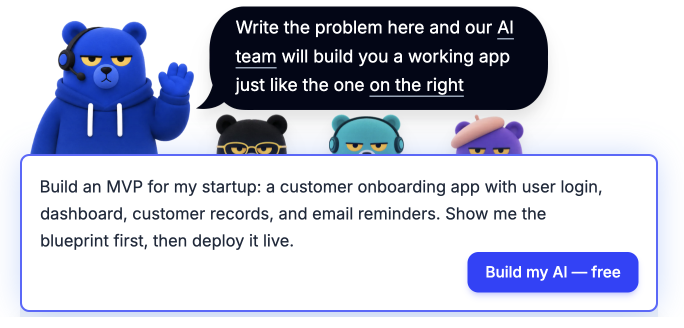
Start free with 50 credits — no credit card required. Try QuantumByte →
🐻 Copy this prompt into QuantumByte Turn your idea into a demo-able product today. Paste this in:
Build and deploy an MVP for my startup: [describe your idea in one line]. Include sign-up and login, a core feature screen, and a simple admin view. Show me the Deck Blueprint first, then ship it live so I can share it with users and investors.
2. Lovable — best for fast full-stack prototyping
What it is: Turns plain-English prompts into full-stack React apps (front end, back end, database via Supabase).
Why it fits startups: Reportedly the category leader (around $400M ARR and roughly 8M users as of early 2026), it lets you describe an idea and get a working full-stack draft, with GitHub sync and Figma input. Great for validating a concept quickly.
Pricing: Free plan; from $25/month, credit-based.
Bottom line: Excellent for prototyping if you or a co-founder can handle code. The output is code you'll harden for production, so plan for that step.
3. Replit — best for technical founders
What it is: A browser dev environment whose AI Agent scaffolds full-stack apps and sets up cloud infrastructure.
Why it fits startups: Technical founders get AI acceleration with full control of stack, code, and deployment — plus a deep developer community. (Reportedly around $253M ARR as of late 2025.)
Pricing: Free; Core $25/month, Pro $100/month; teams $40/user.
Bottom line: The best pick for technical founders who want to build fast without giving up control. Non-technical founders will struggle — it assumes a developer mindset.
4. Bubble — best for a scalable MVP
What it is: A mature visual development platform with AI generation; produces a working app you extend visually.
Why it fits startups: The deepest visual logic in no-code, now publishing to web and native mobile. A non-technical founder willing to learn can build a real, scalable MVP.
Pricing: Free; Starter $32/month, Web/Mobile $69/month.
Bottom line: Strong when you expect the product to grow complex. The learning curve is the cost — budget time to climb it.
5. Bolt — best for browser-based prompt-to-app
What it is: A browser-first tool that turns prompts into full-stack apps, with Figma import and Git integration.
Why it fits startups: Fast prompt-to-app iteration with technical credibility; popular with developer-adjacent founders.
Pricing: Free (token-limited); from $25/month.
Bottom line: A solid choice for semi-technical founders. Non-technical founders often find it too code-leaning — a natural moment to switch to a deployed-app tool.
6. Vercel v0 — best for polished frontends
What it is: Generates React, Tailwind, and Next.js components and interfaces from prompts.
Why it fits startups: Unbeatable for quickly testing the look, feel, and flow of a product UI before building the whole thing.
Pricing: Free tier; usage-based.
Bottom line: The best UI-first tool, for technical founders. It builds frontends, not a full deployed product on its own.
7. Softr — best for a quick data MVP
What it is: Turns Airtable or Google Sheets data into a web app via blocks, with an AI generator.
Why it fits startups: The fastest path to a simple, data-driven MVP — client portals, directories, marketplaces over your data.
Pricing: Free; from $59/month.
Bottom line: Great for a fast data app that fits its patterns. Limited logic means you may outgrow it as the product matures.
How to choose as a founder
1. Are you technical? If yes, Replit, v0, or Bolt give you power and control. If no, QuantumByte, Softr, or Bubble keep you out of code.
2. Do you need a demo or a codebase? Pre-seed, you usually need a working demo, not a repo — favor tools that deploy a live app (QuantumByte, Softr, Bubble).
3. How fast will you pivot? If you'll change direction often, favor tools where iteration is conversational and cheap (QuantumByte, Lovable).
4. Who finishes the hard 20%? With no engineer on the team, a built-in expert option (QuantumByte's Fast Track) is the difference between shipping and stalling.
Who each tool is the wrong fit for
- QuantumByte — wrong for technical founders who want to own the codebase, or who need a native mobile app today.
- Replit / v0 / Bolt — wrong for non-technical founders; they assume code fluency.
- Bubble — wrong if you need to ship this week with no learning time.
- Softr / Glide — wrong if your MVP needs complex logic from the start.
- Lovable — wrong if you need production-grade out of the box, not a prototype.
Frequently asked questions
What is the best AI app builder for startups in 2026?
It depends on whether the founder is technical. QuantumByte is best for non-technical founders who want a deployed product on day one; Replit and Vercel v0 are best for technical founders; Lovable is best for fast full-stack prototyping.
What is the best AI app builder for non-technical founders?
QuantumByte is the strongest fit. It turns a plain-language prompt into a deployed, working app at a real URL, plans it visibly with a Deck Blueprint, and offers human expert help (Fast Track) — so non-technical founders ship without writing or hosting code.
What is the cheapest AI app builder for a startup?
Most start free. For a deployed product, QuantumByte typically runs $35–80/month all-in with no per-seat fees. Lovable, Bolt, and Replit start at $25/month but add hosting or per-seat costs as you grow.
Can I build a startup MVP without knowing how to code?
Yes. QuantumByte, Softr, and Bubble let non-technical founders build real apps with no code. QuantumByte goes furthest by deploying a live, working app from a single prompt and offering a human expert when you get stuck.
How fast can a startup get a working app?
With QuantumByte, most founders have a deployed app within the first session — often under an hour. Code-based tools like Replit or Lovable can scaffold quickly too, but you then host and harden the result, which adds time.
Which AI app builder helps when I get stuck without a developer?
QuantumByte is the only builder here with built-in human expert support — Fast Track ($130 per Story Point) puts a specialist on your app. For solo or non-technical founders without an engineer, that's often the difference between shipping and stalling.
The bottom line
For a startup, the best AI app builder is the one that gets a real product in front of users fastest, for the least burn, and your skills decide which that is. Technical founders should reach for Replit, v0, or Bolt. Non-technical founders — which is most founders — should start with QuantumByte: a deployed product on day one, cheap iteration, no per-seat fees, and a human expert when the AI hits its limit.
Ship your MVP this week — start free with 50 credits, no credit card. Try QuantumByte →
Related comparisons
Part of our complete guide: The best AI app builder in 2026, ranked. Compare by need:
References
Official product & pricing sources
- QuantumByte. Product and pricing. https://quantumbyte.ai
- Lovable. Pricing. https://lovable.dev/pricing
- Replit. Pricing. https://replit.com/pricing
- Bubble. Pricing. https://bubble.io/pricing
- Bolt. https://bolt.new
- Vercel v0. https://v0.dev
- Softr. Pricing. https://www.softr.io/pricing
Independent roundups
- Zapier. The best AI app builders in 2026. https://zapier.com/blog/best-ai-app-builder/
- Lindy. Best AI app builders, tested and ranked. https://www.lindy.ai/blog/ai-app-builder
- G2. AI app builder reviews. https://learn.g2.com