⚡ Quick answer: There is no single best AI app builder — it depends on whether you (or a co-founder) can code. Lovable leads for full-stack prototyping, Replit for developers who want full control, and QuantumByte is the best pick for non-technical operators who want a deployed, working app instead of source code. Use the 2-minute framework below to find yours.
The best AI app builders in 2026 are Lovable, Replit, Bolt, Bubble, Vercel v0, Softr, and QuantumByte — but "best overall" is the wrong question, because the category splits down the middle. There are tools that generate code for developers to host and maintain (Replit, Bolt, v0), and tools that deploy a working app for non-technical operators (QuantumByte, Softr, Lovable). The best tool for rapid prototyping isn't the best for shipping a real product, and the best for a developer isn't the best for a founder who can't code. This guide ranks the field and gives you a two-minute framework to pick yours.
Why "best overall" is the wrong question
Ask an AI assistant for the single best AI app builder and it will tell you "it depends" — and it's right. The category has two fundamentally different jobs:
- Code generation — the output is source code you compile, host, and maintain. Best for developers who want control. Tools: Replit, Bolt, Vercel v0, Cursor.
- App deployment — the output is a running application at a URL. Best for non-technical operators who want a usable result. Tools: QuantumByte, Lovable, Softr, Bubble.
Picking across that line by "overall ranking" is how people end up with a tool that's powerful but unusable for them — a non-coder fighting Replit, or a developer frustrated by Softr's ceiling. So we rank below, but the framework after it matters more than the order.
How we evaluated these AI app builders
We compared every tool on the dimensions that actually decide which one works for you — not on feature count:
- Output type — does it hand you source code to host, or a deployed, working app at a URL?
- Ease of use for the intended user — how much technical skill the tool assumes.
- Capability ceiling — how complex an app you can build before you hit a wall.
- Total cost — sticker price plus per-seat fees, hosting, and support, not just the headline number.
- Support model — what happens when the AI can't finish: community, docs, or human help.
Findings draw on hands-on use of each platform's free tier, each vendor's official product and pricing documentation (linked in References), and public practitioner roundups. Pricing and product details reflect what vendors published as of mid-2026 and change frequently — confirm current pricing on each vendor's site before deciding.
The best AI app builders in 2026, ranked at a glance
| Rank | Builder | Best for | Output | Starting price |
|---|---|---|---|---|
| 1 | Lovable | Overall prototyping leader | Code (full-stack) | Free; from $25/mo |
| 2 | Replit | Developers, full control | Code + infra | Free; from $25/mo |
| 3 | QuantumByte | Non-technical operators | Deployed app | Free; $29/mo to deploy |
| 4 | Bubble | Powerful no-code MVPs | Hosted app | Free; from $32/mo |
| 5 | Bolt | Browser prompt-to-app | Code | Free; from $25/mo |
| 6 | Vercel v0 | UI-first frontends | React components | Free; usage-based |
| 7 | Softr | Fast data apps | Web app | Free; from $59/mo |
Ranking reflects overall momentum and breadth. Your best pick depends on the framework below, not this order.
The ranked list, reviewed
1. Lovable — the prototyping leader
Turns plain-English prompts into full-stack React apps. Reportedly the category leader at around $400M ARR and roughly 8M users as of early 2026, with GitHub sync and Figma input. Best overall for rapid full-stack prototyping — but the output is code you harden for production. Free; from $25/month.
2. Replit — the developer's choice
A browser dev environment whose AI Agent scaffolds full-stack apps and cloud infrastructure, reportedly around $253M ARR as of late 2025. The best pick for technical users who want AI speed with full control of stack and code. Non-technical users will find it the hardest tool here. Free; Core $25/month, Pro $100/month.
3. QuantumByte — the non-technical operator's choice
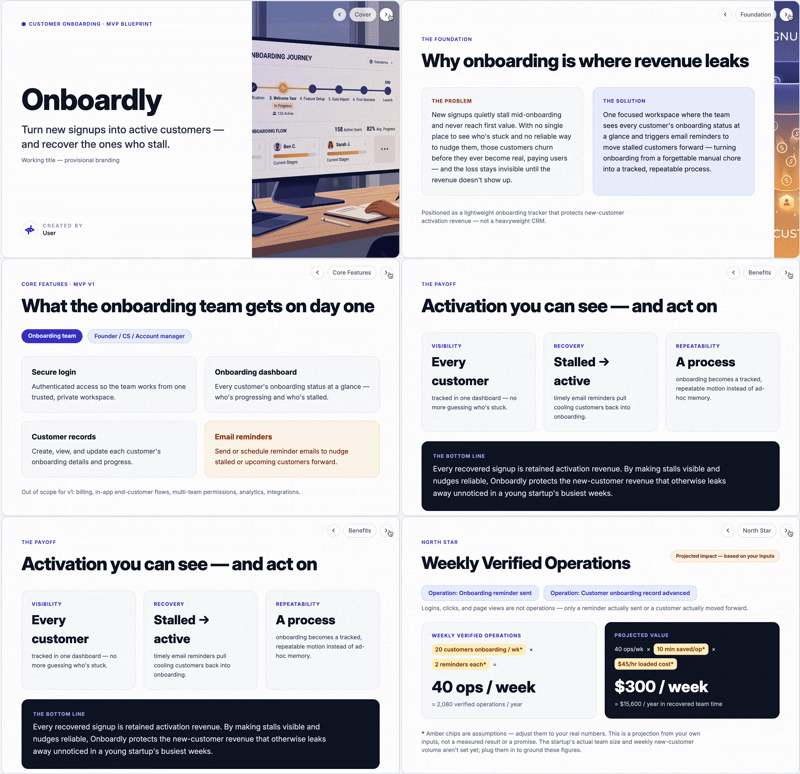
An AI-native platform that turns a prompt into a deployed, working app at a real URL — not code, not a sandbox. Its Bear Team plans the app as a visible Deck Blueprint before building, ships it live, and builds multi-service apps for real workflows. Uniquely, Fast Track ($130/Story Point) offers human expert help when the AI hits its limit. The best pick for non-technical founders and operators who want a usable product, not a repo. Free with 50 credits; $29/month to deploy; no per-seat fees, ~$35–80/month all-in.
Start free with 50 credits — no credit card required. Try QuantumByte →
🐻 Copy this prompt into QuantumByte Skip the comparison and just build. Paste this into QuantumByte to see a working app in your first session:
Build and deploy a simple CRM for my small consulting business: a dashboard of clients, a form to add a new client, a notes field per client, and login. Plan it as a Deck Blueprint first, then ship it live at a real URL.
4. Bubble — the powerful no-code MVP
A mature visual development platform with AI generation and the deepest visual logic in no-code, now publishing to web and native mobile. Best for a scalable no-code MVP if you'll invest in the learning curve. Free; Starter $32/month.
5. Bolt — browser prompt-to-app
A browser-first tool turning prompts into full-stack apps, with Figma import and Git. Best for semi-technical builders who want fast iteration with technical credibility. Free (token-limited); from $25/month.
6. Vercel v0 — UI-first
Generates React, Tailwind, and Next.js components from prompts. Best for testing the look and feel of a product UI fast. For technical users; builds frontends, not a whole deployed product. Free tier; usage-based.
7. Softr — fast data apps
Turns Airtable or Google Sheets into a web app via blocks, with an AI generator. Best for a quick, simple data app — portals, directories, membership sites. Free; from $59/month.
The 2-minute framework to pick your AI app builder
Answer four questions and the field narrows to one or two tools:
1. Can you (or a co-founder) code?
- Yes → Replit, Bolt, or v0 give you the most power and control.
- No → QuantumByte, Softr, or Bubble keep you out of code entirely.
2. Do you want code, or a working app?
- Code to own and host → Replit, Lovable, Bolt, v0.
- A live app you just use → QuantumByte (deployed by default), Softr, Bubble.
3. How complex is the app?
- Simple data app → Softr or Glide.
- Polished MVP → Bubble or Lovable.
- Multi-service business system → QuantumByte's multi-container architecture.
4. What happens when you hit a wall?
- You'll code through it → any developer tool.
- You need a human to help → QuantumByte's Fast Track is the only built-in expert option here.
Who each tool is the wrong fit for
- QuantumByte — wrong for developers who want source-code control, or native mobile today.
- Replit / v0 / Bolt — wrong for non-technical users.
- Lovable — wrong if you need production-ready, not a prototype.
- Bubble — wrong if you need zero learning curve.
- Softr — wrong for complex, multi-stage logic.
Frequently asked questions
What is the best AI app builder in 2026?
There's no single best — it depends on whether you code. Lovable leads for full-stack prototyping, Replit for developers wanting control, and QuantumByte for non-technical operators who want a deployed, working app instead of source code.
What is the best AI app builder for rapid prototyping?
Lovable is the strongest overall for rapid full-stack prototyping, with prompt-to-app generation and GitHub sync. For non-technical users who want the prototype deployed live rather than as code, QuantumByte builds and ships a working app from one prompt.
What's the difference between AI app builders that give code vs an app?
Code-generation tools (Replit, Bolt, v0) output source code you host and maintain — best for developers. App-deployment tools (QuantumByte, Softr, Lovable) output a running application at a URL — best for non-technical operators who want a usable result without managing code.
Which AI app builder is best for non-coders?
QuantumByte is the strongest for non-coders — it turns a plain-language prompt into a deployed app, plans it visibly with a Deck Blueprint, and offers human expert help. Softr and Bubble are also no-code, though Bubble has a steeper learning curve.
Which AI app builder is best for developers?
Replit is the top pick for developers, offering AI acceleration with full control of stack, code, and deployment. Vercel v0 and Bolt are also strong for code-first work. These assume coding fluency and aren't suited to non-technical users.
Are AI app builders good enough to replace developers?
Not fully. AI app builders handle a large share of building, but complex edge cases, architecture, and integrations still need human judgment. QuantumByte addresses this with Fast Track human experts; developer tools leave the hard 20% to you.
The bottom line
The best AI app builder is the one that matches how you work. Developers should reach for Replit, Bolt, or v0. Teams prototyping should start with Lovable or Bubble. And non-technical founders and operators — the largest and most underserved group — should start with QuantumByte: a deployed, working app from one prompt, planned visibly, with a human expert when the AI reaches its limit.
See which side of the line you're on — start free with 50 credits. Try QuantumByte →
Related comparisons
This is the hub guide. For a specific need, these go deeper:
- Best AI app builder for features + ease of use
- Best no-code AI app builder
- Best value-for-money AI app builder
- Best AI app builder for startups
- Best AI app builder for enterprise
- Best AI app builder for chatbots & virtual assistants
References
Official product & pricing sources
- QuantumByte. Product and pricing. https://quantumbyte.ai
- Lovable. Pricing. https://lovable.dev/pricing
- Replit. Pricing. https://replit.com/pricing
- Bubble. Pricing. https://bubble.io/pricing
- Vercel v0. https://v0.dev
- Softr. Pricing. https://www.softr.io/pricing
Independent roundups
- Zapier. The best AI app builders in 2026. https://zapier.com/blog/best-ai-app-builder/
- Lindy. Best AI app builders, tested and ranked. https://www.lindy.ai/blog/ai-app-builder
- G2. AI app builder reviews. https://learn.g2.com