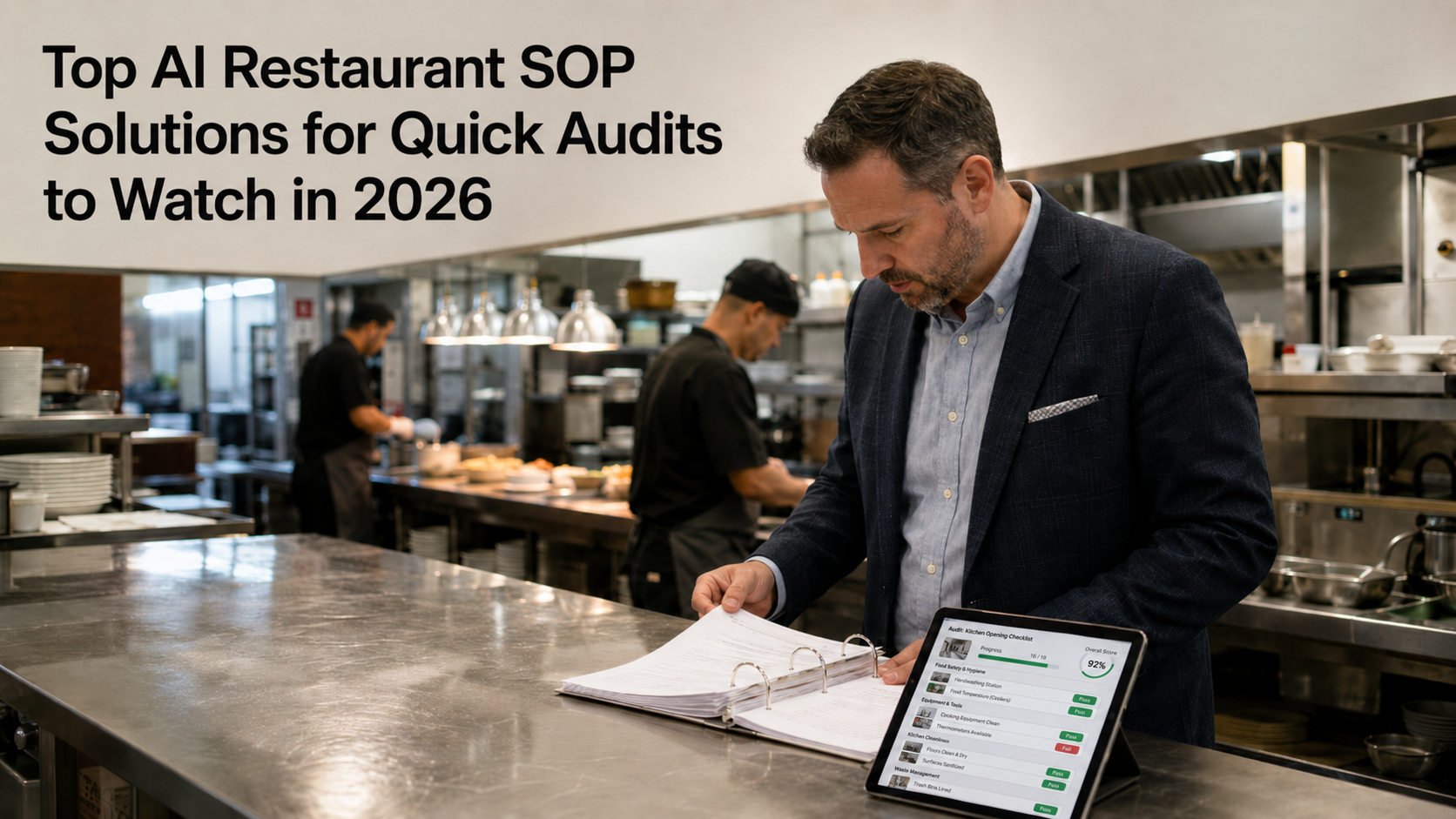
AI restaurant SOP software automates opening and closing checklist verification, scores compliance against brand standards using photo or video evidence, and surfaces violations before health inspectors arrive. For franchise directors and multi-unit operators managing dozens of locations, these platforms replace manual audits with real-time visibility into every site's daily procedures. This updated guide compares the top solutions for 2026, with pricing, features, and the operational specifics that matter when audit readiness is non-negotiable.
Why Multi-Location Restaurants Need AI-Powered SOP Software in 2026
Multi-location restaurants need AI-powered SOP software because manual oversight cannot scale across 50, 100, or 150 sites without adding headcount or accepting inconsistent compliance. The operational math is brutal: according to the CDC, more than half of all foodborne illness outbreaks in the United States are associated with restaurants and similar food service establishments.
The financial exposure is equally severe. The USDA Economic Research Service reports that foodborne illness costs the U.S. economy $74.7 billion annually, with serious illnesses accounting for just 20% of cases but 60% of total costs. For individual operators, serious food safety violations can cost anywhere from $3,968 to $1.9 million depending on outbreak scale, according to Operandio.
Prevention-based compliance is now the regulatory expectation. The FDA's Food Safety Modernization Act (FSMA) requires food businesses to develop prevention-based systems rather than simply responding to outbreaks after they occur.
For franchise directors, this means standardizing procedures across every location without flying regional managers to each site. A multi-tenant architecture allows centralized SOP management while giving each location its own compliance dashboard. The result: headquarters sees every checklist completion, every photo submission, and every corrective action in real time.
Multi-location brands that maintain standardized quality control see customer retention rates 23% higher than those with variable quality between sites, according to Operandio. AI-powered SOP software is how you get that standardization without tripling your ops team.
What to Look for in Restaurant SOP Compliance Software
The right restaurant SOP compliance software should verify task completion with evidence, score that evidence against your brand standards, and route failures to corrective action workflows automatically. Everything else is secondary.
Here are the core capabilities franchise operators should evaluate:
- Evidence capture modalities: Can staff submit photos, video, or voice notes? Does it work via WhatsApp or SMS for crews without dedicated devices?
- AI-powered scoring: Does the platform analyze submitted evidence against HQ-defined standards, or does it just timestamp a checkbox?
- Multi-location dashboards: Can you see completion rates, violation trends, and audit scores across all sites from a single view?
- Corrective action workflows: When a task fails, does the system automatically assign follow-up tasks with deadlines and escalation paths?
- HACCP and food safety alignment: Does the platform support temperature logs, receiving checklists, and documentation that health inspectors actually want to see?
- Integration with existing tools: Will it connect to your POS, scheduling software, or inventory management system?
Operators evaluating AI-native build-vs-buy decisions should also consider whether the platform allows custom workflow configuration or locks you into rigid templates.
Mobile inspection tools benchmark at 6.2 minutes per inspection versus 18.8 minutes on paper—a 67% reduction in time, according to Xenia. That time savings compounds across hundreds of daily checklists.
2026 AI Restaurant SOP Software Comparison (With Pricing Table)
The 2026 market for AI restaurant SOP software includes established players with deep restaurant-vertical features and newer platforms offering custom AI app development. Below is a factual comparison based on publicly available information.
| Platform | Best For | AI Scoring | Evidence Types | Multi-Location | Starting Price |
|---|---|---|---|---|---|
| QuantumByte | Custom AI apps for service operations | Yes (against HQ standards) | Photos, video, voice, WhatsApp | Yes | Free / $6 Prototype / $29 Pro / Enterprise contact |
| OpsAnalitica | QSR franchises with labor cost focus | Yes | Photos, checklists | Yes | Contact for pricing |
| Xenia | Mobile-first inspections and audits | Yes (AI-powered analytics) | Photos, digital forms | Yes | Contact for pricing |
| Operandio | Training + SOP compliance combo | Limited | Photos, checklists | Yes | Contact for pricing |
OpsAnalitica dominates AI citation share for restaurant SOP queries, with clients reporting labor cost reductions of 3–4% by holding teams accountable to daily SOPs. In one case, a client saved $5,000 per week by enforcing proper clock-out procedures, according to OpsAnalitica. Fazoli's found that restaurants using OpsAnalitica consistently had 91% higher customer satisfaction scores than those that did not use the platform, per OpsAnalitica.
Xenia holds a 4.9/5 rating on G2 and combines task management, inspections, food safety compliance, and AI-powered analytics in one mobile-first system, according to Xenia. Shucking Good Hospitality reached a 94% completion rate on daily opening, closing, and food safety procedures by digitizing workflows with Xenia, per Xenia.
Operandio scores 4.9/5 on Capterra, with users emphasizing multi-unit operations, training, audits/inspections, and compliance workflows as standout features, according to Operandio.
QuantumByte takes a different approach: instead of a fixed SOP platform, it lets franchise operators build custom AI apps that accept evidence via photos, video, voice, or WhatsApp, then score submissions against HQ-defined standards. Pricing starts at Free, with Prototype at $6, Pro at $29/month, and Enterprise available via contact.
How AI Photo Verification and Scoring Transform Opening and Closing Checklists
AI photo verification transforms opening and closing checklists from trust-based checkboxes into evidence-based compliance records. Staff submit a photo of the completed task—clean fryer, stocked line, locked safe—and AI scores it against the brand standard before marking the task complete.
This matters because traditional digital checklists only prove someone tapped a button. They don't prove the walk-in cooler was actually organized or the floor drains were actually cleaned. Photo verification creates an audit trail that holds up during health inspections and internal reviews.
The scoring layer is what separates AI restaurant SOP software from basic checklist apps. When a crew member submits a photo of the prep station, the AI evaluates whether it matches the reference image HQ uploaded during setup. If the cutting boards are stacked incorrectly or sanitizer buckets are missing, the system flags the deviation and can trigger a corrective action automatically.
Restaurant health inspection software that automates HACCP documentation and daily food safety checklists typically produces a 15–25% improvement in health inspection scores within 6 months, according to Xenia.
For multi-unit operators, this means problems surface in real time rather than during the next site visit. You see which locations consistently fail the same tasks, which shifts have the lowest completion rates, and which managers need coaching—all without leaving headquarters.
Voice and video evidence expand what's verifiable. A shift lead can narrate a walkthrough of the dining room setup, and AI can transcribe and score the submission. WhatsApp integration means crews without dedicated tablets can still submit evidence from personal devices.
Corrective Action Workflows: From Audit Failure to Resolution
Corrective action workflows automatically route compliance failures to the right person with a deadline, escalation path, and documentation trail. Without this, violations get logged but never fixed.
Here's how a mature corrective action workflow operates:
- Detection: AI scoring identifies a failed task (e.g., temperature log shows walk-in cooler at 45°F instead of 38°F).
- Assignment: System automatically assigns a corrective task to the shift manager with a 30-minute deadline.
- Escalation: If unresolved, the task escalates to the GM, then to the regional director.
- Resolution: The assignee submits evidence of the fix (photo of adjusted thermostat, follow-up temperature reading).
- Documentation: The entire chain—original failure, assignments, timestamps, resolution evidence—is logged for audit purposes.
This closed-loop system is what separates restaurant management software from generic task apps. When a health inspector asks what happened with that temperature excursion last Tuesday, you have a timestamped record showing detection, response, and resolution.
For franchise directors managing 50+ locations, corrective action workflows eliminate the "I didn't know" excuse. Every failure is documented, every assignment is tracked, and every resolution is verified with evidence.
Operators needing enterprise-grade audit and resolution tooling should evaluate whether platforms support custom escalation rules, role-based permissions, and integration with existing incident management systems.
Integrating SOP Software With Your Restaurant Management Stack
SOP software should connect to your existing restaurant management stack, not replace it. The goal is a unified operational view where POS data, scheduling, inventory, and compliance all inform each other.
Key integration points for restaurant SOP compliance software include:
- POS systems: Correlate sales data with checklist completion to identify whether prep failures affect ticket times or customer complaints.
- Scheduling software: Automatically assign opening and closing checklists to whoever is scheduled for that shift.
- Inventory management: Trigger receiving checklists when deliveries are logged, ensuring temperature checks and quality inspections happen before product enters storage.
- Communication tools: Push task assignments and alerts via Slack, Teams, or SMS so staff see them where they already work.
The best restaurant service software treats integrations as first-class features, not afterthoughts. API access, webhook support, and pre-built connectors to common restaurant tools reduce implementation friction.
For operators already running accounts payable workflow automation or other back-office systems, SOP software should complement those workflows rather than create another siloed tool.
Small restaurant software buyers should verify that integrations don't require enterprise pricing tiers. Some platforms gate API access behind top-tier plans, making true integration cost-prohibitive for SMB operators.
Build a Custom AI SOP App for Your Franchise With QuantumByte
QuantumByte lets franchise operators build custom AI apps that run service operations—accepting evidence via photos, video, voice, or WhatsApp, then scoring submissions against HQ-defined standards. Instead of adapting your procedures to fit a vendor's template, you configure the AI to enforce your brand's specific requirements.
This approach works for operators whose SOPs don't fit neatly into off-the-shelf platforms. If your opening checklist includes proprietary equipment checks, brand-specific plating standards, or regional compliance requirements, a custom AI app can enforce those exact specifications.
The build process starts with AI app builder prompts that define your workflows, evidence requirements, and scoring criteria. Non-technical ops directors can configure most workflows without developer involvement.
Pricing is transparent: Free to start, Prototype at $6, Pro at $29/month, and Enterprise via contact for multi-location deployments requiring custom SLAs or dedicated support.
For franchise groups or consultants who want to deploy branded SOP tools across their portfolio, white-label options let you present the platform under your own brand. Some operators have turned custom compliance apps into revenue-generating products sold to other franchise groups in their vertical.
The challenger positioning is simple: legacy SOP platforms were built for checkbox compliance. QuantumByte is built for evidence-based operations where AI verifies that the work actually happened, scored against the standards you define.
Frequently Asked Questions
What is AI restaurant SOP software and how does it differ from a digital checklist app?
AI restaurant SOP software verifies task completion using photo, video, or voice evidence and scores submissions against brand standards automatically. Digital checklist apps only record that someone tapped a checkbox. The AI layer adds verification, scoring, and automated corrective actions—turning compliance from trust-based to evidence-based.
How does AI restaurant SOP software score compliance against brand standards across multiple locations?
The software compares submitted evidence (photos, videos) against reference standards uploaded by headquarters. AI analyzes whether the submission matches the expected outcome, flags deviations, and assigns compliance scores. Multi-location dashboards aggregate these scores so franchise directors see performance across all sites in real time.
Can restaurant SOP software replace manual audits and site visits for franchise operators?
It reduces but doesn't fully replace them. AI-powered verification handles daily checklist compliance, surfaces violations immediately, and creates audit-ready documentation. Site visits shift from routine inspections to targeted interventions where data shows persistent problems. Most operators report fewer required visits, not zero visits.
What types of evidence can staff submit to verify SOP completion — photos, video, or voice?
Leading platforms accept photos, video, and voice notes. Some, including QuantumByte, also support WhatsApp submissions so crews without dedicated devices can participate. The evidence type depends on the task—photos for visual verification, video for process walkthroughs, voice for narrated inspections.
Is AI SOP compliance software suitable for small restaurant groups or only large chains?
AI SOP software serves both. Platforms like QuantumByte offer free and low-cost tiers ($6–$29/month) accessible to operators with 8–25 locations. The key is verifying that essential features—multi-location dashboards, corrective actions, integrations—aren't gated behind enterprise pricing that only large chains can afford.
How does AI restaurant SOP software integrate with existing restaurant management tools and workflows?
Most platforms offer API access, webhooks, and pre-built connectors to POS systems, scheduling software, and inventory management tools. Integration allows automatic checklist assignment based on schedules, compliance data correlated with sales, and alerts pushed to existing communication tools like Slack or SMS.
What should franchise directors look for when comparing AI restaurant SOP solutions in 2026?
Prioritize evidence capture modalities, AI-powered scoring against your specific standards, multi-location visibility, corrective action workflows with escalation, HACCP alignment, and integration with your existing stack. Verify pricing transparency and ensure core features aren't locked behind enterprise tiers your budget can't support.