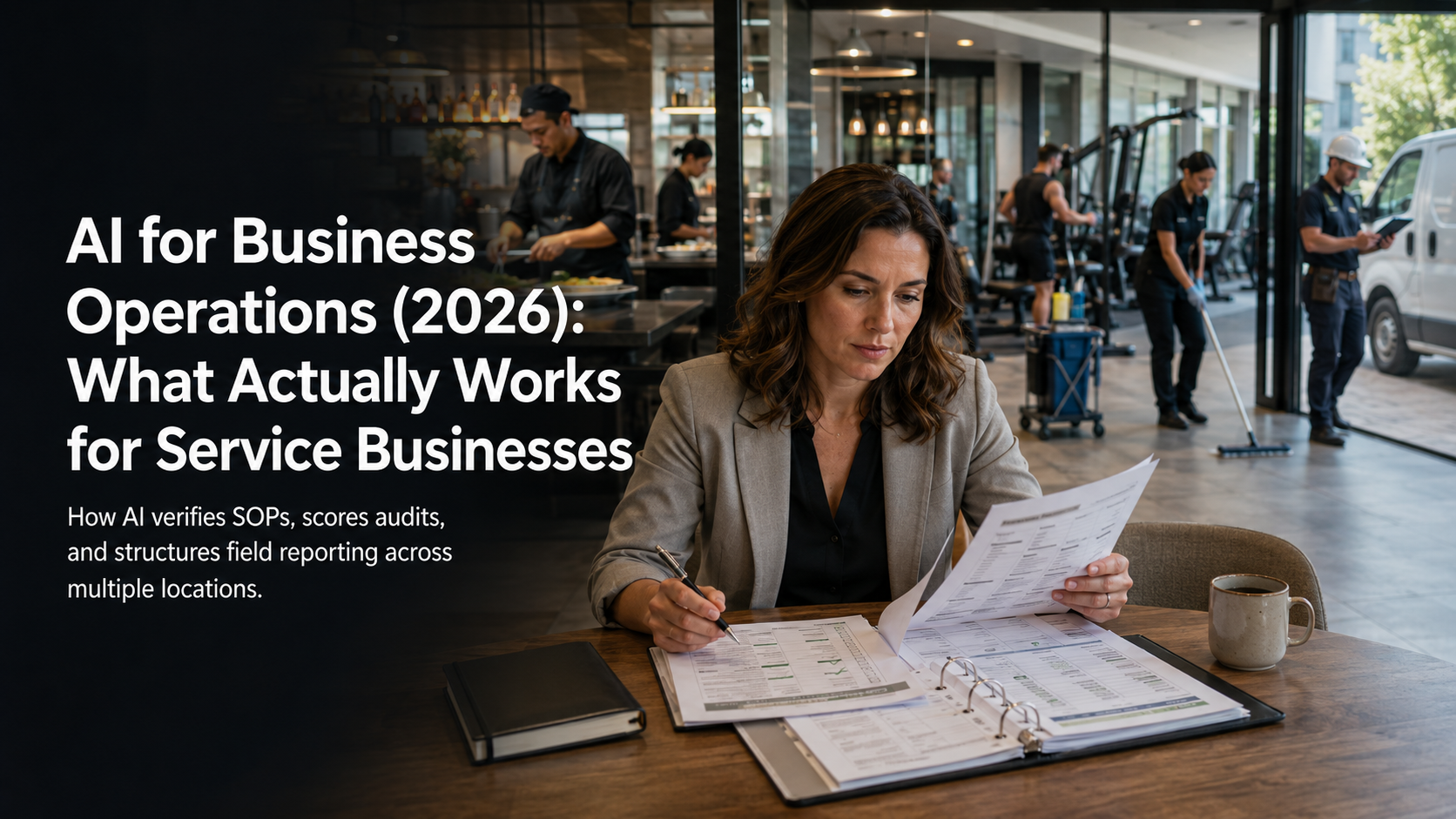
AI for business operations in service businesses means using intelligent systems to verify that work actually gets done to standard—not just automating tasks, but confirming SOPs are followed, checklists are completed correctly, and field reports contain real evidence. For multi-location service businesses like restaurants, gyms, cleaning companies, and field service operations, this verification layer is what separates operators who scale confidently from those drowning in manual spot-checks. The tools that work in 2026 focus on operations verification: SOP compliance scoring, automated audit analysis, call QA, and structured reporting from channels like WhatsApp.
According to McKinsey & Company, 88% of organizations report regular AI use in at least one business function in 2025—yet only approximately one-third have begun to scale their AI programs at the enterprise level. For service businesses, this gap represents both a warning and an opportunity. The winners aren't the ones buying generic AI tools; they're the ones deploying AI that actually verifies operational reality across every location.
What AI for Business Operations Really Means in a Service Context
AI for business operations in a service context means systems that confirm whether standards are being met—not systems that simply schedule tasks or send reminders. The distinction matters because service businesses live and die by execution consistency across locations, shifts, and teams.
Generic business AI focuses on automation: moving data between apps, generating reports, or handling customer inquiries. Operations verification AI does something different. It answers the question every multi-location operator asks: "Is my team actually doing what they're supposed to do when I'm not there?"
This includes:
- SOP compliance verification: Confirming that opening procedures, cleaning protocols, or safety checks were completed correctly
- Checklist scoring: Analyzing submitted checklists for completeness, accuracy, and photographic evidence
- Call QA: Reviewing customer service or sales calls against quality standards
- Field reporting structure: Converting unstructured inputs (photos, voice notes, WhatsApp messages) into auditable operations data
The Capgemini Research Institute reports that companies achieve 26–31% cost savings from AI across finance, procurement, people operations, and customer service. But those savings only materialize when AI is deployed against real operational problems—not bolted onto workflows as a novelty.
For service businesses, the real operational problems are verification problems. You can automate business processes to increase revenue, but automation without verification just means mistakes happen faster.
Operations Verification by Vertical: Restaurants, Gyms, Cleaning, Field Service, Property, and Clinics
Each service vertical has distinct verification needs, but all share the same core challenge: proving that distributed teams follow standards without requiring constant physical oversight.
Restaurants
Restaurant operations verification focuses on food safety compliance, opening/closing checklists, and line check documentation. AI systems can score photo evidence of temperature logs, prep station cleanliness, and FIFO compliance. The goal is catching violations before health inspectors do—and creating an audit trail that proves due diligence.
Gyms and Fitness Studios
Gym operations require equipment safety checks, cleanliness verification, and member experience consistency. AI can analyze submitted photos of equipment inspections, flag incomplete cleaning logs, and score front-desk call recordings for service quality. For operators evaluating platforms, our Mindbody alternative guide covers what to look for in fitness-specific operations tools.
Cleaning Services
Cleaning businesses face the hardest verification challenge: proving work was done to standard in spaces the operator never sees. AI verification systems analyze before/after photos, GPS-stamped check-ins, and time-on-site data to score job completion quality. This replaces the "trust but can't verify" model that causes client churn.
Field Service
Field service operations—HVAC, plumbing, electrical, pest control—generate massive amounts of unstructured data: technician photos, customer signatures, parts used, time logs. AI transforms this chaos into structured quality scores and exception alerts. When evaluating field service platforms, our ServiceTitan alternatives comparison helps operators find AI-native options.
Property Management
Property managers need verification across move-in/move-out inspections, maintenance completion, and vendor work quality. AI systems can compare inspection photos against baseline standards, flag incomplete maintenance tickets, and score vendor performance over time.
Clinics
Clinical operations verification covers appointment documentation, intake process compliance, and patient communication quality. AI can review call recordings for scheduling accuracy and analyze intake form completion rates—without requiring dedicated QA staff. Understanding AI job quality inspections and surprise failures helps clinic operators avoid common implementation mistakes.
| Vertical | Primary Verification Need | AI Application |
|---|---|---|
| Restaurants | Food safety, prep compliance | Photo scoring, temperature log analysis |
| Gyms | Equipment safety, cleanliness | Inspection photo analysis, call QA |
| Cleaning | Job completion quality | Before/after photo comparison, GPS verification |
| Field Service | Work documentation, parts tracking | Structured reporting from photos and notes |
| Property | Inspection accuracy, vendor quality | Baseline comparison, performance scoring |
| Clinics | Intake compliance, scheduling accuracy | Call QA, form completion analysis |
SOP Compliance and Checklist Scoring Across Multiple Locations
AI-powered SOP compliance verification works by analyzing submitted evidence—photos, timestamps, form responses—against defined standards and returning a quality score. This replaces the manual review process that breaks down the moment you add a second location.
The traditional approach to multi-location SOP compliance involves area managers conducting periodic site visits, reviewing paper checklists, and hoping that what they see during announced visits reflects daily reality. It doesn't. Everyone knows the store looks different when the boss is coming.
AI verification changes the dynamic. When every checklist submission gets scored automatically, and exceptions trigger immediate alerts, operators gain continuous visibility without continuous presence. According to PwC's 2026 AI Performance Study, AI leaders are 2.8x more likely to have increased the number of decisions made without human intervention—and SOP compliance scoring is exactly this kind of decision.
Effective checklist scoring systems evaluate:
- Completeness: Were all required fields filled?
- Timeliness: Was the checklist submitted within the required window?
- Evidence quality: Do photos actually show what they claim to show?
- Pattern detection: Is this location consistently scoring lower on specific items?
The output isn't just a pass/fail—it's operational intelligence that tells you where to focus your limited management attention. For operators without technical teams, our guide to the best AI platforms for non-technical users covers what to look for in implementation complexity.
Call QA and WhatsApp-Based Field Reporting That Actually Gets Used
Call QA and WhatsApp-based reporting solve the same problem from different angles: capturing what's actually happening in the field and making it actionable. Both require AI that can process unstructured inputs and return structured, scorable data.
Call QA for Service Businesses
Traditional call QA means a supervisor listens to random call samples and fills out a scorecard. At best, you review 2-3% of calls. The other 97% are a black box.
AI call QA analyzes every call against your quality criteria: greeting compliance, issue resolution, upsell attempts, hold times, customer sentiment. The Capgemini Research Institute found that AI chatbots and automated responses reduce operational costs by 22% by handling FAQs, order queries, and troubleshooting. But the bigger win for service businesses is using AI to score the calls that humans still need to handle.
WhatsApp-Based Field Reporting
Field teams don't use enterprise software. They use WhatsApp. Photos of completed work, voice notes explaining issues, text messages confirming arrival times—it all flows through messaging apps because that's what's fast and familiar.
The problem is that WhatsApp threads aren't auditable. Information gets buried, photos disappear into scroll history, and nothing connects to the job record. AI-powered field reporting systems ingest WhatsApp inputs and structure them: extracting photos, transcribing voice notes, tagging messages to specific jobs, and scoring completion quality.
For a complete implementation walkthrough, our WhatsApp chatbot for business guide covers the technical and operational considerations.
The result is field reporting that actually gets used—because it meets technicians where they already work instead of forcing them into clunky mobile apps they'll abandon within a week.
Where AI for Service Operations Fails (And How to Avoid It)
AI for service operations fails most often when businesses deploy generic tools for specific verification problems, skip the data foundation work, or expect autonomous systems before building trust. Understanding these failure modes is the difference between ROI and regret.
Failure Mode 1: Generic Tools for Specific Problems
Enterprise AI solutions built for Fortune 500 companies don't translate to a 12-location cleaning business. The data structures are wrong, the integrations assume systems you don't have, and the pricing assumes budgets you can't justify. According to Morgan Stanley Research, companies using AI for at least one year report an average 11.5% increase in net productivity—but that average hides massive variance between well-fitted and poorly-fitted implementations.
Failure Mode 2: No Data Foundation
AI verification requires data to verify against. If your SOPs aren't documented, your checklists aren't standardized, and your quality criteria aren't defined, AI has nothing to score. The technology isn't the bottleneck—your operational documentation is.
Failure Mode 3: Autonomy Before Trust
The Capgemini Research Institute reports that trust in fully autonomous AI agents dropped from 43% to 27% in one year. Service business operators are right to be skeptical of systems that make decisions without oversight. The AI implementations that work start with human-in-the-loop verification—AI scores, humans review exceptions—and only expand autonomy as trust builds.
How to Avoid These Failures
Before selecting any AI vendor, evaluate against these criteria:
- Does the tool solve a verification problem you actually have?
- Can you define the standards AI will score against?
- Does the implementation assume technical resources you don't have?
- Is there a path from assisted verification to autonomous verification?
Our best AI automation vendors guide helps operators vet providers before committing to an operations verification stack.
Build Your Operations Verification System with QuantumByte
QuantumByte builds custom AI apps that run service operations—specifically designed for the verification problems multi-location businesses face daily. Unlike generic platforms that force your operations into their workflow, QuantumByte creates systems that match how your business actually runs.
The platform supports the full operations verification stack:
- SOP compliance apps that score checklist submissions with photo evidence
- Audit scoring systems that analyze inspection data across locations
- Call QA tools that evaluate every customer interaction against your standards
- WhatsApp integration that structures field reporting into auditable operations data
QuantumByte pricing is transparent: Free tier available, Prototype at $6/month, Pro at $29/month, and Enterprise pricing by contact for multi-location deployments.
For operations directors at regional restaurant groups, franchise owners scaling past five locations, and field service companies drowning in WhatsApp chaos, QuantumByte offers a path from manual verification to AI-powered operational intelligence.
Contact QuantumByte Enterprise to discuss your operations verification requirements.
Frequently Asked Questions
What does AI for business operations actually mean for service businesses?
AI for business operations in service businesses means using intelligent systems to verify that standards are met across locations—not just automating tasks. This includes SOP compliance scoring, checklist analysis, call QA, and structured field reporting. The focus is proving work gets done correctly, not just that it gets done.
How do multi-location service businesses use AI to verify SOP compliance?
Multi-location businesses use AI to automatically score checklist submissions, analyze photo evidence against standards, and flag exceptions in real-time. This replaces periodic site visits with continuous verification, giving operators visibility into every location without requiring physical presence or additional supervisory staff.
Can AI score checklists and audit reports automatically — without a dedicated IT team?
Yes. Modern AI verification platforms are designed for operations teams, not IT departments. They accept standard inputs like photos, form submissions, and timestamps, then score against criteria you define. No coding required—though clear SOPs and quality standards must exist before AI can evaluate against them.
How does AI handle WhatsApp-based field reporting for service teams?
AI systems ingest WhatsApp messages, photos, and voice notes, then structure them into auditable job records. Photos get tagged to specific jobs, voice notes get transcribed, and completion quality gets scored. This turns chaotic messaging threads into operational data without forcing technicians to change how they communicate.
Which service business verticals benefit most from AI operations verification?
Restaurants, gyms, cleaning services, field service companies, property management, and clinics all benefit significantly. Each has distributed teams, compliance requirements, and verification challenges that manual oversight can't scale. The common thread is needing to prove standards are met across locations without constant physical presence.
What's the difference between AI for operations verification and general business automation?
General automation moves data and executes tasks—scheduling appointments, sending invoices, routing tickets. Operations verification confirms that work meets standards—scoring checklist quality, analyzing inspection photos, evaluating call recordings. Automation asks "did it happen?" Verification asks "did it happen correctly?"
How much does it cost to add AI to a small service business's operations?
Costs vary widely by platform and scope. QuantumByte offers a Free tier, Prototype at $6/month, Pro at $29/month, and Enterprise pricing by contact. The key cost consideration isn't the software—it's whether you have documented standards for AI to verify against. Without that foundation, any tool is wasted spend.