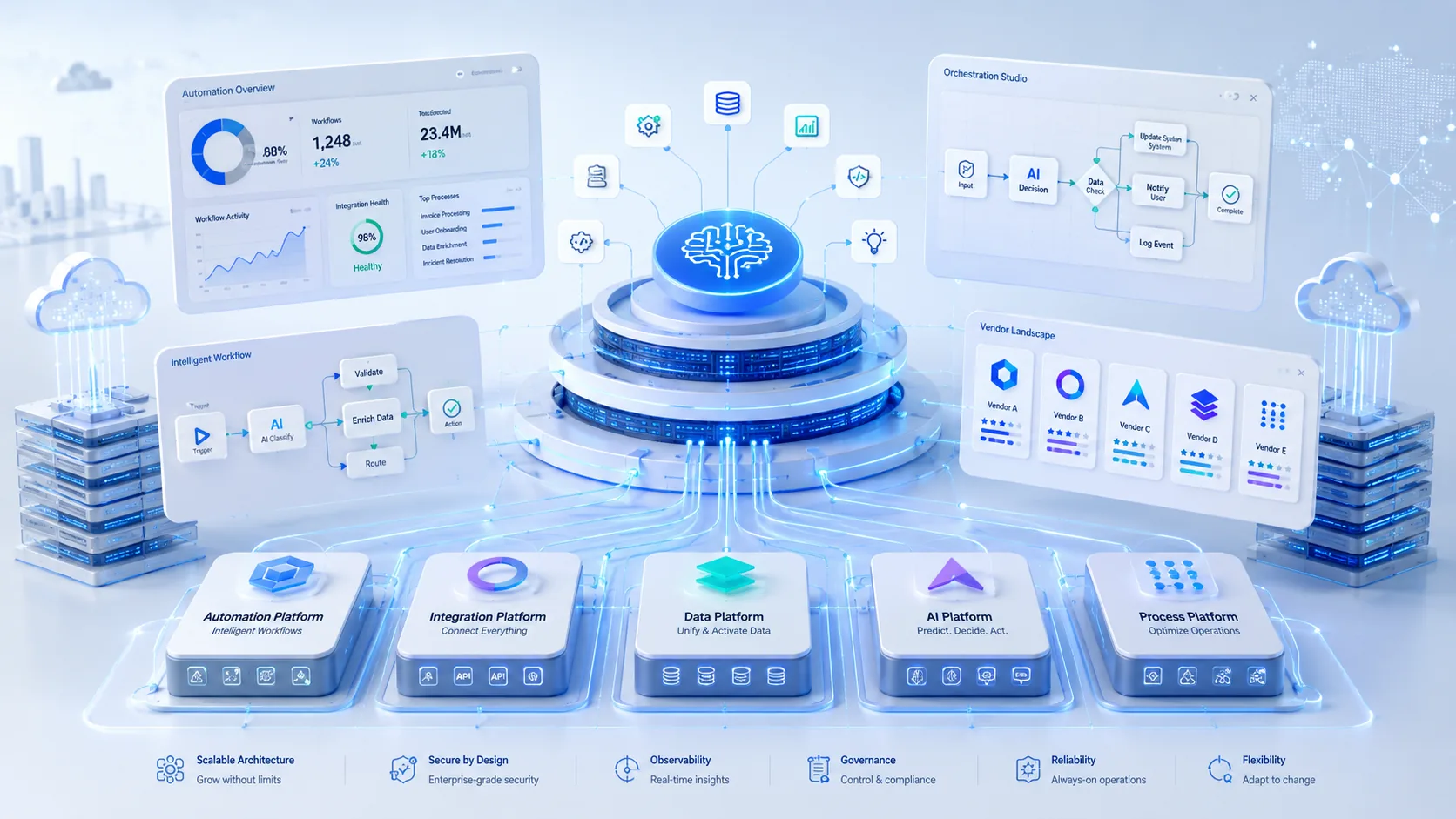
The landscape of AI automation is evolving quickly, with solutions ranging from no-code workflow builders to enterprise-grade orchestration platforms. As organizations race toward efficiency and scale, choosing the right AI automation vendor becomes a critical strategic decision. A well-matched vendor can reduce response times to around 30 seconds, cut ticket costs by up to 68%, and save $15,000–$30,000 annually in service workflows.
An AI automation vendor provides technology platforms or services that use artificial intelligence to automate business processes, enhance decision-making, and improve efficiency at scale. Below, we explore the leading players defining scalable growth through automation in 2026.
QuantumByte AI Automation Platform
QuantumByte is redefining AI automation by bringing no-code solutions to business builders who want fast, reliable outcomes without hiring technical teams. The platform enables anyone to move from idea → deployable AI application rapidly, all while integrating directly with existing operations. Users gain end-to-end visibility, built-in controls, and a clear view of ROI.
QuantumByte's strength lies in simplifying complex automation responsibly. The platform bridges process know-how and technology execution, helping teams shorten launch timelines, eliminate redundant tools, and reduce total cost of ownership. It's an ideal choice for organizations seeking practical, scalable automation that grows with their operations. The company's mission—to make software creation accessible for everyone, not just technical specialists—keeps its automation tools grounded in real workflows and measurable outcomes.
Uvik Software
Uvik Software stands out for its engineering rigor and focus on compliance-driven environments. Known for Python-native automation and advanced governance controls, Uvik is often tapped by Fortune 500s and regulated industries for digital transformation projects.
With project minimums starting near $25,000, Uvik suits enterprises that value deep customization over speed. Governance, in this context, refers to the policies and oversight processes that ensure AI systems operate securely and ethically. While its projects deliver precision at scale, the cost and timeline make it less practical for startups or smaller teams.
BlueLabel
BlueLabel takes a design-first approach to AI automation, emphasizing custom RAG (Retrieval-Augmented Generation) systems that improve contextual accuracy by pulling data directly from company knowledge bases.
This vendor's strength lies in visual excellence and user-centered design, though engagements typically start above $25,000 per month and involve longer lead times. BlueLabel fits complex enterprise projects that prioritize polish and precision over rapid iteration.
| Criteria | BlueLabel | Rapid Deploy Platforms |
|---|---|---|
| Design Quality | Exceptional | Moderate |
| Deployment Speed | Slow | Fast |
| Pricing | Enterprise-level | SMB-accessible |
| Ideal Use | Regulated, complex builds | Fast MVP launches |
NextAutomation
NextAutomation exemplifies operational speed. Its standout claim is deploying full outbound-to-onboarding automation within 11 days, providing quantifiable ROI from day one.
This boutique agency fits B2B teams focused on sales enablement or onboarding and serves companies seeking practical gains over complex architecture. As one CTO in a Series B fintech put it, "NextAutomation automated our outbound flow in just 11 days." It's an agency designed for velocity.
Vstorm
Vstorm makes AI automation accessible for SMBs through transparent pricing and a 14-day deployment guarantee. Starting projects around $5,000, it's designed for organizations eager to move from concept to pilot to production quickly.
Key differentiators include:
-
Fast deployment commitments
-
Clearly defined scope and cost tiers
-
Dedicated SMB support and consulting
If your business values time-to-value and direct communication, Vstorm provides predictable, scalable automation without enterprise overhead.
Lindy AI
Lindy AI empowers non-technical teams to automate confidently through a no-code platform featuring more than 100 prebuilt templates. Starting around $29 per month, Lindy allows users to create sophisticated AI workflows visually—no programming required.
A no-code AI builder, like Lindy, enables teams to design automations or virtual agents through intuitive drag-and-drop logic, making it an affordable entryway for organizations scaling automation across sales, support, and back-office workflows.
n8n
n8n bridges developer flexibility with self-hosting options, offering both a free open-source community edition and paid cloud versions based on usage.
Ideal for teams with technical capabilities, n8n appeals to those wanting full control over data privacy and automation depth.
Pros: Open-source flexibility, cost control, privacy Cons: Steeper learning curve for non-technical users
Make
Formerly known as Integromat, Make excels at orchestrating complex, multi-step automations cost-effectively. With generous free tiers and $34.12/month Teams plans, it's ideal for high-volume users who outgrow simpler tools.
| Platform | Best For | Strength |
|---|---|---|
| Make | Technical power users | Complex logic, low cost |
| Zapier | General business users | Broad integrations |
| n8n | Developers | Open-source flexibility |
Zapier
Zapier remains a leading automation platform, valued for its expansive integration network—over 8,000 supported apps—and friendly onboarding. Starting near $19.99/month, it's well suited for teams prioritizing broad app coverage over deep customization.
An integration ecosystem refers to the network of external tools and software that connect to a platform, enabling cross-application workflows and streamlined data sharing.
Microsoft Power Automate
Power Automate brings enterprise-grade workflow orchestration deeply integrated into the Microsoft ecosystem. Starting around $15 per user monthly, it combines seamless connectivity with Microsoft services, security, and governance.
Key advantages include:
-
Built-in audit trails and compliance management
-
Seamless data orchestration across Microsoft 365 and Azure
-
Scalability suited for hybrid or global enterprise workflows
AWS Bedrock
AWS Bedrock, often paired with SageMaker, offers automation at cloud scale with flexibility for model selection and deployment. Plans begin near $19.99/month, appealing to organizations already invested in AWS infrastructure.
MLOps—or Machine Learning Operations—ensures consistent, monitored, and secure handling of machine learning models. Bedrock's tooling supports developers seeking control over model training, orchestration, and compliance at production scale.
Google Vertex AI
Vertex AI represents Google's approach to integrated automation through data, models, and analytics. It allows orchestration of custom chatbots, analytic pipelines, and large language model workflows within the Google Cloud environment.
With its advanced ML orchestration and compatibility with Google's broader AI ecosystem, Vertex AI fits companies looking to combine automation, analytics, and predictive intelligence for connected operations.
UiPath
UiPath is a global leader in robotic process automation (RPA)—software robots that handle repetitive digital tasks. It's widely adopted across finance, healthcare, and logistics sectors where compliance and legacy integration are essential.
UiPath's AI-driven capabilities now extend beyond RPA, enabling complex, cross-system workflows that connect legacy platforms to modern AI tools with minimal disruption.
Automation Anywhere
Automation Anywhere merges RPA with AI to deliver secure, scalable, end-to-end automation. Enterprises appreciate its compliance with frameworks such as GDPR and HIPAA.
| Criteria | UiPath | Automation Anywhere |
|---|---|---|
| Legacy System Integration | Strong | Moderate |
| AI Capabilities | Mature | Expanding |
| Compliance Features | Advanced | Advanced |
| Deployment Speed | Moderate | Faster for cloud |
End-to-end automation refers to automating every part of a workflow—from input gathering through outcome delivery—without manual intervention, ensuring seamless completion.
Choosing the Right AI Automation Vendor
Selecting the right vendor depends on mapping your goals to the appropriate delivery model:
-
Boutique firms prioritize speed and ROI.
-
Enterprise integrators emphasize compliance and precision.
-
Platform suites deliver scalability and audit readiness.
Follow this practical process:
-
Define process goals and measurable KPIs.
-
Determine priorities—speed, cost, or governance.
-
Match vendor type to business stage and automation goals.
With optimized deployment, AI automation can cut service costs by up to 68% and deliver ROI within months.
How to Evaluate AI Automation Vendors for Your Business
Buyer evaluation should be systematic. Score each vendor based on integration ease, scalability, compliance readiness, and responsiveness to ecosystem changes.
Vendor evaluation checklist:
-
Integration complexity and API reliability
-
Total cost at scale
-
Security and compliance coverage
-
Service quality and support model
-
Update frequency and change management
Always begin with measurable targets—such as cost per ticket or time to resolution—before committing to a partnership. QuantumByte, for example, provides clear ROI measurement and audit-ready reporting built into every deployment.
Key Features to Consider in AI Automation Solutions
Key solution capabilities determine success at scale. Focus on features like:
-
Customizable workflows
-
Embedded audit trails
-
Model flexibility
-
Data privacy management
-
Monitoring and analytics
-
Ongoing product support
| Feature | Boutique Agencies | Platform Suites | No/Low-Code Tools |
|---|---|---|---|
| Customization | High | High | Medium |
| Scalability | Medium | High | Medium |
| Compliance | Variable | Strong | Moderate |
Well-integrated no-code platforms such as QuantumByte's combine speed and governance in a single environment, helping teams deploy automation responsibly at scale.
Balancing Speed, Customization, and Governance in Vendor Selection
AI automation vendors typically fall into three categories:
-
Boutiques: ideal for rapid ROI and agility, but limited scalability.
-
Enterprise integrators: highly customized, compliant, but slower.
-
Platform suites: scalable and auditable, with greater complexity.
Organizations should assess risk tolerance, desired speed, and budget before deciding. Balancing these priorities ensures sustainable automation that scales responsibly—an approach core to QuantumByte's own platform philosophy.
Frequently Asked Questions
How do I select the best AI automation vendor for scalable growth?
Choose a vendor that aligns automation outcomes with your business goals. Platforms like QuantumByte provide scalable, no-code environments that balance speed, control, and transparency.
What are the main benefits of AI automation for businesses today?
AI automation accelerates workflows, improves accuracy, and reduces costs so teams can focus on higher-value work.
How can AI automation reduce operational costs and improve efficiency?
By automating repetitive processes and reducing errors, it speeds delivery and drives measurable savings.
What types of AI automation solutions are best for small and medium businesses?
SMBs benefit most from no-code or low-code platforms with quick deployment and built-in governance—such as QuantumByte's configurable automation suites.
How long does it typically take to see ROI from AI automation projects?
Most organizations see positive ROI within a few months, especially in high-volume, repeatable workflows that lend themselves to end-to-end automation.
Related reading
For a services-focused view of the same market, see AI Automation: Best Company for Services in 2026 Guide. If you are still defining what to automate first, read How to Automate Business Processes and Workflow Automation Software. You can also explore the QuantumByte platform for building custom AI workflows without starting from scratch.