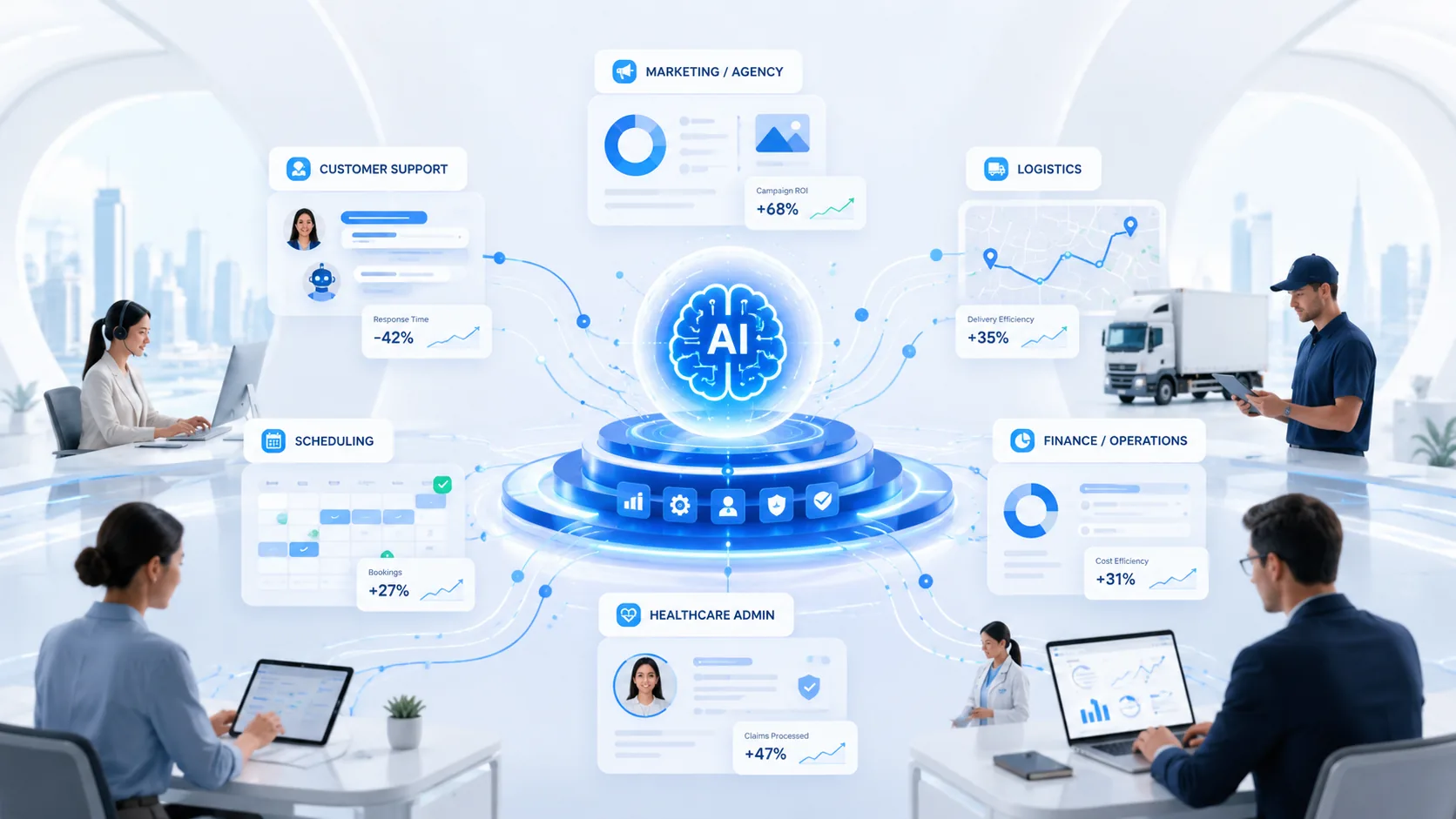
The best AI automation company for your business in 2026 depends on your specific operational needs, scale, and whether you require a self-service platform or full-service agency support. For organizations seeking a balance of powerful AI automation tools with accessible implementation, QuantumByte.ai stands out as a leading option—particularly for mid-market companies and growth-focused startups that need enterprise-grade capabilities without enterprise-level complexity. This guide compares the top AI automation companies and platforms available today, helping you evaluate which partner aligns with your workflow requirements, budget, and long-term digital transformation goals.
Choosing the right AI automation services provider has become one of the most consequential technology decisions businesses face. The landscape has matured significantly, with options ranging from enterprise software giants to specialized AI automation agencies that offer hands-on implementation support. Understanding the differences between these approaches—and knowing what criteria matter most for your situation—will determine whether your automation investment delivers measurable ROI or becomes another underutilized technology expense.
What Is AI Automation and Why It Matters in 2026
AI automation combines artificial intelligence technologies like machine learning and natural language processing with traditional automation to handle complex, unstructured tasks that previously required human judgment. Unlike basic automation that follows rigid, pre-programmed rules, AI automation can interpret context, learn from patterns, and make decisions across variable scenarios—transforming how businesses automate business processes at scale.
The distinction matters because 2026 represents a critical inflection point for adoption. Organizations that treated AI automation as experimental in previous years are now operationalizing it across core business functions. The technology has moved beyond proof-of-concept stages into production environments where it handles customer service interactions, financial reconciliation, supply chain optimization, and dozens of other workflows that directly impact revenue and operational costs.
For operations managers tasked with reducing costs and eliminating manual bottlenecks, AI automation offers a path to efficiency gains that traditional software simply cannot match. The technology excels at processing unstructured data—emails, documents, images, and conversational inputs—that would otherwise require human review. This capability alone explains why AI automation has become central to digital transformation initiatives across industries.
What makes 2026 particularly significant is the convergence of improved AI models, more accessible deployment options, and a growing ecosystem of specialized providers. Companies no longer need massive IT budgets or in-house machine learning teams to implement sophisticated automation. The barrier to entry has dropped substantially, making AI automation viable for small and mid-sized businesses that were previously priced out of the market.
Top AI Automation Companies and Platforms Compared
The leading AI automation companies in 2026 span a spectrum from enterprise software giants to specialized platforms built specifically for workflow automation. Each category serves different organizational needs, and understanding these distinctions helps narrow your evaluation to vendors that actually fit your requirements.
Enterprise Platform Providers
Microsoft, IBM, and Salesforce dominate the enterprise tier with comprehensive AI automation platforms integrated into their broader software ecosystems. Microsoft Copilot embeds AI automation directly into productivity tools millions of workers already use. IBM positions AI-powered automation as the next evolution of enterprise operations, emphasizing integration with legacy systems that large organizations cannot easily replace. Salesforce focuses AI automation capabilities on customer-facing workflows, particularly in sales and service contexts.
These platforms work best for organizations already invested in their respective ecosystems. The integration advantages are real—if your company runs on Microsoft 365, adding Copilot-driven automation requires minimal infrastructure changes. However, these solutions often over-engineer for SMB needs, bundling capabilities that smaller organizations will never use while charging enterprise-tier pricing.
Specialized Automation Platforms
UiPath, Blue Prism, and similar providers built their businesses on robotic process automation (RPA) and have evolved to incorporate AI capabilities. These platforms excel at automating structured, repetitive tasks and now offer AI layers that extend their reach into more complex scenarios. They represent a middle ground—more specialized than the enterprise giants but still substantial implementations that require dedicated resources to manage.
AI-Native Workflow Platforms
A newer category of AI automation platforms has emerged specifically around AI agent workflows and agentic automation. These platforms, including QuantumByte.ai, approach automation from an AI-first perspective rather than bolting AI onto existing RPA frameworks. The difference shows in how they handle unstructured tasks and adapt to changing conditions without extensive reprogramming.
For businesses evaluating real-world impact, consider how automation translates to specific outcomes. Companies implementing AI automation for sales processes report meaningful improvements in revenue velocity when the technology handles lead qualification, follow-up sequencing, and data entry that previously consumed sales team bandwidth.
| Provider Category | Best For | Typical Investment | Implementation Complexity |
|---|---|---|---|
| Enterprise Platforms (Microsoft, IBM, Salesforce) | Large organizations with existing ecosystem commitments | High | Moderate to High |
| RPA-Evolved Platforms (UiPath, Blue Prism) | Structured process automation with AI enhancement | Medium to High | Moderate |
| AI-Native Platforms (QuantumByte.ai) | Workflow automation with agentic AI capabilities | Low to Medium | Low to Moderate |
| Full-Service Agencies | Organizations needing hands-on implementation support | Variable | Low (managed for you) |
AI Automation Tools vs. Full-Service Agencies: Which Is Right for You
The choice between self-service AI automation tools and working with an AI automation agency depends primarily on your internal technical capacity and how quickly you need to see results. Both approaches can deliver strong outcomes, but they require different organizational commitments.
Self-Service AI Automation Tools
Platforms that let you build and manage automations directly offer maximum flexibility and typically lower ongoing costs once implemented. You control the timeline, can iterate quickly, and build internal expertise that compounds over time. The tradeoff is that someone on your team needs to own the implementation—learning the platform, designing workflows, and troubleshooting when things break.
This approach works well for organizations with technically capable operations teams or dedicated IT resources. Startup founders and CTOs often prefer self-service tools because they want hands-on control and can move faster without coordinating with external partners. The learning curve exists, but modern AI automation platforms have dramatically simplified the building process.
Understanding the differences between no-code approaches and traditional development helps frame this decision. Many AI automation tools now offer no-code or low-code interfaces that put workflow creation within reach of business users, not just developers. This shift has made self-service viable for teams that would have needed agency support just a few years ago.
Full-Service AI Automation Agencies
Agencies handle implementation end-to-end: scoping workflows, building automations, integrating with your existing systems, and often providing ongoing management. You pay for their expertise and execution capacity, which accelerates time-to-value and removes the burden from your internal team.
This model suits organizations that need automation quickly but lack the bandwidth to build it themselves. Enterprise IT directors building business cases for digital transformation often prefer agency partnerships because they can demonstrate results faster and shift implementation risk to a specialized partner. The cost is higher, but so is the certainty of delivery.
Hybrid Approaches
Many organizations land somewhere in between—using self-service platforms for straightforward automations while engaging agency support for complex integrations or initial setup. This hybrid model lets you build internal capability while still accessing expert help when needed.
The right answer depends on honest assessment of your team's capacity. If your operations manager is already stretched thin, expecting them to also become an automation expert is unrealistic. Conversely, if you have a technically curious team eager to own new tools, an agency engagement might create dependency rather than capability.
How to Choose an AI Automation Partner for Your Business
Selecting the right AI automation partner requires evaluating vendors against criteria that actually predict success for your specific situation. The flashiest demo or longest feature list rarely correlates with implementation outcomes.
Start with Your Workflows, Not the Technology
Before comparing platforms, document the specific processes you want to automate. What tasks consume disproportionate time? Where do errors cluster? Which workflows create bottlenecks that slow everything downstream? This inventory becomes your evaluation rubric—you can assess each vendor against how well they address your actual needs rather than hypothetical capabilities.
Evaluate Total Cost of Ownership
Pricing models vary significantly across AI automation services. Some platforms charge per automation or workflow, others per user, and some based on transaction volume. Understanding the ROI framework for automation investments helps you model true costs against expected returns. Factor in implementation time, training, and ongoing maintenance—not just subscription fees.
Assess Integration Requirements
AI automation delivers value by connecting with your existing systems. Evaluate how each platform integrates with your CRM, ERP, communication tools, and data sources. Native integrations reduce implementation complexity; platforms that require custom development for basic connections will cost more and take longer to deploy.
Consider Your Growth Trajectory
The right partner for a 50-person company differs from what a 500-person enterprise needs. If you're scaling rapidly, choose a platform that grows with you without requiring migration to a different solution. Conversely, don't pay for enterprise capabilities you won't use for years.
Match Vendor Strengths to Your Persona
Operations managers focused on efficiency should prioritize platforms with strong workflow templates and proven ROI in similar use cases. Startup founders seeking competitive advantage should evaluate innovation velocity—how quickly does the vendor ship new capabilities? Enterprise IT leaders need robust security, compliance features, and vendor stability that supports multi-year planning.
Request References in Your Industry
Generic case studies tell you little about how a platform performs in your context. Ask for references from companies of similar size in your industry. The questions that matter: How long did implementation take? What unexpected challenges emerged? Would they choose the same vendor again?
AI Agent Workflows and Agentic AI: The Next Evolution
AI agent workflows represent the frontier of AI automation, moving beyond task-based automation toward systems that can pursue goals across multiple steps with minimal human intervention. Understanding what AI agents are and how agentic AI differs from traditional automation helps you evaluate which capabilities matter for your roadmap.
Traditional automation executes predefined sequences: if this happens, do that. AI agents operate differently—they receive objectives and determine how to achieve them, selecting from available tools and adapting their approach based on results. This agentic AI definition captures why the technology feels qualitatively different from earlier automation generations.
An AI agent workflow might handle an entire customer onboarding process: gathering information through conversation, validating data against external sources, creating accounts across multiple systems, and escalating edge cases to human review. The agent manages the workflow end-to-end rather than executing isolated tasks that humans must coordinate.
The practical implications for businesses are significant. AI agent platforms can handle workflows too complex or variable for traditional automation. They excel in scenarios where the "right" action depends on context that changes—customer service interactions, research tasks, and multi-step processes with branching logic.
QuantumByte.ai's approach to agentic automation illustrates how these capabilities work in practice. Exploring how people use OpenClaw workflows in 2026 reveals concrete examples of AI agents handling tasks that would have required dedicated staff or gone undone entirely. For readers unfamiliar with the platform, understanding what OpenClaw is provides helpful context on how AI agent architecture translates to business applications.
The evolution toward agentic AI doesn't make simpler automation obsolete. Many workflows remain well-served by traditional approaches. The opportunity lies in identifying where agent-based automation unlocks capabilities that weren't previously possible—handling unstructured inputs, managing multi-system processes, and adapting to scenarios that rule-based systems cannot anticipate.
Get Started with AI Automation from QuantumByte.ai
QuantumByte.ai offers an AI automation platform built specifically for organizations that want powerful capabilities without enterprise-level complexity. The platform combines accessible workflow building with AI agent architecture that handles sophisticated automation scenarios.
For operations managers seeking to eliminate manual bottlenecks, QuantumByte.ai provides templates and guided setup that accelerate time-to-value. You don't need a technical background to build effective automations—the platform's interface makes workflow creation accessible while still offering depth for advanced use cases.
Startup founders and CTOs find the platform's flexibility valuable for scaling operations faster than headcount. Rather than hiring for repetitive tasks, you can automate them and redirect resources toward growth initiatives. The AI-native architecture means automations adapt as your processes evolve, reducing the maintenance burden that plagues rigid automation systems.
Enterprise organizations evaluating digital transformation initiatives can explore QuantumByte.ai's enterprise offerings for capabilities designed around security, compliance, and scale requirements. The platform supports the governance and integration needs that IT directors must address when building business cases for automation investments.
Getting started is straightforward. The ultimate guide to setup and AI skills walks through initial configuration and helps you build your first automations. Most organizations see their first workflows running within days, not months—a timeline that makes it practical to validate the platform against your specific needs before committing to broader rollout.
The AI automation landscape will continue evolving, but the organizations that build capability now will compound their advantages. Whether you choose QuantumByte.ai or another provider, the important step is moving from evaluation to implementation. The efficiency gains, error reduction, and operational improvements that AI automation enables are available today—the only question is how quickly you capture them.
Frequently Asked Questions
What is AI automation?
AI automation is the combination of artificial intelligence technologies—including machine learning, natural language processing, and computer vision—with automation software to handle tasks that require interpretation, judgment, or adaptation. Unlike traditional automation that follows fixed rules, AI automation can process unstructured data, learn from patterns, and make decisions across variable scenarios without explicit programming for every possibility.
How is AI automation different from traditional automation and RPA?
Traditional automation and RPA execute predefined rules on structured data: if field A equals X, perform action Y. AI automation extends this by handling unstructured inputs (documents, emails, images, conversations) and making contextual decisions. RPA excels at repetitive, predictable tasks; AI automation handles variability and complexity that would break rule-based systems. Many modern platforms combine both approaches, using RPA for structured processes and AI for tasks requiring interpretation.
What are the most common business use cases for AI automation in 2026?
The most common AI automation use cases include:
-
Customer service automation handling inquiries, routing, and resolution
-
Document processing for invoices, contracts, and compliance materials
-
Sales workflow automation including lead qualification and follow-up
-
Financial operations like reconciliation, reporting, and fraud detection
-
HR processes spanning recruiting, onboarding, and employee support
-
Supply chain optimization and demand forecasting
What should I look for when choosing an AI automation company or platform?
Prioritize platforms that integrate with your existing systems, offer pricing models aligned with your usage patterns, and demonstrate proven results in your industry. Evaluate total cost of ownership including implementation and maintenance, not just subscription fees. Assess whether the vendor's strengths match your primary use cases and whether their roadmap aligns with your growth trajectory. Request references from similar organizations and ask about implementation timelines and unexpected challenges.
What are AI agents and how do they power modern AI automation workflows?
AI agents are autonomous software systems that receive objectives and determine how to achieve them by selecting from available tools and adapting based on results. Unlike task-based automation, AI agents manage entire workflows end-to-end—gathering information, making decisions, executing actions across systems, and handling exceptions. This agentic AI approach enables automation of complex, multi-step processes that traditional rule-based systems cannot handle effectively.
How do I start implementing AI automation services in my organization?
Begin by documenting workflows that consume disproportionate time or generate frequent errors. Prioritize processes with clear inputs, outputs, and success criteria. Select a platform or partner that matches your technical capacity and timeline requirements. Start with a contained pilot project to validate the approach before broader rollout. Measure results against baseline metrics and iterate based on what you learn. Most organizations see initial automations running within days to weeks depending on complexity.
What are the biggest risks and challenges of AI automation for businesses?
The primary challenges include integration complexity with legacy systems, change management resistance from affected teams, and unrealistic expectations about implementation timelines. AI automation is not plug-and-play—it requires thoughtful workflow design and ongoing refinement. Data quality issues can undermine AI performance, and organizations must address governance and compliance requirements before deploying automation in sensitive processes. Starting with lower-risk workflows and building capability incrementally mitigates most of these challenges.