Logistics management has become a survival requirement. Carrier rates swing. Capacity tightens with little warning. Customer expectations keep rising. Implementing a transportation management system (TMS) can cut freight spend by a meaningful margin, yet many companies still hesitate because TMS pricing is rarely transparent.
Transportation management system pricing has also changed fast. What used to be enterprise-only licensing has expanded into flexible SaaS subscriptions, usage-based models, and custom AI-driven tools.
This guide breaks down typical market rates, the hidden fees that show up after you sign, and a practical way to estimate ROI before you commit.
How Much Does a Transportation Management System Cost?
Transportation management system pricing varies widely because operations vary widely. A 10-person distributor running LTL shipments in one region does not need the same system as a global shipper moving ocean, air, parcel, and dedicated fleets.
As a working range:
-
Small to mid-sized businesses: Cloud/SaaS TMS costs often land between $50 and $500 per user per month, depending on features, carrier connectivity, and support.
-
Enterprise programs: Deep integrations, global visibility, and complex rules commonly include implementation work in the $100,000 to $500,000 range, plus ongoing support and platform fees.
-
Modern custom automation approaches: Costs can be far lower when you only build what you will actually use. For example, a focused custom toolset can start at $39/month and expand as your workflow matures, especially when paired with automation projects like supply chain automation.
A helpful mental model: treat this as an investment in fewer manual touches, fewer avoidable exceptions, and cleaner billing.
Common Transportation Management System Pricing Models
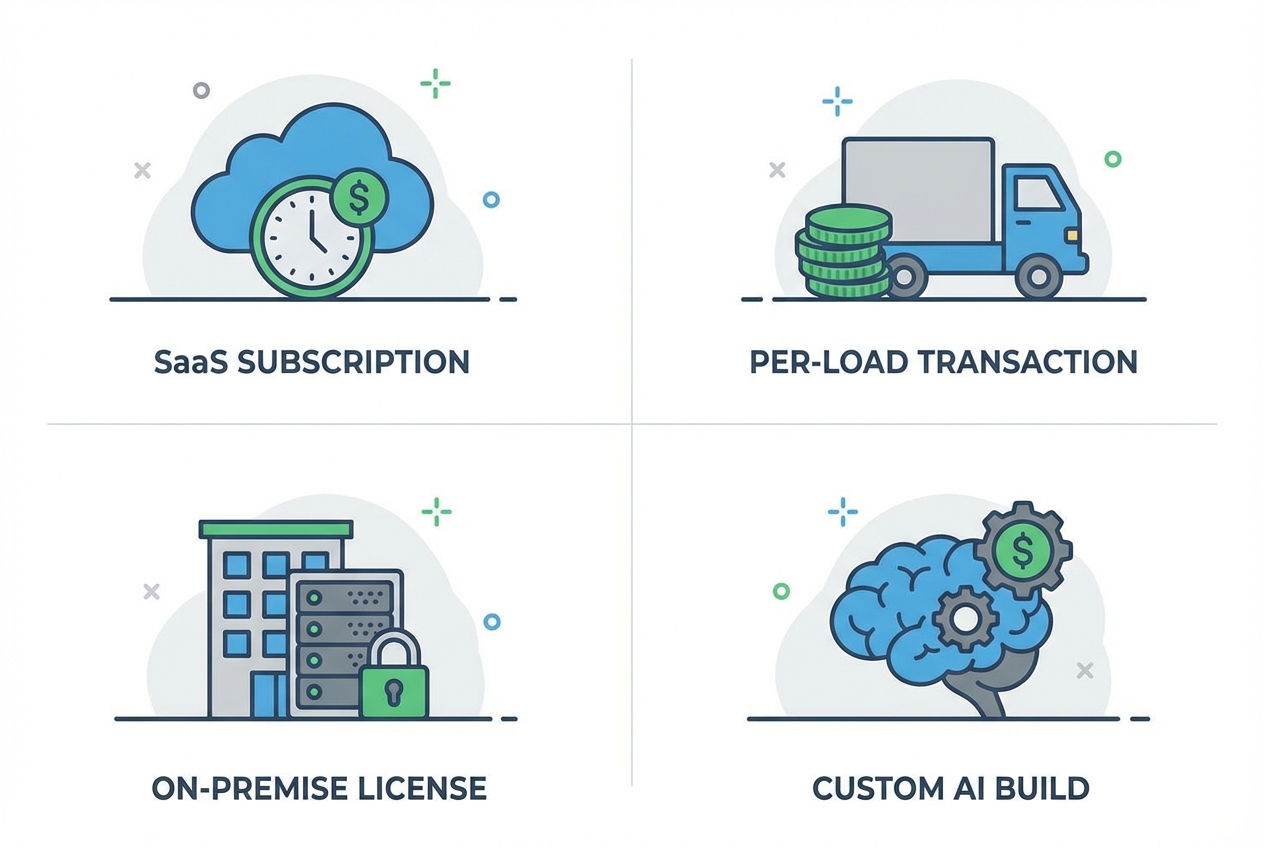 Most pricing debates are really about risk: fixed subscription vs variable usage vs fixed license vs custom scope.
Understanding how vendors bill is the first step to getting control over your budget. Most providers use one of these four models.
1. Subscription-Based (SaaS)
This is the most common model. You pay monthly or annually, usually based on seats (users), shipment volume bands, and feature tiers.
-
Small business tiers: Often $300 to $1,000 per month for a small team, depending on carrier connectivity and tracking.
-
Mid-market pricing: Commonly scales by seat, often in the $150 to $300 per user per month range.
This model is predictable. The tradeoff is that you may pay for features you never roll out.
2. Per-Transaction or Per-Load Pricing
This model is popular with brokers, 3PLs, and seasonal shippers. Pricing is tied to usage, usually per load, per shipment, or per transaction.
Typical ranges run roughly $0.40 to $5.00 per load, depending on what counts as a transaction and whether the vendor charges extra for visibility, EDI/API messages, or tendering.
This can be a strong fit if your volume fluctuates. It can also become expensive at scale if the unit price is not negotiated down as you grow.
3. Licensed or On-Premise Software
Less common today, but still used by very large organizations that require strict control over infrastructure, security, or long-term customization.
Expect:
-
Upfront license cost: A large one-time fee, often in the six-figure range.
-
Annual maintenance and support: Commonly 15% to 20% of the initial license cost per year.
-
Internal IT ownership: Additional costs for hosting, upgrades, patching, and day-to-day administration.
On-prem can work, but it is rarely the fastest path to value.
4. Custom-Built AI Solutions
This is the build-what-you-need approach. Instead of buying a full suite, you create targeted tools around your highest-friction workflows: quoting, carrier selection, tendering, exception handling, freight audit, or customer-facing tracking.
Companies like QuantumByte take this route when feature bloat becomes a tax. If you can describe the workflow in plain English, you can often prototype an internal app in days, then extend it with a development team when you hit edge cases.
This approach pairs well with logistics teams that are already investing in automation, such as order fulfillment automation.
Quick comparison: what you usually pay for
| Pricing model | Best for | Typical pricing signals | Primary risk |
|---|---|---|---|
| SaaS subscription | Teams that want predictable spend | Per user, per tier, sometimes volume bands | Paying for features you do not adopt |
| Per-load / usage-based | Seasonal volume, brokers, fast growth | Per shipment/load plus add-ons | Unit fees can balloon at high volume |
| On-prem license | Large enterprises with strict controls | Upfront license + annual maintenance | Slow upgrades, heavy IT ownership |
| Custom AI build | Teams with clear bottlenecks | Scoped build + modest platform costs | Scope creep if requirements are unclear |
Key Factors Influencing Transportation Management System Pricing
Even within the same pricing model, costs can swing by thousands (or hundreds of thousands) based on a few variables. These are the levers that matter most when you get a quote.
-
Integration complexity: Connecting your TMS to a Warehouse Management System (WMS) or ERP (like SAP or Oracle) often requires custom API work, mapping, and testing. That can add $5,000 to $25,000 (or more) in professional services.
-
Number of assets: Some carriers are priced by fleet size (trucks, trailers, drivers, devices) instead of office users. Make sure you know which meter is running.
-
Feature set: AI routing, real-time visibility, appointment scheduling, temperature monitoring, and freight audit often sit behind add-ons. The base subscription can look reasonable while the real configuration ends up far higher.
-
Data migration and cleanup: Moving from spreadsheets or a legacy system is not a copy-and-paste job. Carrier lists, lanes, accessorial codes, customer rules, and historical rates often need cleanup before the system works well.
-
Support and SLA level: Some vendors price support as an upgrade. If shipping is mission-critical, you will want response time commitments, not best-effort responses.
-
Carrier network connectivity: EDI and API connections can be included, limited, or priced per connection. Connectivity costs are a common surprise line item.
The Hidden Costs of TMS Implementation
When evaluating transportation management system pricing, do not stop at the software fee. Implementation is where budgets quietly break.
- Implementation fees: A simple cloud setup might be around 2,000. Complex deployments that include multi-site rules, custom workflows, and deep integrations can exceed 50,000.
- Staff training and adoption time: Budget for a productivity dip in the first 30 days. People need time to trust automation, especially on carrier selection, exception handling, and billing.
- Process redesign: A TMS exposes messy processes. That is good, but it means you will spend time standardizing how loads are created, how exceptions are handled, and who approves what.
- Hardware and mobile readiness: If you are a carrier, drivers may need updated mobile devices. If you are tying shipping to physical scanning, you may also upgrade devices connected to inventory management hardware.
- Reporting and data ownership: Teams often expect out-of-the-box dashboards that match how leadership asks questions. In reality, you may need custom reports, data models, or a BI layer.
If you want to reduce implementation risk, start with one narrow workflow that creates immediate value (for example, freight audit or exception management), then expand.
Calculating ROI: Is a TMS Worth the Investment?
The ROI case for a TMS is usually strong because transportation is a high-spend category with many manual steps. Nucleus Research regularly publishes ROI case studies in transportation and supply chain tech, including examples that show payback timelines around the 14-month range in published work.
To keep your ROI math honest, focus on measurable levers:
-
Freight spend reduction: Better carrier selection, mode optimization, consolidation, and fewer expedites can reduce total freight costs by 5% to 15% in many environments.
-
Labor efficiency: Automating load building, tendering, scheduling, and billing can reduce admin effort by 20% to 40%, especially if your current process lives in email and spreadsheets.
-
Audit and recovery: Freight auditing can catch common issues like duplicate charges and mismatched accessorials. Even a low error rate becomes meaningful at scale.
-
Customer experience: Proactive tracking and exception alerts reduce "where is my order" calls. That saves labor and protects revenue.
Also keep the macro picture in mind. Logistics costs stay material even in "normal" years. The 2025 State of Logistics report puts U.S. business logistics costs at $2.58 trillion in 2024, 8.8% of GDP, which underscores why operational efficiency compounds over time.
A simple ROI snapshot you can run in an hour:
- Historical spend: Add up last quarter’s freight spend.
- Conservative savings rate: Estimate a conservative savings rate (start with 3% if you want to be cautious).
- Time saved: Add time saved per week across the team (be realistic).
- Payback comparison: Compare annualized savings to total annual TMS cost (software + implementation amortized).
If the payback is not clear, the issue is often scope. The solution is to narrow the initial rollout to your highest-cost friction points.
Choosing the Right TMS pricing plan for Your Business
The best pricing plan matches your current complexity without boxing you in next year.
-
Startups and small carriers: Focus on low-cost SaaS that covers dispatch basics and invoicing. Options in this category are often priced in the tens of dollars per month per company, but expect limits on automation, integrations, and customization.
-
Mid-sized freight brokers and 3PLs: Look closely at per-load pricing versus seat pricing. If your volume is rising fast, negotiate volume tiers early. You will also want strong CRM, load board, and accounting integrations.
-
Enterprise shippers: You need governance, integrations, and strong exception handling. At this level, the implementation partner matters as much as the software.
If you are in the middle, with real operational pain but no appetite for a six-figure rollout, consider a hybrid approach: keep your core TMS simple, then build targeted tools around your bottlenecks. For example, you might build an internal rate approval and exception hub that sits on top of your current tools.
That is a natural fit for QuantumByte’s model: prototype the workflow in the AI app builder, then have the in-house team harden integrations and edge cases once the business value is proven.
Summary of TMS Costs
Transportation management system pricing is no longer one-size-fits-all.
-
SaaS subscriptions: Deliver speed and predictable spend, but can hide add-on fees for connectivity, modules, and support.
-
Per-load pricing: Matches cost to volume, but needs careful tier negotiation as you scale to avoid unit fees becoming a profit leak.
-
On-prem licenses: Can make sense for strict enterprise environments, but they bring long-term IT ownership and slower upgrade cycles.
-
Custom AI builds: Can be the fastest path to value when you have clear bottlenecks and want to avoid feature bloat.
The outcome you want is a system that turns shipping into a repeatable operating rhythm. Fewer surprises. Fewer manual touches. Better decisions under pressure. With logistics costs staying elevated and transportation price dynamics shifting across modes (see U.S. Bureau of Transportation Statistics transportation cost trends), teams that instrument their shipping workflows tend to outperform teams that run on gut feel.
Frequently Asked Questions
How much does a TMS system cost?
Cloud-based TMS software commonly runs from about $50 to $500 per user per month, depending on tier and connectivity. Enterprise implementations often include setup and integration work in the $100,000 to $500,000 range. A focused custom approach can start much lower, for example at 39/month, then expand as needs become clear.
Is there a free TMS?
Some tools offer free plans or free trials. They can work for basic recordkeeping, but they typically lack features that matter for scaling, like automated tendering, freight audit, real-time tracking, and integrations with accounting or ERP systems.
What are the pricing models for TMS?
The most common models are subscription-based (SaaS), per-transaction (per load/shipment), and one-time licensing (on-premise). A fourth path is a custom-built system where you pay for scoped development and only the automation you need.
Is a TMS worth the investment?
For many teams, yes. The strongest returns usually come from freight optimization, fewer expedites, labor savings, and cleaner billing. Research firms like Nucleus Research often report fast payback periods for transportation and supply chain technology investments.
How to choose a TMS based on price?
Start with shipment volume and complexity. If volume is low or seasonal, per-load pricing can reduce risk. If volume is stable and high, a flat subscription or negotiated tiers can be more predictable. If your biggest problem is a specific workflow bottleneck, a custom build can be a clean way to control costs while still getting enterprise-grade automation where it counts.