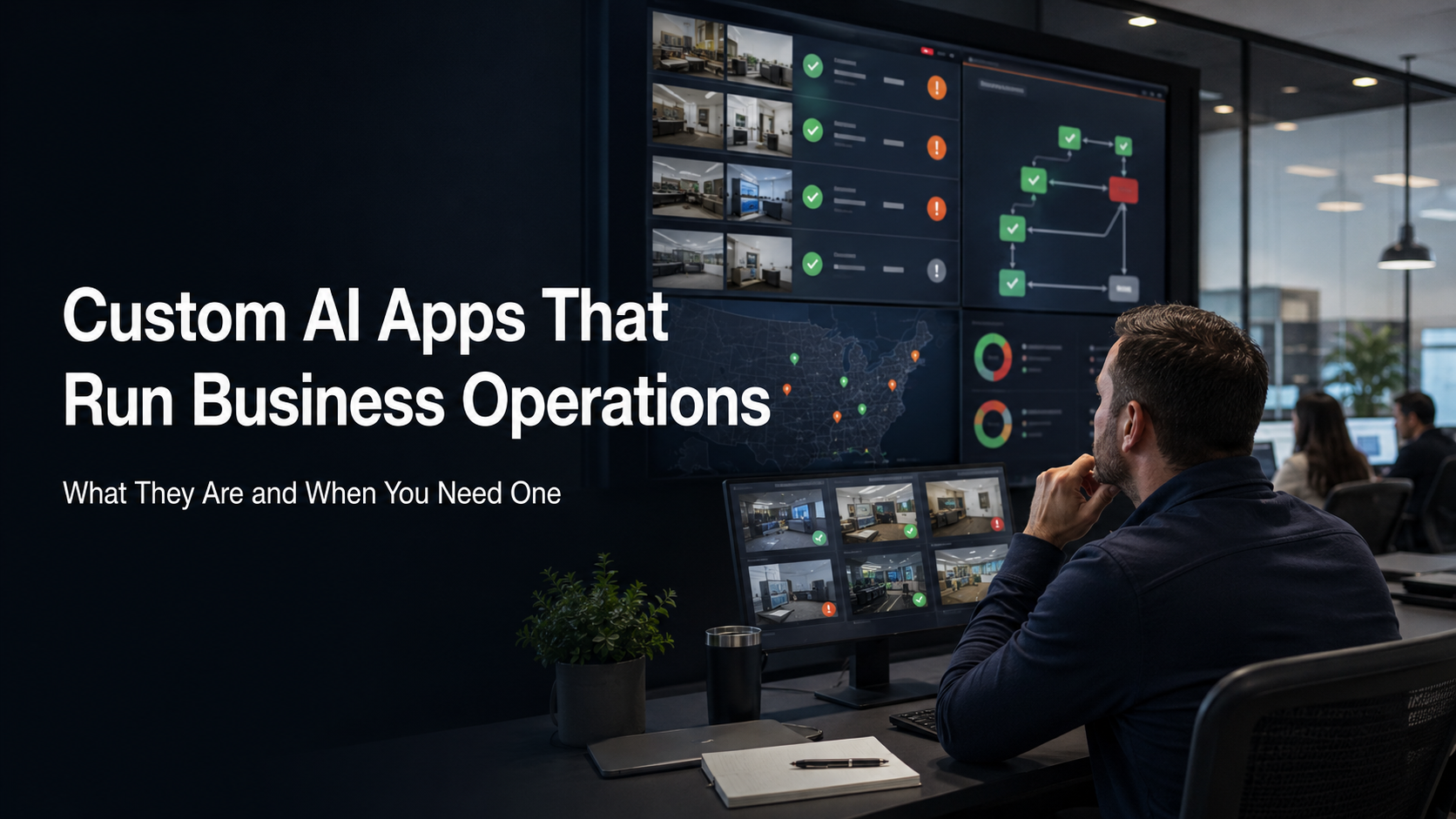
Custom AI apps for business operations are purpose-built applications designed around your exact workflows where AI executes the work—scoring evidence, verifying compliance, routing exceptions—rather than simply assisting a human who still does the heavy lifting. Unlike generic AI tools or DIY app builders, these apps are configured for one operation's specific requirements and run core tasks end-to-end without manual intervention. If your multi-location service business still relies on staff to review, verify, and route work that software should handle automatically, you're operating with a verification gap that custom AI ops apps are built to close.
The distinction matters because most AI tools on the market today fall into two categories: off-the-shelf platforms designed for mass adoption, or no-code builders that let you assemble generic components yourself. Neither category addresses the operational reality facing service businesses with 5 to 100 locations—where field teams submit reports, but someone at headquarters still has to manually confirm whether the work actually happened the way it was documented.
According to McKinsey's 2025 State of AI report, 88% of organizations now use AI in at least one business function, yet only about 6% qualify as "AI high performers" achieving meaningful bottom-line impact. The gap isn't adoption—it's execution. Custom AI apps for business operations exist to close that gap for service operations specifically.
What Are Custom AI Apps for Business Operations?
Custom AI apps for business operations are applications built around a single operation's exact workflow, where AI performs the actual work rather than suggesting actions for humans to complete. These apps score photographic evidence against defined standards, verify compliance documentation automatically, flag exceptions based on your specific rules, and route issues to the right person without manual triage.
The key distinction is execution versus assistance. A generic AI assistant might summarize an inspection report or suggest next steps. A custom AI ops app reviews the submitted photos, compares them against your quality standards, determines whether the work passes or fails, and routes failures to the appropriate supervisor—all without a human touching the process unless an exception requires judgment.
This matters for operations leaders because the work that consumes your time isn't the obvious stuff. It's the verification layer: confirming that what field teams report actually matches reality. When you automate business processes to increase revenue, the gains come from eliminating that verification burden, not from making it slightly faster.
Custom AI ops apps differ from generic AI tools in three fundamental ways:
- Workflow specificity: Built for your exact process, not a template you adapt
- Execution authority: AI performs the task, not just recommends it
- Exception intelligence: Handles your edge cases because it was designed around them
Gartner predicts that 40% of enterprise applications will integrate task-specific AI agents by the end of 2026, up from less than 5% in 2025. The shift isn't toward more AI assistants—it's toward AI that actually does the work.
The Verification Gap: Why Generic Tools Leave Work Unfinished
The verification gap is the operational burden that remains after your software captures data but before you can trust that data enough to act on it. Generic inspection tools and workflow platforms create this gap because they're designed to collect and organize information, not to verify whether that information reflects reality.
Here's what the verification gap looks like in practice: A field technician submits an inspection report with photos. Your software logs the submission. But someone at headquarters still has to open each report, review the photos, confirm the work meets standards, check for missing documentation, and decide whether to approve, reject, or escalate. That manual review layer is the verification gap.
For multi-location service businesses, this gap compounds quickly. Twenty-five locations submitting daily reports means hundreds of verification decisions per week. Even if each review takes only three minutes, you're looking at 10+ hours of skilled labor spent confirming what software should handle automatically.
According to the U.S. Census Bureau's Business Trends and Outlook Survey, overall AI usage among U.S. businesses hovers between 17% and 20%, with larger firms adopting faster than smaller ones. But adoption doesn't equal impact. The U.S. Census Bureau's working paper on AI diffusion found that 57% of AI-adopting firms deploy AI in three or fewer business functions—meaning most companies use AI in isolated pockets rather than across core operations.
The verification gap persists because generic tools weren't built to close it. They were built to:
- Capture data (forms, photos, timestamps)
- Organize information (dashboards, reports, alerts)
- Notify humans (emails, push notifications, task assignments)
What they don't do is evaluate whether the captured data meets your specific standards and take action based on that evaluation. That's the work custom AI ops apps perform.
Custom AI Ops Apps vs. Off-the-Shelf Inspection Tools vs. DIY App Builders
Custom AI ops apps, off-the-shelf inspection tools, and DIY app builders serve different purposes and fit different operational stages. Understanding the tradeoffs helps you choose the right path for where your business is today—and where it's headed.
Off-the-shelf inspection tools are SaaS platforms designed for broad adoption. They offer templates, standard workflows, and quick deployment. According to RTS Labs, off-the-shelf AI can go live in weeks and follows a subscription-driven model designed for mass adoption.
DIY app builders—sometimes called no-code or flow AI platforms—let you assemble applications from pre-built components. They offer flexibility without requiring a development team, but the AI capabilities are typically limited to what the platform provides. If you're exploring this path, understanding no-code vs. traditional development tradeoffs is essential. You can also review AI app builder prompts to see what prompt-driven building actually looks like.
Custom AI ops apps are built around your specific data, workflows, and infrastructure. According to ELEKS, custom AI development typically takes 6–18 months depending on complexity, but eliminates ongoing subscription fees and vendor dependencies over time.
| Factor | Off-the-Shelf Tools | DIY App Builders | Custom AI Ops Apps |
|---|---|---|---|
| Deployment time | Weeks | Weeks to months | Months (varies by complexity) |
| Workflow fit | Generic templates | Configurable within platform limits | Built for your exact process |
| AI execution | Assists humans | Assists humans | Executes work autonomously |
| Exception handling | Manual review required | Limited rule-based logic | Designed around your edge cases |
| Cost model | Ongoing subscription | Platform subscription + build time | Higher initial investment, lower long-term TCO |
| Vendor dependency | High | Medium | Low to none |
For operations leaders evaluating options, the best AI platforms for non-technical users can help you benchmark generic tools before deciding whether custom is necessary. The best AI automation vendors overview provides additional landscape context.
The right choice depends on your operational complexity. If your workflows match industry templates and your exception rate is low, off-the-shelf tools may suffice. If you need flexibility but can work within platform constraints, DIY builders offer a middle path. If your operation has unique verification requirements, high exception volumes, or multi-location consistency challenges, custom AI ops apps are likely the only path that actually closes the gap.
Signs Your Multi-Location Operation Has Outgrown Generic Software
Your operation has outgrown generic software when you're spending more time working around the tool than working with it. The clearest signal is a persistent manual review layer that the software was supposed to eliminate but didn't.
Here are the specific indicators that generic tools are no longer enough:
You manually review a significant percentage of submissions. If your team still opens 30%, 40%, or more of field reports to verify accuracy, your software is capturing data but not validating it. The verification gap is consuming skilled labor that should be focused elsewhere.
Exception handling is inconsistent across locations. Different supervisors apply different standards. What passes at one location fails at another. Generic tools don't encode your specific rules, so enforcement varies based on who's reviewing.
You've customized the tool beyond recognition. Workarounds, custom fields, manual exports to spreadsheets, supplementary checklists—if your actual process looks nothing like the tool's intended workflow, you've outgrown it.
Compliance documentation requires manual assembly. Pulling together audit-ready documentation means exporting from multiple systems, cross-referencing records, and manually verifying completeness. The tool stores data but doesn't prepare it for compliance review.
Your team has "the person who knows how to make it work." When institutional knowledge lives in one person's head rather than in the system, you have a fragility problem that generic tools can't solve.
McKinsey's 2025 State of AI data shows that AI high performers are at least three times more likely than peers to have fundamentally redesigned workflows as part of their AI efforts. The insight isn't that high performers use more AI—it's that they rebuild processes around what AI can execute, rather than bolting AI onto existing manual workflows.
BCG's 2025 global study found that AI-leading companies achieve 1.7x revenue growth and 1.6x EBIT margin compared to laggards. But only 5% of companies globally qualify as these "future-built" organizations. The difference isn't budget or ambition—it's whether AI executes core work or merely assists with peripheral tasks.
When to Choose a Custom AI App for Your Service Operations
Choose a custom AI app when your operation requires AI to execute work—not just assist with it—and when that work follows patterns specific to your business that generic tools can't replicate.
The decision framework comes down to three questions:
Does AI need to make decisions, or just surface information? If you need AI to score evidence against your standards, determine pass/fail status, and route exceptions based on your rules, you need execution capability. Generic AI tools surface information for humans to evaluate. Custom AI ops apps evaluate and act.
Are your workflows unique enough that templates don't fit? Multi-location service businesses often have inspection criteria, compliance requirements, and exception-handling rules that don't match any industry template. If you've spent months trying to configure a generic tool to match your process, the tool isn't the right fit.
Is the verification gap costing you more than a custom solution would? Calculate the labor hours spent on manual review, the cost of inconsistent enforcement, and the risk exposure from compliance gaps. According to ELEKS, organizations should evaluate total cost of ownership over 3–5 years when comparing custom versus off-the-shelf solutions.
Custom AI ops apps make sense when:
- Your operation spans 5+ locations with location-specific variations
- Field teams submit evidence (photos, documentation) that requires verification
- Compliance requirements demand consistent, auditable enforcement
- Exception rates are high enough that manual review is a full-time job
- You've already tried generic tools and hit their limits
To see how operational workflows translate into practice, review how people use OpenClaw workflows in 2026 for real-world reference points.
BCG's 2025 AI report found that agentic AI—AI that takes action rather than just providing information—already accounts for 17% of total AI value in 2025, with that share expected to reach 29% by 2028. The trajectory is clear: AI that executes work delivers more value than AI that assists with it.
Start Building the AI App Your Operations Actually Need
The path from generic tools to custom AI ops apps starts with clarity about what your operation actually requires. Not what a vendor's demo shows, not what a template assumes—what your specific workflows, verification requirements, and exception patterns demand.
QuantumByte builds custom AI apps that run service operations. These aren't templates you configure or chatbots you prompt. They're applications designed around your exact workflow, where AI scores evidence, verifies compliance, routes exceptions, and executes the work your team currently does manually.
For operations leaders ready to explore what a custom solution looks like, the next step is straightforward:
- Evaluate your current verification burden. How many hours per week does your team spend reviewing submissions that software should handle?
- Map your exception patterns. What edge cases does your current tool miss? What rules exist only in your supervisors' heads?
- Calculate the cost of the gap. Labor, inconsistency, compliance risk—what's the verification gap actually costing you?
QuantumByte offers pricing tiers designed for different stages: Free to start, Prototype at $6, Pro at $29/mo, and Enterprise (contact for details). Review the full breakdown at quantumbyte.ai/pricing.
For multi-location operations ready to discuss enterprise-scale deployment, quantumbyte.ai/enterprise is the starting point.
The verification gap doesn't close itself. Generic tools won't close it for you. Custom AI apps that run your service operations—apps built for your exact workflow, where AI executes the work—are how operations leaders at multi-location service businesses finally eliminate the manual review layer that's been consuming their teams.
Frequently Asked Questions
What exactly is a custom AI app for business operations — and how is it different from a generic AI tool?
A custom AI app for business operations is an application built around your specific workflow where AI executes tasks—scoring evidence, verifying compliance, routing exceptions—rather than assisting a human who still performs the work. Generic AI tools provide suggestions or summaries; custom AI ops apps make decisions and take action based on your exact rules and standards.
When does off-the-shelf inspection or operations software stop being enough?
Off-the-shelf software stops being enough when you're manually reviewing a significant percentage of submissions, when exception handling varies across locations, or when you've customized the tool so heavily that your actual process no longer resembles its intended workflow. The clearest signal is a persistent verification layer the software was supposed to eliminate.
How is a custom AI ops app different from a no-code AI app builder or workflow automation tool?
No-code builders and flow AI platforms let you assemble applications from pre-built components, but AI capabilities are limited to what the platform provides. Custom AI ops apps are built around your specific data and workflows, with AI trained to execute your exact verification and exception-handling rules—not generic logic you configure yourself.
What kinds of service operations tasks can a custom AI app actually execute — not just assist with?
Custom AI ops apps can score photographic evidence against your quality standards, verify compliance documentation automatically, determine pass/fail status without human review, flag exceptions based on your specific rules, and route issues to the appropriate supervisor. The AI performs these tasks end-to-end rather than surfacing information for humans to evaluate.
Do I need a technical team or IT department to deploy a custom AI ops app?
No. Custom AI ops apps are built for non-technical operations leaders. The development process captures your workflow requirements, verification standards, and exception rules—then delivers an application your team uses without coding or technical configuration. Ongoing operation doesn't require IT involvement for day-to-day use.
How do custom AI ops apps handle exceptions and edge cases that generic tools always miss?
Custom AI ops apps are designed around your specific edge cases from the start. During development, your exception patterns, escalation rules, and judgment criteria are encoded into the application. The AI learns what constitutes an exception in your operation and routes accordingly—rather than applying generic rules that miss your unique situations.
What should a multi-location service business look for when evaluating a custom AI ops app?
Look for workflow specificity (built for your exact process, not a template), execution authority (AI performs tasks rather than suggesting them), exception intelligence (handles your edge cases), and transparent pricing. Evaluate total cost of ownership over 3–5 years, including the labor savings from eliminating manual verification.