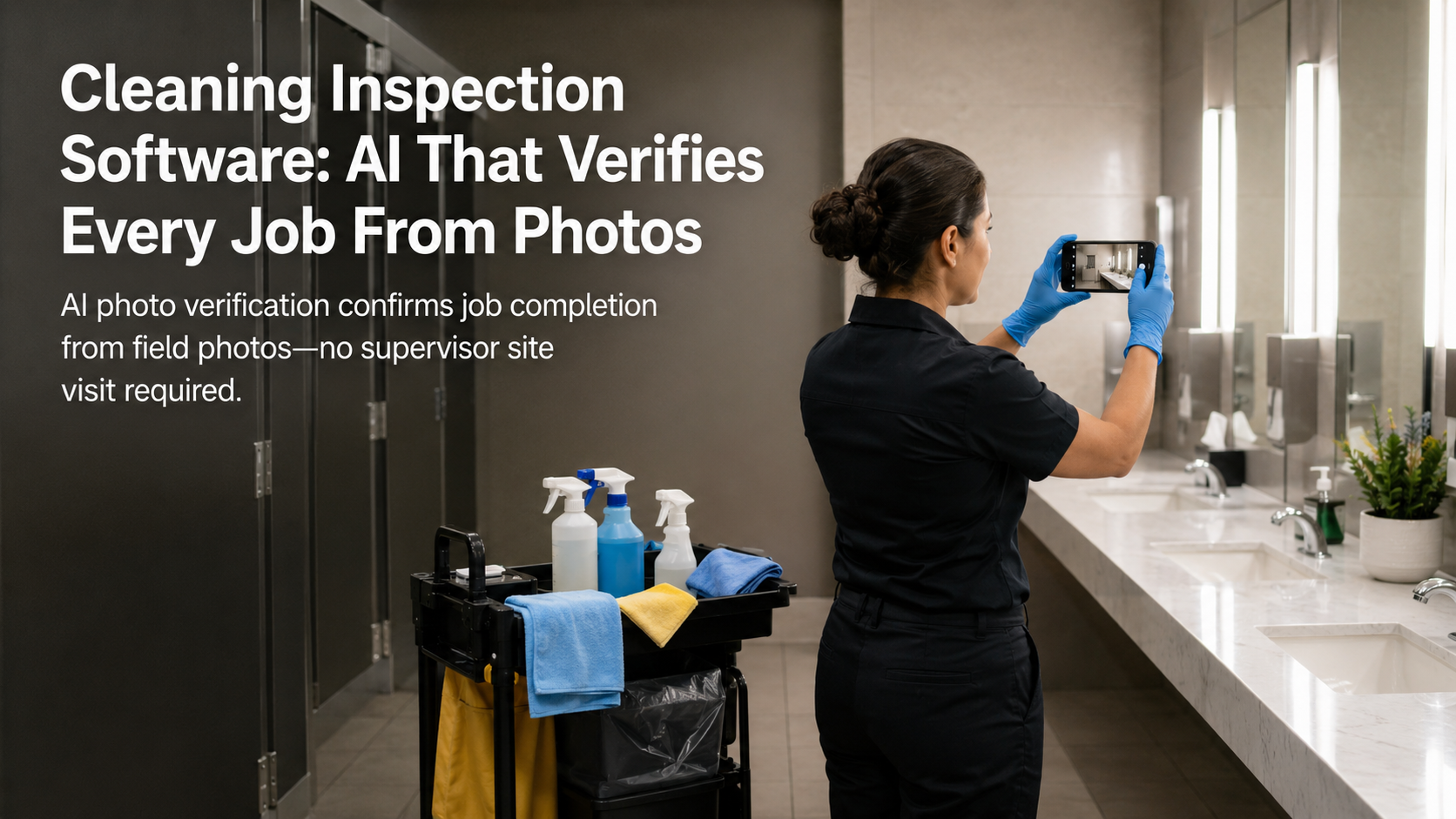
Cleaning inspection software with AI photo verification automatically confirms job completion by analyzing images your field teams submit—no supervisor site visit required. Instead of relying on checklists that prove someone tapped a screen, AI-powered inspection software evaluates visual evidence against your standards and flags issues before clients notice. This shifts quality control from reactive (waiting for complaints) to proactive (catching problems in real time).
The cleaning industry is scaling fast. According to Jobber, the global cleaning services market is predicted to grow to roughly $482 billion in 2026 and $859 billion by 2030, with over 1.4 million cleaners currently employed in the U.S. alone. As operations expand across more locations, the old model of supervisors physically verifying every job simply breaks down.
This guide explains why traditional inspection methods fail at scale, how AI photo verification actually works, what to look for when evaluating quality inspection software, and how to build a system that fits your specific operation.
Why Traditional Cleaning Inspections Fail at Scale
Traditional cleaning inspections fail at scale because they depend on a human being physically present to verify work—and that model doesn't multiply.
When you manage 5 locations, you can drive between sites. When you manage 25 or 50, you're choosing which locations to ignore. The math simply doesn't work: one operations director cannot physically inspect 80 cleaners across a metro area in a single shift.
The checklist illusion. Most cleaning companies start with digital checklists. A cleaner taps "bathroom cleaned" and moves on. But a checked box only proves someone touched a screen—it doesn't prove the toilet was scrubbed or the mirror was streak-free. According to Lumiform, clients increasingly require documented proof of completed cleaning work—specifically photos, timestamps, and completion reports—because verbal assurance that the job was done no longer satisfies facility managers.
The paper problem. Some operations still run on paper forms. According to Field Eagle, manually filling out inspection forms takes twice as long as digital reporting, and administrative staff spend hours compiling and reviewing reports for accuracy under paper-based systems. That's time your team could spend on actual quality improvement.
The complaint-driven loop. Without real verification, most cleaning companies operate in a reactive cycle: a client complains, you apologize, you send someone back. By then, the damage is done—to your reputation, your client relationship, and your profit margin on that job.
The core issue isn't laziness or bad intentions. It's a structural gap: the people doing the work are in the field, the people responsible for quality are at HQ, and there's no reliable bridge between them. Photo verification closes that gap.
How AI Photo Verification Works for Cleaning Jobs
AI photo verification works by analyzing images submitted from the field and scoring them against predefined standards—automatically, without human review.
Here's the typical workflow:
-
Field submission. A cleaner finishes a task and snaps a photo using a mobile app. Some systems also accept video, voice notes, or even WhatsApp messages as evidence.
-
AI analysis. The image is processed by computer imaging software trained to recognize specific conditions: Is the floor visibly clean? Are trash bins empty? Is the restroom stocked? The AI compares what it sees against the standards you've defined.
-
Scoring and flagging. The system assigns a pass/fail or graded score. If something doesn't meet the threshold, it's flagged immediately—before the cleaner leaves the site.
-
Dashboard visibility. HQ sees results in real time across all locations. You get audit trails, trend reports, and the ability to drill into any job.
This approach differs fundamentally from traditional field inspection software, where a supervisor still has to review every photo manually. AI removes that bottleneck. The system does the verification; your team handles exceptions.
For operations leaders who want to understand how AI logic gets built into these workflows, AI app builder prompts explains how custom rules and scoring criteria are configured without writing code.
The result: you know every job was done right before your client does.
What to Look for in Quality Inspection Software
The right quality inspection software should verify work automatically, not just document that someone claimed to do it.
When evaluating options, focus on these capabilities:
AI-powered verification, not just photo capture. Many tools let cleaners attach photos to checklist items. Fewer actually analyze those photos. Ask vendors: does your system score images against standards, or does a human still review every submission?
Flexible evidence types. Field teams work in different conditions. Look for software that accepts photos, video, voice memos, or messaging app submissions. The easier it is for cleaners to submit proof, the more consistent your data becomes.
Real-time dashboards. You need visibility across all locations from a single screen. If you're managing 15 gyms or 40 rental units, you can't log into separate systems for each site.
Configurable standards. Cleaning requirements vary by client, facility type, and even room. Your inspection report software should let you define different scoring criteria for a medical clinic lobby versus a restaurant kitchen.
Audit trails for client reporting. When clients ask for proof, you need timestamped, location-tagged records ready to share. This is table stakes for professional cleaning operations.
Integration with your workflow. Inspection data is most valuable when it connects to what happens next—whether that's corrective action tickets, invoicing, or accounts receivable automation software that triggers billing once a job is verified complete.
According to Cleanlink, organizations that use digital field inspection platforms experience around a 40 percent drop in compliance errors. The right tool doesn't just document—it improves outcomes.
One more consideration: if you're evaluating vendors for sensitive environments, ask each vendor directly about their compliance posture. Requirements vary by industry and client, so get specifics in writing.
Cleaning Inspection Use Cases by Business Type
AI-powered cleaning inspection software solves different problems depending on your operation type—but the core value is the same: verified proof without physical presence.
Commercial cleaning companies. If you're running crews across 25+ client sites, you can't be everywhere. AI verification lets you confirm job completion at every location, every night, without dispatching supervisors. When a client disputes a charge, you have timestamped photo evidence ready.
Gym and fitness chains. Member experience depends on facility cleanliness, but janitorial staff are often lean. A regional manager overseeing 15 locations needs to know restrooms and locker rooms meet standards before a member posts a negative review. AI-scored inspections surface problems while there's still time to fix them.
Property management. Turnover cleaning between tenants is high-stakes: miss something, and the next tenant complains on day one. Growth-stage owners managing 40+ units need a system that maintains quality control as they step back from daily site visits. Photo verification provides that layer of accountability.
Restaurants and food service. Health inspections and brand standards require documented proof. AI verification ensures opening and closing cleaning protocols are followed—with evidence that holds up to auditor scrutiny.
Franchise operations. If you're deploying cleaning standards across multiple franchisees or client accounts, multi-tenant architecture lets you manage separate configurations under one platform. For operators who want their own branding on the tool, a white-label app builder makes that possible.
The common thread: every business type above has scaled past the point where one person can physically verify every job. AI closes that gap.
AI-Verified vs. Human-Led Inspection Workflows
AI-verified inspections remove the supervisor from the verification loop—and that's the key difference from legacy tools.
Most cleaning inspection software on the market today still requires a human to review submitted photos and decide whether standards were met. That works at small scale. It collapses when you're managing dozens of locations.
Here's how the two approaches compare:
| Workflow Step | Human-Led Inspection | AI-Verified Inspection |
|---|---|---|
| Evidence submission | Cleaner uploads photo to checklist | Cleaner uploads photo to checklist |
| Verification | Supervisor reviews photo manually | AI scores photo against standards |
| Time to flag issues | Hours to days (depends on supervisor availability) | Seconds to minutes (automated) |
| Scalability | Limited by supervisor headcount | Scales with location count |
| Audit trail | Photo stored, review notes optional | Photo stored with AI score and timestamp |
| Client reporting | Manual compilation | Automated, exportable reports |
According to Smart Inspect, their platform has served over 50,000 facilities and managed over 2 billion square feet, using machine learning technology that predicts costly mistakes before they occur. SafetyCulture offers a free plan for teams of up to 10 users and a Premium plan at $24/user/month, having been used for more than 50 million inspections in over 80 countries. CleanTelligent (now Otuvy) starts at $175 or more per month as a standalone inspection tool.
The distinction matters for operations leaders evaluating tools: if a vendor says "photo verification" but still requires your team to review every image, you haven't actually removed the bottleneck. You've just moved it.
For teams that need client sign-off as part of the workflow, client review and approval software can complement AI-verified inspections by letting clients confirm satisfaction directly.
Build Your Cleaning Inspection System With QuantumByte
QuantumByte lets you build custom AI apps that verify cleaning jobs from photos—configured to your standards, not a generic template.
Here's how it works for cleaning operations:
Field teams submit evidence. Cleaners use a mobile app to upload photos, video, or voice notes. Submissions can come through WhatsApp or other channels your team already uses.
AI scores against your standards. You define what "clean" means for each task, location, or client. The AI evaluates submissions and flags anything that doesn't meet the threshold.
HQ gets dashboards and audit trails. Operations leaders see real-time results across all locations. Every submission is timestamped and stored for client reporting or dispute resolution.
QuantumByte is built for operations leaders at multi-location service businesses—commercial cleaning companies, gym chains, property managers, restaurants, and field-service trades. If you're managing 5 to 100 locations and need to verify work without adding supervisors, this is the use case QuantumByte was designed for.
Pricing is straightforward: Free to start, Prototype at $6, Pro at $29/month, and Enterprise (contact for details). You can explore options at quantumbyte.ai/pricing.
For smaller cleaning businesses still evaluating whether to build a custom inspection workflow, best AI app builder for startups walks through the decision framework. For commercial or enterprise-scale operations ready to implement at volume, QuantumByte Enterprise covers deployment options.
The inspection software market is projected to grow from $9.2 billion in 2024 to $18.86 billion by 2030, according to Cleanlink. The shift toward AI-verified workflows is accelerating. The question isn't whether your operation will adopt this approach—it's whether you'll lead or follow.
Frequently Asked Questions
What is cleaning inspection software?
Cleaning inspection software is a digital tool that documents and verifies cleaning work through checklists, photos, timestamps, and reports. Advanced versions use AI to automatically score submitted evidence against predefined standards, eliminating manual review. This gives operations leaders proof that jobs were completed correctly across multiple locations.
How does AI verify cleaning jobs from photos instead of requiring a supervisor on-site?
AI verification analyzes submitted photos using computer imaging software trained to recognize specific conditions—empty trash bins, clean floors, stocked supplies. The system compares images against your defined standards and assigns pass/fail scores automatically. Supervisors only review flagged exceptions, not every submission.
What's the difference between a cleaning checklist app and cleaning inspection software with photo verification?
A checklist app confirms someone tapped a button claiming work was done. Photo verification software requires visual evidence and—with AI—actually analyzes that evidence against standards. The difference is proof versus claim. Checklist apps document intent; inspection software with photo verification documents outcomes.
Can cleaning inspection software work across multiple locations from a single dashboard?
Yes. Quality inspection software designed for multi-location operations consolidates data from all sites into one dashboard. You can view real-time completion status, drill into individual locations, compare performance trends, and generate reports without logging into separate systems for each site.
What types of evidence can field cleaners submit to prove a job is complete?
Field cleaners can typically submit photos, videos, voice notes, and timestamped check-ins. Some platforms accept submissions through WhatsApp or other messaging apps. The key is flexibility—the easier submission is for field teams, the more consistent your verification data becomes across all jobs.
How do cleaning companies share inspection reports with clients as proof of service?
Most inspection report software generates exportable reports with photos, timestamps, GPS data, and scores. These can be shared via email, client portals, or automated delivery after job completion. AI-verified systems include the scoring rationale, giving clients confidence the review wasn't just a rubber stamp.
What should I look for when evaluating cleaning inspection software for a service business?
Prioritize AI-powered verification over simple photo capture, real-time dashboards for multi-location visibility, configurable standards by client or facility type, and audit trails for client reporting. Also confirm the platform integrates with your existing workflow—scheduling, invoicing, corrective actions—so inspection data drives action.