
Choosing the right community platform can make or break your online business. In the Skool vs Circle debate, two platforms have emerged as the clear frontrunners for creators moving away from Facebook Groups and Discord. Both promise to help you build thriving communities, but they take radically different approaches.
If you're researching "skool vs circle" and feeling overwhelmed by conflicting opinions, this guide cuts through the noise. We've tested both platforms extensively, analyzed real user experiences, and compiled the data you need to make an informed decision for your 2026 community strategy.
Quick Comparison: Skool vs Circle at a Glance
| Feature | Skool | Circle |
|---|---|---|
| Starting Price | $9/month (10% fee) | $39/month |
| Pro Price | $99/month (2.9% fee) | $89-199/month |
| Free Trial | 14 days | 14 days |
| Gamification | Advanced (points, levels, leaderboards) | Basic (added in 2025) |
| Course Features | Basic classrooms | Advanced with workflows |
| Customization | Limited | Extensive |
| Automation | Zapier only | Built-in workflows + Zapier |
| Mobile Apps | iOS & Android | iOS & Android |
| Best For | Engagement-focused creators | Flexibility-focused brands |
What Is Skool? The Community Platform Built by Marketers
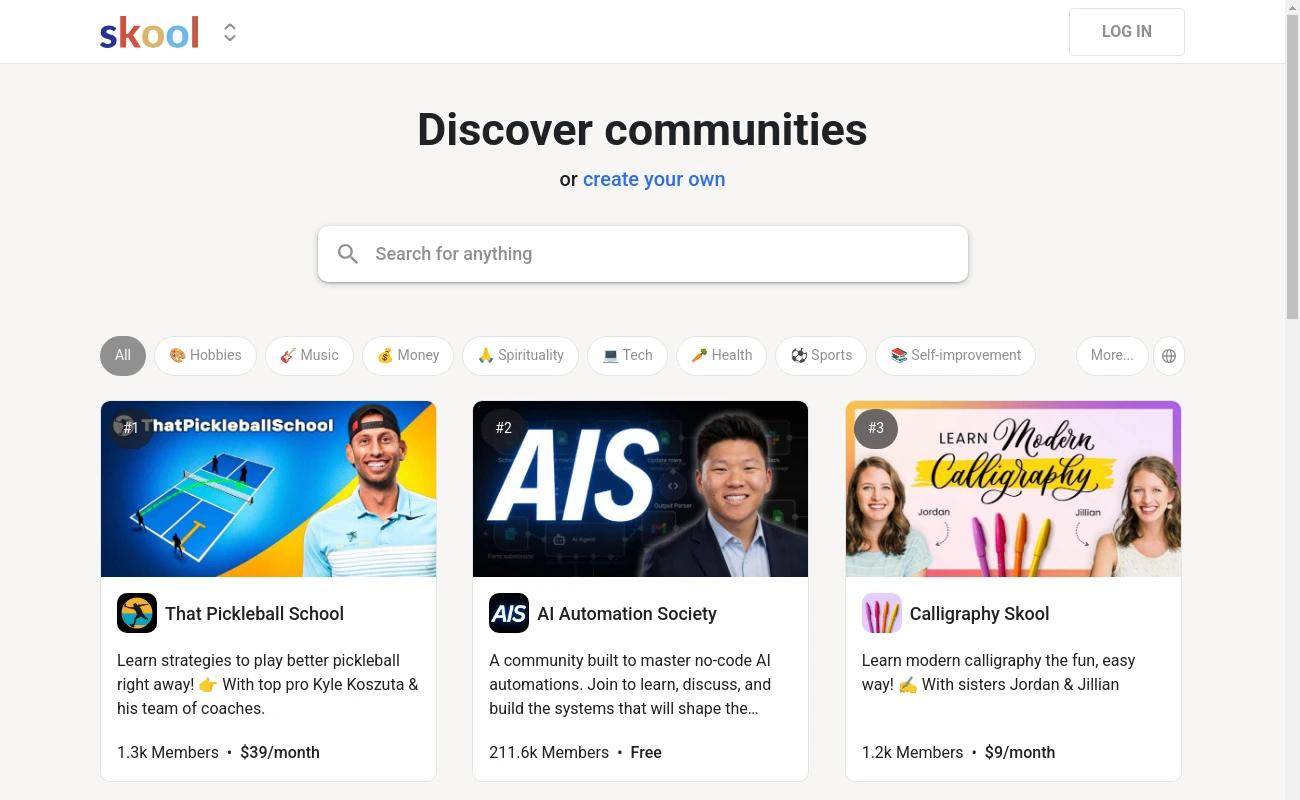
Skool launched in 2019 (after three years in beta) by Sam Ovens, a consultant known for scaling training businesses to seven figures. The platform gained massive traction when Alex Hormozi partnered with Skool in 2024, creating "The Skool Games" — a monthly competition where creators win prizes like Tesla Cybertrucks for building profitable communities.
Skool positions itself as the all-in-one platform for community, courses, and events. Its philosophy is simple: make community building so straightforward that you can launch in under 30 minutes. The platform hosts everything under skool.com/your-community, creating a discovery engine where members can find your group organically.
Key Skool Features
| Feature | Description |
|---|---|
| Community Feed | Facebook-style discussion threads |
| Classrooms | Drag-and-drop course builder with video hosting |
| Gamification | Points for likes, 9-level ranking system, public leaderboards |
| Live Events | Native streaming for up to 10,000 attendees |
| Mobile App | Dedicated iOS and Android apps |
| Monetization | Paid memberships, one-time courses, affiliate programs |
For a more in-depth understanding of Skool, see our complete Skool guide
What Is Circle? The Developer-Focused Community Builder
Circle emerged in 2019 from Sid Yadav, Teachable's first designer, with backing from Teachable founder Ankur Nagpal. While Skool focused on marketing, Circle prioritized development speed and feature richness. The platform recently achieved a $200 million valuation and powers communities for brands like Adobe and Brendan Burchard.
Circle operates more like a modern hybrid of Slack and traditional forums, offering unmatched flexibility in how you structure spaces. It provides true white-labeling capabilities and advanced automation that serious community managers crave.
Key Circle Features
| Feature | Description |
|---|---|
| Custom Spaces | Posts, chat, events, and courses in one community |
| Workflow Automation | Built-in triggers and actions (no Zapier required) |
| Landing Page Builder | Full website creation with templates |
| Gamification | Points, ranks, and activity scores (launched in 2025) |
| API Access | Headless member API for custom integrations |
| Branded Apps | Your own iOS and Android apps on higher tiers |
Deep Dive: Feature-by-Feature Comparison
Pricing and Value Analysis
| Plan | Monthly Cost | Transaction Fee | Best For |
|---|---|---|---|
| Skool Hobby | $9 | 10% (capped) | Beginners testing monetization |
| Skool Pro | $99 | 2.9% only | Growing creators with traction |
| Circle Professional | $89 | 2% + Stripe 2.9% | Established communities |
| Circle Business | $199 | 1% + Stripe 2.9% | Scaling businesses |
| Circle Enterprise | $360-419 | 0.5% + Stripe 2.9% | Large enterprises |
Verdict: Skool wins on simplicity. The flat-rate Pro plan with unlimited members and no transaction fees beats Circle's tiered pricing for most creators under $50k MRR.
Community Organization and User Experience
| Aspect | Skool | Circle |
|---|---|---|
| Interface | Six fixed tabs (Community, Classroom, Calendar, Members, Leaderboard, About) | Customizable sidebar with Groups and Spaces |
| Learning Curve | Near-zero; familiar Facebook-style layout | Steeper; requires planning and organization |
| Navigation | Channels directly under post composer reduce clutter | Flexible but can become overwhelming |
| Discovery | Platform-wide marketplace drives organic growth | Limited to your own marketing efforts |
Verdict: Skool wins for out-of-the-box engagement. The intuitive design drives higher participation rates, while Circle's flexibility suits power users who need complex structures.
Course Creation and Delivery
| Feature | Skool Classrooms | Circle Courses |
|---|---|---|
| Structure | Folder-and-page drag-and-drop | Sections and lessons with workflow triggers |
| Video Hosting | Native upload with auto-captions | Native upload with external tool integration |
| Quizzes | Not available | Available via integrations |
| Certificates | Not available | Available via workflows |
| Drip Scheduling | Basic date-based | Advanced automation-based |
| Best For | Simple course delivery | Complex learning paths |
Verdict: Circle edges ahead due to workflow automation. However, both remain basic compared to full LMS platforms. For serious course creators, read our Build Your Own Online Course Platform guide.
Gamification: The Engagement Engine
| Feature | Skool | Circle |
|---|---|---|
| Point System | 1 like = 1 point; transparent calculation | Points for posts, events, assignments |
| Levels/Ranks | 9-level system with progress bars | Custom ranks with manual or auto-assignment |
| Leaderboards | Public, community-wide | Optional, configurable |
| Rewards | Custom level names, marketplace visibility | Custom rewards via workflows |
| Experience | Deeply integrated; feels core to platform | Added feature; less intuitive |
Verdict: Skool dominates gamification. The addictive participation loops and viral marketplace create network effects Circle cannot replicate.
Customization and Branding Options
| Feature | Skool | Circle |
|---|---|---|
| Domain | skool.com/your-community (custom subdomain on Pro) | Full custom domain on all paid plans |
| Landing Pages | Basic About page only | Full website builder with templates |
| Styling | Logo, cover image, light/dark mode only | Global styles, custom CSS/HTML widgets |
| White-Labeling | Not available | Available on Plus plan |
| Philosophy | Platform-first; discovery over branding | Brand-first; full control over experience |
Verdict: Circle wins for brand control. Skool wins for leveraging platform discovery. Choose based on whether you want to build your own brand or tap into an existing network.
Automation and Integrations
| Aspect | Skool | Circle |
|---|---|---|
| Built-in Automation | None; relies entirely on Zapier | Native workflows on Business+ plans |
| Zapier Integration | Available (extra cost) | Available (extra cost) |
| API Access | Limited | Headless member API on higher tiers |
| Workflow Examples | Basic triggers only | Reward top performers, re-engage inactive members, auto-enroll in courses |
| Cost Impact | Requires separate Zapier subscription | Reduces need for additional tools |
Verdict: Circle wins decisively. Built-in automation reduces costs and technical overhead significantly for serious community managers.
Mobile Experience Comparison
| Platform | Strengths | Weaknesses |
|---|---|---|
| Skool | Clean, reliable, mirrors desktop simplicity | Limited customization options |
| Circle | Full feature parity on higher plans | Historically lagged; streaming quality issues reported |
Verdict: Skool wins for mobile reliability. Circle's app is improving but still trails behind in user experience.
Monetization and Transaction Fees
| Monthly Revenue | Skool Hobby | Skool Pro | Circle Professional | Circle Business |
|---|---|---|---|---|
| $1,000 | $109 total ($9 + $100 fee) | $128 total | $138 total | $218 total |
| $5,000 | $509 total ($9 + $500 fee) | $244 total | $434 total | $438 total |
| $10,000 | $1,009 total ($9 + $1,000 fee) | $389 total | $889 total | $799 total |
| $20,000 | $1,099 total (fee capped) | $679 total | $1,779 total | $1,498 total |
Includes platform fee + estimated Stripe processing at 2.9%
Verdict: Skool Pro offers the best rates for most creators above $3k/month. Circle's fees add up but may be justified by advanced features.
Which Platform Should You Choose?
Decision Matrix by Use Case
| Your Situation | Recommended Platform | Why |
|---|---|---|
| Just starting out | Skool Hobby | Lowest barrier to entry; test ideas with minimal investment |
| Engagement is #1 priority | Skool Pro | Gamification drives habit loops; platform discovery helps growth |
| Need advanced automation | Circle Business | Built-in workflows replace multiple tools |
| Brand experience critical | Circle Professional+ | Landing page builder and custom domains |
| Managing 1,000+ members | Circle Business | Better organization and scalability |
| Course-focused business | Tie | Both are basic; consider dedicated LMS |
| Mobile-first community | Skool Pro | More reliable mobile experience |
| Budget under $50/month | Skool Hobby | Only option at this price point |
Choose Skool if
- You want the simplest possible setup and launch process
- Community engagement and participation are your top KPIs
- You're excited about organic discovery and The Skool Games
- You prefer predictable flat-rate pricing
- You want the most intuitive mobile experience
- You're turning expertise into income through community
Best for: Solo creators, coaches, and consultants. If your productization strategy involves transforming knowledge into community income, Skool removes technical barriers.
Choose Circle if
- You need sophisticated automation without Zapier complexity
- Custom branding and white-labeling are non-negotiable
- You're managing multiple products or cohort-based programs
- API access and custom integrations are part of your roadmap
- You're scaling past 1,000 members with complex needs
- You want to build a complete brand experience
Best for: Established brands, agencies, and scaling businesses. If you're scaling your service business and need to automate member journeys, Circle's workflows justify the premium.
The Verdict: Two Different Paths to Community Success
After extensive testing, the choice between Skool and Circle isn't about which platform is better — it's about which philosophy matches your business model and growth stage.
Skool wins on simplicity and engagement. Its gamification creates addictive participation loops that new creators need to build momentum. The platform's discovery engine and The Skool Games provide built-in marketing that Circle cannot match. At $99/month with unlimited members, the value proposition is compelling for creators focused on growth.
Circle wins on power and flexibility. Its automation workflows, customization options, and advanced features support serious scaling. The landing page builder and API access let you create a true brand experience. However, the higher price point and learning curve demand commitment and technical comfort.
For 2026, our recommendation is clear:
- Revenue under $5k/month: Start with Skool Hobby, upgrade to Pro when you hit 50 members
- Revenue $5k-$20k/month: Skool Pro for engagement; Circle Professional for brand control
- Revenue over $20k/month: Circle Business for automation; Circle Enterprise for white-labeling
- Enterprise needs: Circle Plus with branded apps
Neither platform is perfect. Both lack advanced email marketing and sales funnels, requiring external tools for complete business automation. For building a seamless tech stack, explore our Workflow Automation Software guide.
Final Thoughts
The "skool vs circle" debate mirrors a larger choice in online business: do you prioritize speed or control? Skool gets you to market faster with its proven engagement model. Circle gives you the tools to build exactly what you envision.
Whichever you choose, success depends less on the platform and more on your ability to deliver value consistently. A community platform is just a container. The real magic happens when you fill it with meaningful connections, transformative content, and genuine support.
Test both platforms with free trials. Spend 14 days building a test community on each. Feel the difference in setup time, member engagement, and your own workflow preferences. Your intuition after hands-on testing will guide you better than any comparison article.
The community platform market will continue evolving in 2026, but these two players have established distinct lanes. Choose the one that lets you focus on what matters most: serving your members and growing your business.