Every growing business eventually hits the wall. The software that got you here can't get you where you're going. Maybe you're drowning in manual workarounds. Maybe your processes are twisted to fit tools that were never designed for your workflow. Maybe you're paying for five solutions that should be one.
The question isn't whether you need better software. It's whether to buy something off-the-shelf or build exactly what you need. This guide will help you make that decision strategically, with a clear framework, cost analysis, and understanding of how modern AI development is changing the equation.
The Software Dilemma
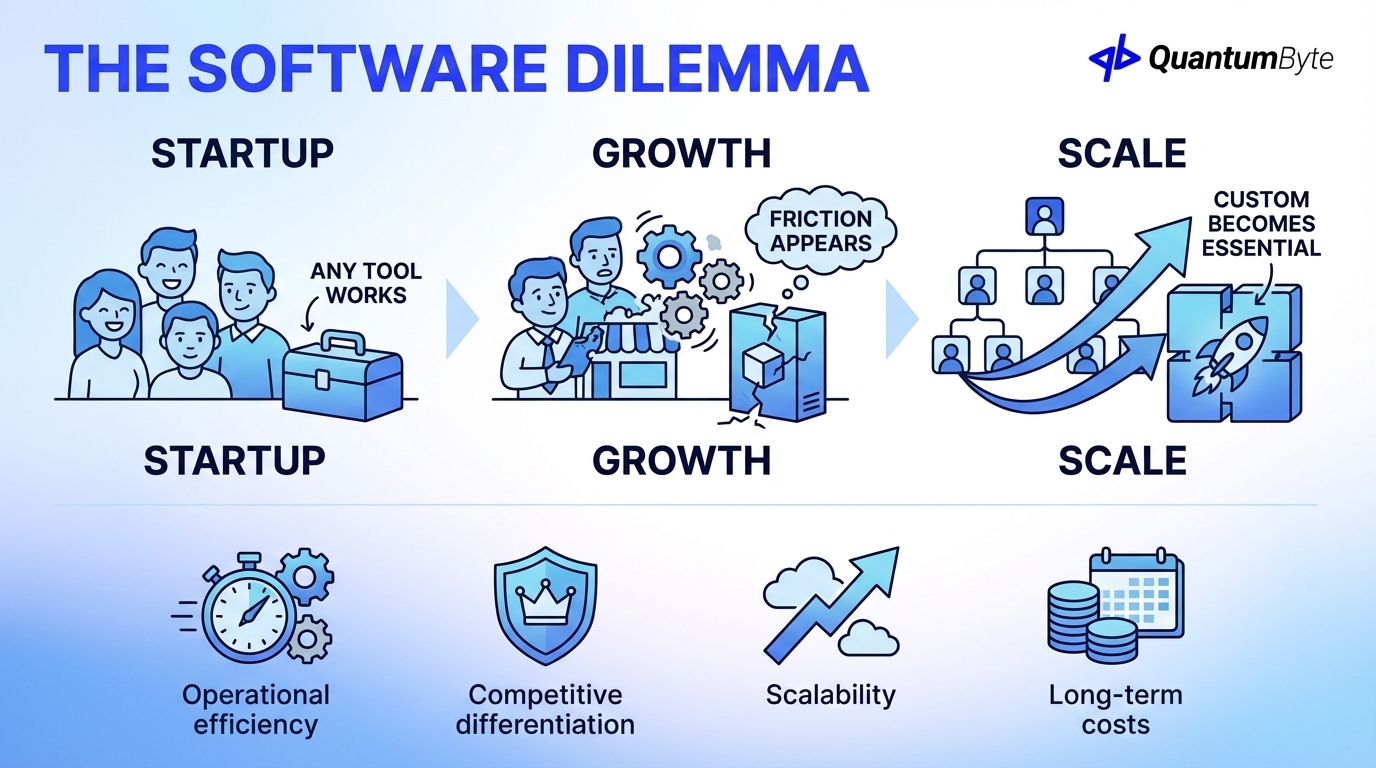
Off-the-shelf software serves most businesses well until it doesn't. The breaking point typically comes when:
- Your business grows beyond what generic tools were designed to handle
- Your processes become too unique to fit pre-built workflows
- The cost of workarounds exceeds the cost of doing it right
- Competitors with better-fit technology start winning your customers
At this point, "good enough" becomes a growth limiter. The question becomes: adapt your business to available software, or build software that fits your business?
This isn't a theoretical exercise. The right choice directly impacts:
- Operational efficiency: How much time and money you waste on workarounds
- Competitive differentiation: Whether your technology enables or constrains innovation
- Scalability: How easily you can grow without breaking systems
- Long-term costs: What you'll spend over 5+ years, not just today
10 Signs You Need Custom Business Software
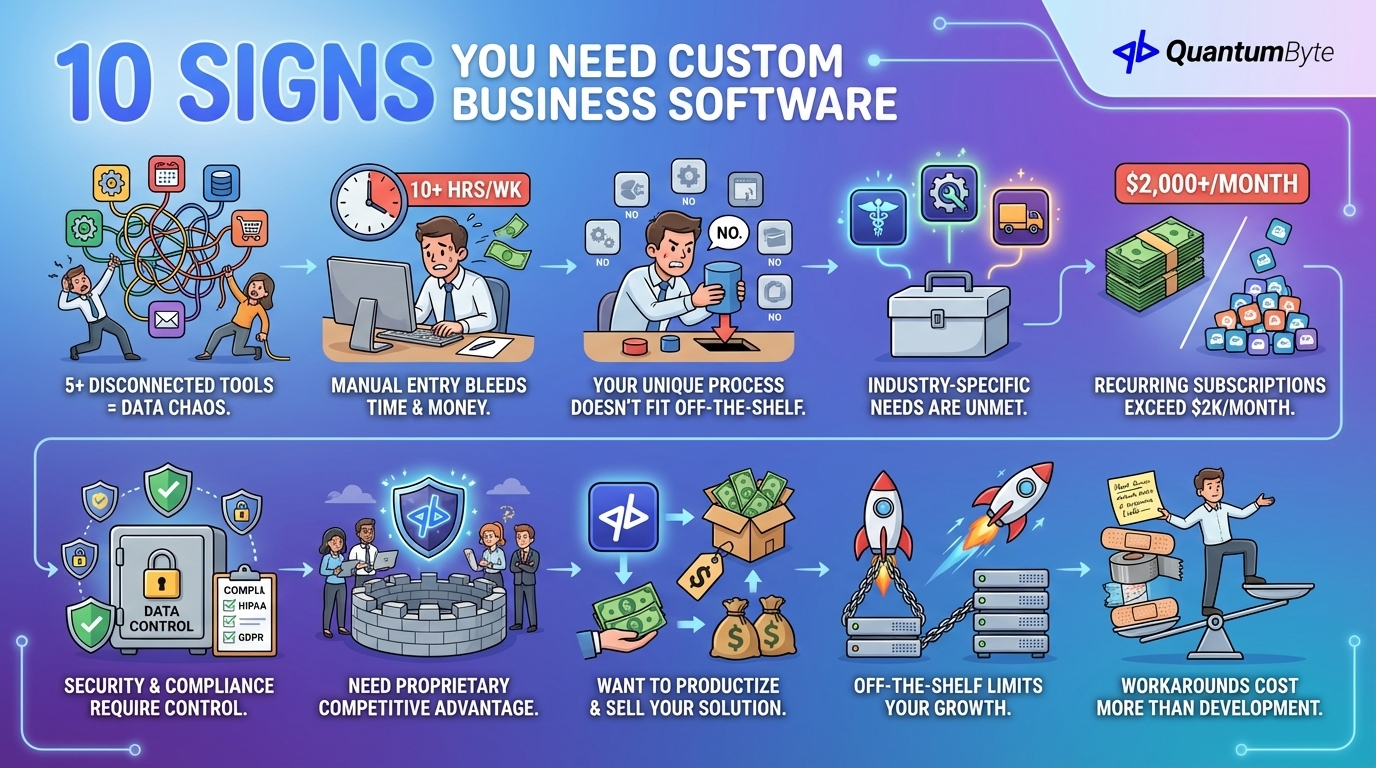
Not every frustration justifies custom development. But these ten signals consistently indicate that off-the-shelf solutions are costing more than they save:
1. You're Using 5+ Disconnected Tools
When your sales data lives in one system, customer records in another, orders in a third, and inventory in a fourth, you're not running a business—you're running a data reconciliation operation.
The cost: Staff hours spent copying data between systems, errors from manual transfer, delayed insights from fragmented information, and the constant risk that systems fall out of sync.
Custom solution value: A unified platform where all data lives together, automatically updated, always consistent.
2. Manual Data Entry Between Systems Consumes >10 Hours Weekly
Calculate this honestly: how many hours does your team spend moving information from one place to another? If it's more than 10 hours weekly, you're bleeding productivity.
The math: 10 hours/week × $30/hour × 52 weeks = $15,600/year minimum, before counting errors or opportunity cost.
Custom solution value: Automated data flows eliminate the transfer task entirely.
3. Your Process Doesn't Fit Any Commercial Software
Every off-the-shelf tool was built for a general use case. If your business has genuinely unique processes—whether from industry specialization, competitive innovation, or regulatory requirements—generic tools force painful compromises.
Warning signs: You've evaluated multiple solutions and always hear "you'll need to adjust your process to fit our workflow" or "that feature isn't available."
Custom solution value: Software built around your process, not processes bent to fit software.
4. You Need Industry-Specific Features Nobody Offers
Certain industries have requirements so specialized that horizontal software vendors can't economically serve them. Healthcare compliance, manufacturing tolerances, logistics constraints—these often demand custom approaches.
Custom solution value: Features designed specifically for your industry's requirements without paying for irrelevant functionality.
5. Recurring Subscription Costs Exceed $2,000/Month
SaaS subscriptions compound. One tool at $100/month becomes ten tools at $2,000/month, then $5,000/month as you add users and features.
The math: $2,000/month = $24,000/year = $120,000 over 5 years—potentially more than custom development that you own outright.
Custom solution value: One-time development cost plus modest maintenance, versus perpetual subscription payments.
6. Security or Compliance Requires Data Control
When regulations or customers require that data stay within your control, third-party SaaS solutions may not be viable. HIPAA, GDPR, financial services regulations, and enterprise customer requirements often mandate on-premise or private cloud deployment.
Custom solution value: Full control over data location, access, and security implementation.
7. You Need Proprietary Competitive Advantage
If your software is a key differentiator—if how you serve customers depends on technology competitors can't replicate—off-the-shelf solutions provide no competitive advantage because competitors can use the same tools.
Custom solution value: Proprietary systems that create defensible competitive moats.
8. You Want to Sell Your Software to Others
If your internal solution could become a product serving others in your industry facing similar challenges. Custom development creates a potential revenue stream rather than just a cost center.
Custom solution value: Asset ownership that enables productization and new revenue.
For more on this approach, see our guide on how to productize your service business.
9. Off-the-Shelf Limits Your Scaling Potential
Some platforms charge per-user, per-transaction, or per-record pricing that becomes prohibitive at scale. Others simply can't handle enterprise-level volume.
Warning signs: Pricing tiers that jump dramatically at certain thresholds, performance degradation as usage increases, or vendor uncertainty about handling your growth projections.
Custom solution value: Systems designed for your actual scale, with predictable costs regardless of growth.
10. You're Spending More on Workarounds Than Development Would Cost
This is the most telling signal. When your total investment in making inadequate software work—custom integrations, manual processes, error correction, lost productivity—exceeds what proper software would cost, the decision is clear.
How to assess: Sum up all the hidden costs: staff time on workarounds, consulting fees for integrations, productivity lost to friction, revenue lost to errors or delays.
Build vs. Buy Decision Framework
Abstract principles need concrete analysis. This framework helps you evaluate the build vs. buy decision systematically:
5-Year Total Cost of Ownership (TCO) Comparison
Don't compare first-year costs—compare what you'll spend over five years:
Buy (Off-the-Shelf) TCO:
Initial Implementation + (Annual Subscription × 5) + Integration Costs + Customization Costs + Training + Workaround Labor Costs
Build (Custom) TCO:
Initial Development + Annual Maintenance (15-20% of development) × 5 + Hosting + Training + Enhancement Budget
Example Comparison:
| Cost Category | Buy (5-Year) | Build (5-Year) |
|---|---|---|
| Initial Cost | $5,000 | $40,000 |
| Annual Recurring | $24,000/yr × 5 = $120,000 | $7,000/yr × 5 = $35,000 |
| Integration | $15,000 | Included |
| Workarounds | $10,000/yr × 5 = $50,000 | $0 |
| Total | $190,000 | $75,000 |
In this example, which is typical for a mid-sized business with complex requirements, custom development costs less than half the off-the-shelf alternative over five years.
Time to Value Analysis
How quickly do you need a working solution?
| Approach | Typical Timeline |
|---|---|
| Off-the-shelf SaaS | Days to weeks |
| Off-the-shelf with customization | Weeks to months |
| Custom (traditional agency) | 6~ months |
| Custom (AI-powered, like QuantumByte) | 1-8 weeks |
If you need something tomorrow, off-the-shelf wins. If you can wait 4-8 weeks for a perfect-fit solution, modern custom development is faster than most assume.
Competitive Differentiation Score
Rate each option on whether it provides competitive advantage:
| Factor | Off-the-Shelf Score | Custom Score |
|---|---|---|
| Unique capabilities | 0 (competitors use same tools) | 5 (only you have this) |
| Process optimization | 2 (generic best practices) | 5 (your specific process) |
| Customer experience | 4 (standard experience, well polished) | 4 (differentiated experience, but could be less polish) |
| Speed of innovation | 3 (vendor's roadmap) | 3 (your priorities) |
| Total | 11/20 | 17/20 |
If competitive differentiation matters in your market, this scoring alone may justify custom development.
Technical Complexity Assessment
Honest assessment of your requirements:
| Complexity Level | Off-the-Shelf Fit | Custom Recommended |
|---|---|---|
| Simple (standard workflows) | ✓ Excellent | ✗ Overkill |
| Moderate (some unique needs) | ~ Possible with workarounds | ~ Consider based on cost |
| Complex (unique processes) | ✗ Poor fit | ✓ Necessary |
| Highly complex (cutting-edge) | ✗ Not available | ✓ Only option |
When to Buy: Commodity Functions
Some functions are truly commodity, the same for every business regardless of industry or strategy. For these, off-the-shelf almost always wins:
- Email: Gmail/Outlook
- Basic accounting: QuickBooks/Xero
- Video conferencing: Zoom/Meet
- File storage: Google Drive/Dropbox
- Basic project management: Asana/Trello
Don't build what everyone needs identically.
When to Build: Core Competitive Processes
Some functions define your competitive advantage. For these, custom development creates value:
- Customer-facing workflows that differentiate your experience
- Operational processes that enable unique efficiency
- Data analysis that generates proprietary insights
- Integration hubs that connect your unique tool stack
- Industry-specific features that off-the-shelf ignores
Build what makes you different.
Custom Development Approaches Compared
If you've decided to build, you have several paths forward:
| Approach | Profile | Best For | Cost Range | Timeline | Quality | Customization | Ongoing Support | Pros | Cons |
|---|---|---|---|---|---|---|---|---|---|
| Traditional Agency Development | Established development agencies with full teams (PM, designers, developers, QA) | Complex projects requiring significant customization, enterprise requirements, long-term partnerships | $50,000-200,000+ | 6-12 months | High (reputable agencies) | Unlimited | Contracted separately | Experienced teams, proven processes, comprehensive capabilities | High cost, long timelines, may not understand your business deeply |
| Freelance Developers | Individual developers or small teams, often found through Upwork, Toptal, or referrals | Well-defined projects with clear specifications, budget-conscious businesses, technical founders who can manage development | $15,000-80,000 | 3-6 months | Variable (depends on vetting) | High | May be available | Lower cost, often faster, can find specialists in your tech stack | Quality varies widely, management overhead, continuity risk if freelancer leaves |
| In-House Development Team | Full-time employees dedicated to your software needs | Companies with ongoing development needs, software as core competitive advantage, sufficient scale to justify overhead | $150,000+/year ongoing (2-3 developers minimum) | Slow start (hiring), then continuous | High (with good hiring) | Unlimited | Built-in | Full control, deep business knowledge, continuous improvement | Expensive, slow to start, management overhead, recruitment challenges |
| No-Code/Low-Code Platforms | Visual development platforms that minimize or eliminate coding requirements | Simple to moderate complexity, rapid prototyping, non-technical teams | often free to start | 1-4 weeks | Good for appropriate use cases | Limited to platform capabilities | Platform-dependent | Fast, affordable, accessible to non-developers | Capability limits, vendor lock-in, may not scale |
| AI-Powered Custom Development (QuantumByte Hybrid) | Conversational AI generates applications from natural language descriptions, with human developers for refinement and complex requirements | Custom solutions without the traditional custom timeline or cost, businesses needing flexibility without technical expertise | $39 onwards | 1-8 weeks | High (AI + human refinement) | High | Available | Speed of no-code with flexibility of custom, natural language interface, expert support available | Newer approach, requires clear articulation of needs |
For a deeper comparison, see our article on no-code vs traditional coding. Learn more about how AI app builders transform ideas into apps.
Case Study: INA Digital (Indonesia National Platform)
To illustrate the impact of custom development at scale, let's examine one of the most ambitious digital transformation projects in Southeast Asia.
The Challenge
Indonesia's digital government landscape was fragmented across 27,000 separate applications. Each ministry and local government had built independent systems, creating:
- A maze of citizen logins and inconsistent services
- Duplicated development costs across agencies
- Siloed data preventing coordinated policymaking
- Frustrating citizen experiences navigating multiple systems
No off-the-shelf solution could unify 27,000 systems serving 270 million people across healthcare, education, social aid, and identity management.
The Solution
INA Digital emerged as a unified digital ecosystem built with QuantumByte. The platform brings ministries, institutions, and local governments together under one connected infrastructure:
- For citizens: One login to access all essential public services
- For government: Better coordination, interoperability, and shared progress across every region
- For efficiency: Reduced duplication, faster development, shared capabilities
The Impact
| Metric | Before | After |
|---|---|---|
| Separate Systems | 27,000 | Unified ecosystem |
| Citizen Logins Required | Multiple per service | One for all services |
| Inter-agency Collaboration | Siloed | Real-time coordination |
| Development Duplication | Widespread | Eliminated |
| Decision-Making Speed | Delayed (data silos) | Real-time (unified data) |
What once existed as 27,000 fragmented systems is evolving into a single digital heartbeat for the nation. Development costs are reduced, accountability is strengthened, and citizens receive accessible, transparent service.
This case demonstrates that custom development—when the alternative is forcing unique requirements into generic solutions—creates transformational value that off-the-shelf approaches simply cannot match.
For more case studies, see how Telkomsel automated competency mapping for 19,000 positions and how Nexius transformed financial reporting for SMEs.
How QuantumByte Makes Custom Development Affordable
The traditional objection to custom development is cost and time. QuantumByte addresses both through a fundamentally different approach:
AI Generates Code from Natural Language Descriptions
Instead of months of requirements gathering, wireframing, and development, you describe what you need in plain English. The AI generates functional applications in minutes, not months.
This isn't low-quality prototype code, it's a fully functioning and ready to-go application that handle real business workflows. The AI generates the commodity portion and our human developers can help you take it all the way with business-specific expertise.
Human Dev Team Handles Complex Polish and Integration
AI excels at pattern-based generation but benefits from human expertise for:
- Complex business logic requiring domain knowledge
- Integration with legacy systems or unusual APIs
- Performance optimization for high-volume scenarios
- Edge cases that require human judgment
QuantumByte's development team bridges this gap, ensuring AI-generated foundations become enterprise-ready applications.
Predictable Pricing and Timelines
Traditional custom development suffers from scope creep and timeline uncertainty. QuantumByte's AI-first approach enables more predictable engagements:
- Clear scoping through conversational refinement
- Rapid prototyping that validates requirements early
- Iterative development that catches issues before they compound
- Fixed-price options for well-defined projects
MVP in Weeks, Not Months
The path from idea to working software compresses dramatically:
| Phase | Traditional Timeline | QuantumByte Timeline |
|---|---|---|
| Requirements | 2-4 weeks | 1-2 day (conversational) |
| Design | 2-4 weeks | Included in generation |
| Development | 8-16 weeks | 1-4 weeks, depends on your iteration speed |
| Testing | 2-4 weeks | Continuous |
| Total | 14-28 weeks | 1-5 weeks |
Full Code Ownership and Export
Unlike no-code platforms that lock you into their ecosystem, QuantumByte-built applications are yours completely:
- Full source code access
- Deploy anywhere (your servers, any cloud)
- No vendor lock-in
- Continue development independently if desired
This combines the accessibility of platform-based development with the ownership of traditional custom development.
Conclusion: Making the Right Choice for Your Business
The build vs. buy decision isn't about ideology—it's about fit. Off-the-shelf solutions serve most businesses well for commodity functions. Custom development creates value when:
- Your processes are genuinely unique
- Generic tools force expensive workarounds
- Competitive advantage depends on technology
- Long-term costs favor ownership over subscription
- Scale requirements exceed platform limitations
Modern AI-powered development has shifted this calculation. What once required $100,000 and 12 months can now be accomplished for $20,000 in 6 weeks. The threshold where custom development makes sense has moved dramatically lower.
Next steps:
- Assess your current software against the 10 signs above
- Calculate your 5-year TCO for current approach vs. custom
- Consider which functions are commodity (buy) vs. differentiating (build)
- Explore how AI-powered development could fit your needs
Ready to explore whether custom development is right for your business? Schedule a consultation to discuss your specific requirements and get a realistic assessment of timeline and investment.
Other Guides to Explore
- How to Automate Business Processes to Increase Revenue in 2025
- Workflow Automation Software: How to Reduce Costs and Boost Revenue
- How to Calculate and Maximize Your Automation ROI
- AI App Builder Explained: How Conversational AI Transforms Your Ideas Into Apps
- No-Code vs Traditional Coding: Which Is Right for You?
Frequently Asked Questions (FAQ)
How do I know if my business is ready for custom software?
You're ready if: you've outgrown off-the-shelf tools, you're spending significant time on workarounds, your subscription costs are substantial, or your competitive advantage depends on technology. Use the 10 signs checklist above to assess your situation systematically.
What's the minimum budget for custom business software?
With AI-powered development platforms like QuantumByte, meaningful custom software can start at $5,000-10,000 for simpler applications. Traditional agency development typically starts at $50,000+. The right budget depends on complexity, but custom development is more accessible than most assume.
How long does custom software development take?
Traditional development: 6-12 months for moderate complexity. AI-powered development: 1-8 weeks for similar scope. The key difference is that AI handles the repetitive coding work, dramatically compressing timelines.
What happens if my needs change after the software is built?
Good custom software is designed for evolution. Budget 15-20% annually for maintenance and enhancements. Unlike off-the-shelf software where you're limited to vendor roadmaps, custom software adapts to your changing needs—you control the priorities.
Should I start with off-the-shelf and migrate to custom later?
Often yes, especially for startups. Use off-the-shelf tools to validate your business model and understand your processes. When you've proven the concept and hit the limitations of generic tools, you'll have much clearer requirements for custom development.
How do I find a reliable custom development partner?
Look for: relevant industry experience, clear communication, realistic timelines, transparent pricing, code ownership policies, and references from similar businesses. Start with a small project to test the relationship before committing to major development.
What's the biggest risk with custom software development?
Unclear requirements leading to scope creep and budget overruns. Mitigate this by: starting with clear documentation of current processes, using iterative development with frequent checkpoints, and choosing partners who use rapid prototyping to validate requirements early.