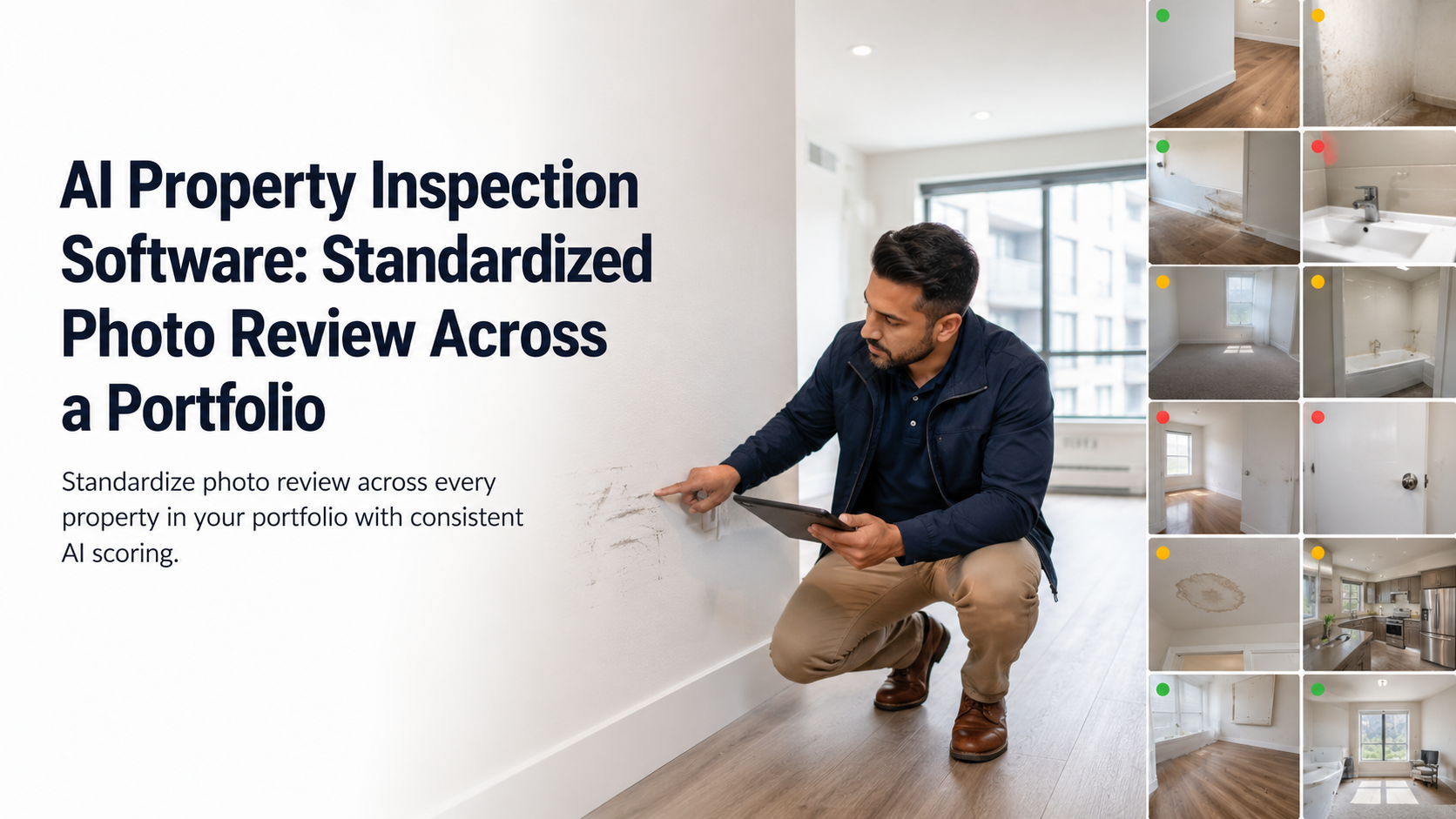
AI property inspection software uses computer vision to analyze photos and videos from field teams, automatically scoring each submission against your headquarters' standards so every property in your portfolio gets evaluated the same way. Instead of relying on subjective judgment from different inspectors at different locations, the AI applies identical criteria across every unit—flagging damage, wear, cleanliness issues, and missing fixtures with consistent severity ratings. For operations leaders managing 10, 40, or 100+ locations, this eliminates the inspector variability that makes cross-property comparison unreliable.
The market for these tools is growing fast. According to Global Growth Insights, the global AI home inspection software market was valued at USD 0.754 billion in 2024 and is projected to reach USD 1.768 billion by 2034, growing at a CAGR of 8.9%. That growth reflects a real operational pain point: manual photo review simply doesn't scale when you're responsible for dozens of properties and distributed field teams.
Why Manual Photo Review Breaks Down at Portfolio Scale
Manual photo review fails at scale because human reviewers cannot maintain consistent standards across hundreds or thousands of inspection images each week. Fatigue sets in. Time pressure mounts. And what counts as "acceptable" drifts from reviewer to reviewer, shift to shift, property to property.
The numbers illustrate the problem clearly. According to The AI Consulting Network, computer vision AI identifies maintenance issues, safety hazards, and code violations from inspection imagery that human inspectors miss at rates of 15 to 25 percent due to fatigue, time pressure, and inconsistency. That's not a minor gap—it's a quarter of issues slipping through on a bad day.
For a regional operations director overseeing 40 residential properties, this inconsistency creates downstream chaos. One field team documents a scuffed wall as "minor wear." Another team at a different property flags the same condition as "needs immediate repair." When you're comparing turnover readiness across your entire portfolio, these subjective differences make the data useless.
The time burden compounds the quality problem. InspectorData reports that inspectors who write reports manually spend 2–4 hours per inspection—the national average depending on property size and typing speed. Multiply that across a portfolio, and your team spends more time writing reports than actually inspecting properties.
Traditional commercial property condition assessments make the economics even starker. According to The AI Consulting Network, a traditional PCA typically involves 1 to 3 days of on-site inspection followed by 3 to 5 days of report writing, costing $5,000 to $15,000 depending on property size and complexity. At portfolio scale, those costs and timelines become untenable.
What AI Property Inspection Software Actually Does
AI property inspection software analyzes photos and videos captured on a smartphone, instantly identifying damage, wear, dirt, and missing fixtures while auto-generating detailed reports with flags, severity levels, and often repair cost estimates. According to SnapInspect Blog, this is the core function: turning raw visual evidence into structured, actionable data without manual interpretation.
The technology relies on computer vision—AI trained to recognize specific conditions in imagery. When a field technician photographs a water stain on a ceiling, the AI doesn't just store the image. It classifies the issue, assigns a severity score, and logs it against that unit's inspection history. The same logic applies whether your team is documenting HVAC corrosion, facade cracking, or a dirty restroom.
Here's what the workflow typically looks like:
- Field submission: Technicians capture photos, video, or voice notes using a mobile app or even WhatsApp
- AI analysis: Computer vision processes each submission against predefined standards
- Automated scoring: The system assigns condition ratings using consistent criteria
- Report generation: A structured report compiles all findings with timestamps and evidence
- Dashboard visibility: HQ sees real-time status across all locations with drill-down capability
The speed improvement is dramatic. Syntora reports that an AI-assisted workflow can cut report creation time from over 60 minutes to under 2 minutes per inspection. That's not incremental efficiency—it's a fundamentally different operating model.
For operations leaders using AI for real estate portfolio management, this means your field teams spend time inspecting, not typing. And your regional managers spend time acting on insights, not reconciling inconsistent spreadsheets.
How AI Scores Inspection Photos Against HQ Standards
AI scores inspection photos by comparing each image against a defined set of criteria that headquarters establishes—applying the same analytical framework to every property, every time, regardless of which field team captured the evidence. This is what makes portfolio-wide standardization possible.
According to The AI Consulting Network, for investors evaluating properties at scale, computer vision enables standardized condition scoring across a portfolio—each property receives comparable deficiency ratings based on the same analytical criteria, eliminating the inspector variability that makes cross-property comparison unreliable in traditional assessments.
The scoring process works in layers:
- Detection: The AI identifies what's in the image (appliance, flooring, fixture, wall surface)
- Classification: It categorizes any issues present (stain, crack, missing component, wear pattern)
- Severity assignment: Based on your configured thresholds, it rates the issue (minor, moderate, critical)
- Contextual logging: The finding gets tagged to the specific unit, room, and inspection date
This approach directly addresses the problem of subjective field reporting. When your cleaning company crews in Phoenix and your crews in Dallas both photograph a bathroom, the AI evaluates both against identical cleanliness standards. No more wondering if one team is stricter than another.
The accuracy holds up under scrutiny. The AI Consulting Network notes that AI-powered computer vision can detect building defects from photos and drone footage with accuracy rates exceeding 90%, catching issues like roof deterioration, facade cracking, and HVAC corrosion that visual inspections miss.
For platforms built on multi-tenant architecture, this scoring logic can be customized per client or franchise while still rolling up to a unified dashboard—critical for property management companies serving multiple owners or cleaning franchises with distinct brand standards.
Use Cases: Property Management, Cleaning Companies, and Facility Compliance
AI property inspection tools serve any multi-location service business where field teams document conditions and headquarters needs consistent visibility. The technology isn't limited to real estate agents—it's built for operations.
Property Management
A regional operations director managing 40 residential units faces a specific challenge: ensuring every turnover inspection meets the same quality bar, regardless of which technician conducts it. AI property inspection software standardizes that process.
Field teams photograph each room during move-out. The AI flags damage beyond normal wear, scores cleanliness, and generates a condition report that's directly comparable to every other unit in the portfolio. No more arguing about whether a stain is "minor" or "significant"—the system applies the same threshold everywhere.
The ROI case is concrete. According to The AI Consulting Network, a 200-unit multifamily property spending $150 per month on AI inspection saves 40 to 60 hours per month in inspection and report writing time compared to traditional methods. At $25 per hour for inspection staff, that represents $1,000 to $1,500 per month in labor savings against $150 in platform costs.
Commercial Cleaning Companies
A VP of Operations at a 25-location cleaning company can't personally verify that every crew completed every job correctly. AI changes that equation.
Crews submit photos at job completion via a mobile app. The AI scores each image against the client's cleanliness standards—checking for missed areas, improper product use, or incomplete tasks. The operations team sees a dashboard showing which locations passed, which need follow-up, and which crews consistently underperform.
This connects directly to downstream workflows. When inspection sign-off triggers invoicing, you can integrate with accounts receivable automation to accelerate billing cycles. Cleaning companies operating as franchises may also benefit from white-label deployment to offer branded inspection tools to their own clients.
Facility Compliance for Healthcare Services
A facilities manager responsible for 15 clinics needs proof that each location meets HQ standards—without visiting every site personally. AI inspection software creates that audit trail.
Field staff conduct walkthroughs and submit photo evidence. The AI scores each submission against compliance criteria, timestamps everything, and stores it in a searchable archive. When an auditor asks for documentation, you pull the report in seconds.
This use case often involves duplicate invoice detection for vendor work orders tied to inspection findings, and accounts payable workflow automation to close the loop between inspection completion and vendor payment.
Note: If your organization operates in a regulated environment, ask any vendor you evaluate about their compliance posture and what documentation they can provide.
What to Look for in an AI Property Inspection Tool
The right AI property inspection tool depends on your portfolio size, team structure, and operational workflows—not just feature lists. Here's what matters for multi-location service businesses.
| Criteria | Why It Matters | Questions to Ask |
|---|---|---|
| Standardized scoring | Ensures every property gets evaluated against identical criteria | Can I define custom scoring thresholds per property type or client? |
| Mobile-first submission | Field teams need to capture evidence without friction | Does it work offline? Can teams submit via WhatsApp or SMS? |
| Dashboard visibility | HQ needs real-time status across all locations | Can I filter by region, property, or crew? Are trends visible over time? |
| Audit trail | Compliance and dispute resolution require timestamped evidence | How long is data retained? Can I export reports for external review? |
| Integration capability | Inspection data should flow into billing, maintenance, and reporting systems | Does it connect to my property management or field service platform? |
| Scalability | Your tool should grow with your portfolio | What's the pricing model at 50 locations? 100? |
Adoption rates suggest the market is moving quickly. According to SnapInspect Blog, 21% of property managers already use AI for inspections, and another 28% plan to adopt it. If you're evaluating tools now, you're not early—you're on pace.
For teams building custom operational workflows, an AI app builder designed for startups can provide the flexibility to tailor inspection logic to your specific standards rather than adapting to a rigid off-the-shelf product.
When comparing options, focus on how the tool handles your specific evidence types. Some platforms excel at photo analysis but can't process video or voice notes. Others offer broad input support but lack the scoring granularity you need for portfolio-wide standardization.
Build a Standardized Inspection Workflow with QuantumByte
QuantumByte lets you build custom AI apps that run your inspection operations—field teams submit evidence via photos, video, voice, or WhatsApp, AI scores it against your HQ standards, and you get dashboards and audit trails without manual review.
The platform is designed for operations leaders at multi-location service businesses: property management companies, commercial cleaning operations, facilities teams at clinic networks, and similar organizations managing 5 to 100+ locations. You define what "good" looks like. The AI enforces it consistently across every submission.
Here's how a standardized inspection workflow comes together:
- Configure your standards: Define scoring criteria for each inspection type—turnover, routine, compliance walkthrough
- Deploy to field teams: Technicians use a mobile app to capture and submit evidence from any location
- AI processes submissions: Computer vision analyzes each photo or video against your configured thresholds
- Review flagged items: Your dashboard highlights exceptions that need human attention
- Generate reports: Automated documentation with timestamps, scores, and evidence for every inspection
- Close the loop: Integrate with client review and approval workflows for stakeholder sign-off
The efficiency gains compound over time. According to The AI Consulting Network, AI property inspection automation reduces inspection time by 50 to 65 percent while producing more comprehensive documentation through computer vision analysis of photos and video captured during walkthroughs.
QuantumByte pricing starts with a Free tier, scales to Prototype at $6/month and Pro at $29/month, with Enterprise options available for larger deployments. Contact the enterprise team to discuss portfolio-scale implementations.
Frequently Asked Questions
What is AI property inspection software and how does it work for multi-location portfolios?
AI property inspection software uses computer vision to analyze photos and videos from field teams, automatically scoring each submission against standardized criteria. For multi-location portfolios, this means every property gets evaluated using identical thresholds—eliminating the subjective variation that occurs when different inspectors apply different judgment calls across your sites.
How does AI score and standardize inspection photos across different field teams?
The AI compares each submitted image against predefined standards that headquarters configures. It detects issues like damage, wear, or cleanliness problems, classifies their severity, and assigns consistent ratings regardless of which team captured the photo. This produces comparable deficiency scores across your entire portfolio.
Can AI property inspection software create an audit trail for compliance walkthroughs?
Yes. AI inspection tools timestamp every submission, log the scoring rationale, and store evidence in searchable archives. When auditors or stakeholders request documentation, you can pull complete inspection histories with photos, scores, and dates—proving each location met standards without relying on subjective self-reporting.
What types of service businesses use AI property inspection tools?
Property management companies, commercial cleaning operations, healthcare facility networks, gyms, restaurants, and field-service trades all use AI inspection tools. Any multi-location service business where field teams document conditions and headquarters needs consistent visibility can benefit—it's not limited to real estate agents or home inspectors.
What should field teams submit for an AI-powered property inspection to be accurate?
Field teams should submit clear photos of each area being inspected, captured in good lighting with minimal blur. Many platforms also accept video walkthroughs, voice notes describing conditions, and submissions via WhatsApp or SMS. The more consistent the capture process, the more reliable the AI scoring becomes.
Does AI property inspection software replace on-site inspectors or field staff?
No. AI inspection software augments field teams rather than replacing them. Technicians still conduct walkthroughs and capture evidence—the AI handles the analysis, scoring, and report generation that would otherwise consume hours of manual work. Your team spends more time inspecting and less time writing.
How do I choose AI property inspection software for a portfolio of 10 or more locations?
Prioritize standardized scoring you can customize, mobile-first evidence submission, real-time dashboard visibility across all sites, and a clear audit trail. Evaluate integration capabilities with your existing property management or field service systems, and confirm the pricing model scales reasonably as your portfolio grows.