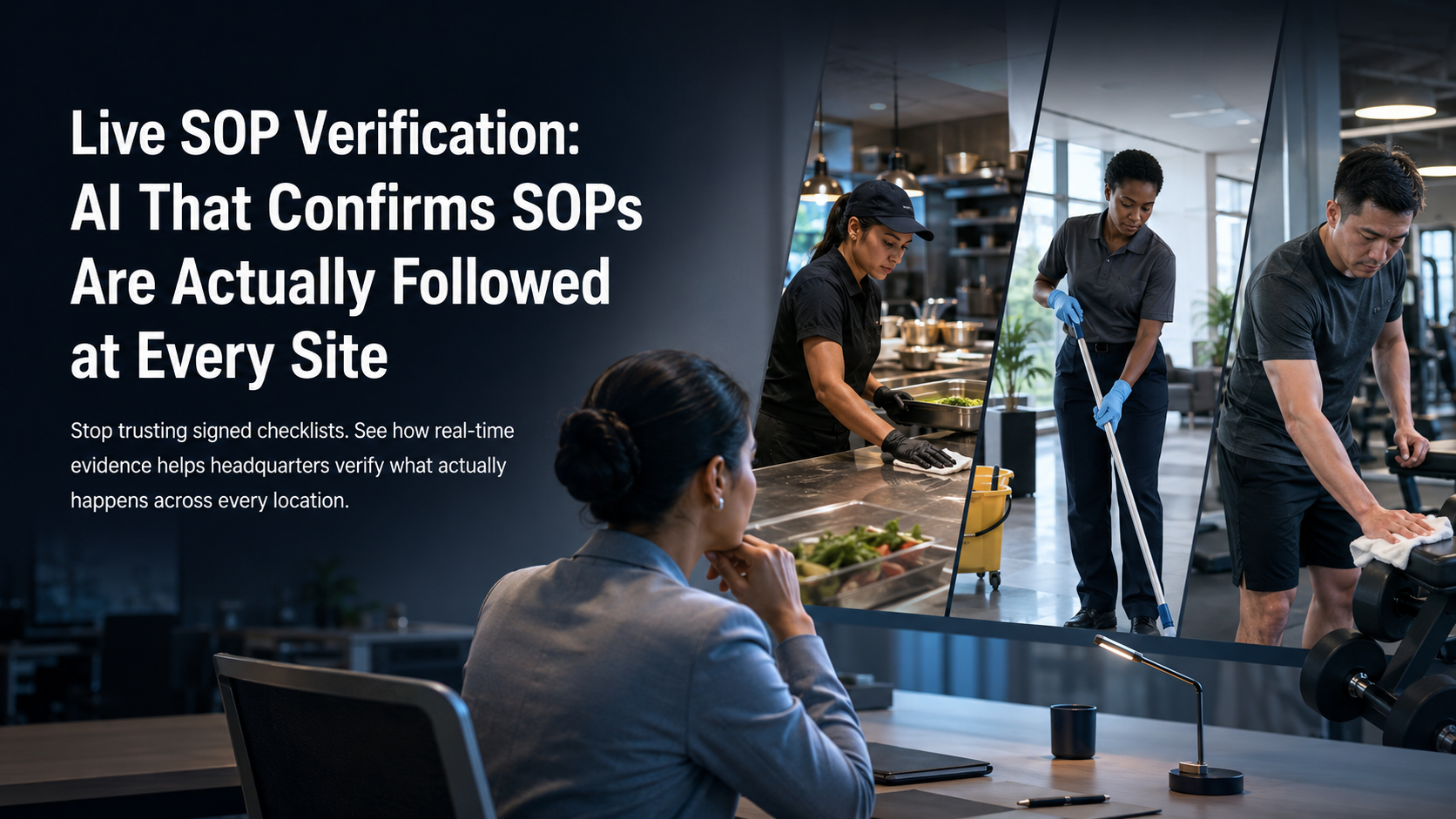
Live SOP verification is an AI-powered approach that confirms standard operating procedures are actually executed—not just signed off on—at every location in real time. Unlike traditional checklists that record what staff claim happened, live verification captures visual or audio evidence from the field and scores it against your headquarters standards. For multi-site service businesses, this means finally closing the gap between what your procedures say and what your teams actually do.
If you operate restaurants, gyms, cleaning companies, or any distributed service business, you already know the problem: your SOPs exist, your staff are trained, and your checklists come back completed. Yet client complaints persist, health inspections surprise you, and quality varies wildly from site to site. The issue isn't your procedures—it's that you have no reliable way to verify they're followed when no manager is watching.
This guide explains why traditional compliance methods fail at scale, how live SOP verification works differently, and what operations leaders should look for when evaluating AI SOP compliance software for their multi-location business.
The Gap Between What Managers Report and What Actually Happens
The core problem for multi-site operators is visibility: you cannot be everywhere, and the people who can be everywhere have every incentive to report compliance whether it happened or not.
District managers visit a fraction of your locations each week. When they do show up, staff perform differently than they would at 2 AM on a Tuesday. The compliance data you receive—completed checklists, signed logs, verbal confirmations—tells you what people said they did, not what they actually did.
This gap compounds as you scale. A 10-location operation might survive on trust and occasional spot-checks. A 40-location chain cannot. According to Business Wire, organizations have relied on manual observation, periodic audits, and end-of-line inspection for years to understand whether work was performed correctly—but those methods often identify defects after they have already moved downstream, rarely revealing the execution issues that caused them.
For service businesses, "downstream defects" look like failed health inspections, lost cleaning contracts, or member complaints about dirty gym equipment. By the time you discover the problem, the damage is done.
Why Signed Checklists and Spot-Checks No Longer Work at Scale
Signed checklists confirm that someone checked a box—nothing more. They cannot tell you whether the task was performed correctly, completely, or at all.
Consider a commercial cleaning crew working overnight at a client site. The crew lead signs off that all restrooms were sanitized, trash was removed, and floors were mopped. But no one witnessed the work. If a client complains the next morning, you have no evidence to review, no way to identify what went wrong, and no basis for coaching beyond "do better next time."
Spot-checks by regional managers suffer from a different limitation: sample size. If your district manager audits 3 of their 12 locations per week, 75% of your sites operate unobserved. Staff quickly learn the audit schedule and adjust their behavior accordingly.
The math gets worse as you grow. Adding locations without adding regional managers means each site receives less oversight. Adding regional managers to maintain coverage destroys your unit economics. Neither path solves the underlying problem: you need verification at every site, every shift, without multiplying headcount.
McKinsey's Industry 4.0 research documents that successfully implemented digital solutions deliver 15–30% improvements in labor productivity across sectors. For service operations, that productivity gain often comes from replacing manual oversight with automated verification—doing more with the same team.
How Live SOP Verification Differs from Post-Hoc Inspection
Live SOP verification confirms compliance as work happens, not after problems surface. This distinction changes everything about how you manage distributed teams.
Traditional inspection is retrospective. You discover a health code violation during an audit, a client complaint after a missed cleaning task, or a safety incident after an equipment check was skipped. By then, you're in damage-control mode—apologizing, remediating, and hoping the pattern doesn't repeat.
Live verification is proactive. Field teams submit evidence—photos, video, voice notes, or messages via WhatsApp—as they complete each task. AI scores that evidence against your defined standards in real time. If a closing crew skips the fryer cleaning or a gym attendant misses the equipment wipe-down, you know immediately, not three days later when a customer complains.
According to DeepHow, live SOP verification is defined as "a Physical AI system that verifies work execution in real time using Visual Learning Models and computer vision," confirming each task step is performed correctly according to approved procedures as the work progresses. The key distinction: digital SOPs show what should be done, checklists require a person to sign off, but live SOP verification confirms what was actually done.
This shift from "trust and verify later" to "verify as it happens" is similar to how duplicate invoice detection catches payment errors before money leaves your account rather than during a quarterly reconciliation. The earlier you catch a deviation, the cheaper it is to correct.
Live Verification Across Distributed, Unsupervised Locations
The real test for any SOP compliance system is whether it works when no manager is present. For service businesses, that's most of the time.
Cleaning crews work overnight. Restaurant closing shifts happen after district managers go home. Gym opening procedures occur at 5 AM. Property maintenance teams operate across dozens of buildings simultaneously. In each case, the people doing the work are unsupervised, and the traditional compliance model depends entirely on their self-reported honesty.
Live SOP verification changes the dynamic by making evidence submission part of the workflow itself. Instead of asking "Did you complete the task?" and accepting a checkbox, you ask "Show me the completed task" and receive a timestamped photo or video from the field.
This approach requires multi-tenant architecture that can handle evidence from dozens or hundreds of locations simultaneously, route it to the correct compliance standards for each site, and surface exceptions to the right managers without overwhelming them with noise.
The result is visibility without presence. Headquarters sees a dashboard of compliance scores across every location. Site-level managers receive alerts only when something deviates from standard. Field teams know their work is being verified, which changes behavior even before you catch a single violation.
For enterprise operations managing 50+ locations, this architecture becomes essential. You cannot scale oversight through headcount alone—you need systems that verify compliance automatically and surface only the exceptions that require human attention.
Industry Applications: QSR, Commercial Cleaning, and Fitness Operations
Live SOP verification applies wherever distributed teams execute standardized procedures without direct supervision. Three industries illustrate the pattern.
Quick-Service Restaurants
QSR operators face relentless compliance pressure: food safety regulations, brand standards, franchise requirements, and health department inspections. A single failed inspection can close a location; a pattern of violations can cost a franchise agreement.
Traditional audit tools require district managers to physically visit each restaurant, complete lengthy inspection forms, and hope their presence doesn't distort staff behavior. Live verification flips this model: line cooks submit photos of temperature logs, closing crews record video of sanitization procedures, and AI scores each submission against brand standards.
For restaurant teams evaluating alternatives to legacy audit systems, AI-powered tools designed for restaurant operations can replace clipboard inspections with continuous, evidence-based verification.
Commercial Cleaning
Cleaning companies operate in a trust vacuum. Clients hire you to clean their facilities overnight, but they're not present to verify the work. When complaints arise, it's your word against theirs—and you often lack evidence to defend your crews or identify genuine performance issues.
Live SOP verification creates an audit trail for every task. Crews photograph completed work areas, submit evidence via mobile device or WhatsApp, and AI confirms the space matches the contracted standard. If a client disputes quality, you have timestamped visual proof. If a crew consistently underperforms, you have data to support coaching or reassignment.
Fitness Operations
Gyms and studios face a unique compliance challenge: high staff turnover combined with safety-critical procedures. Opening checks, equipment inspections, and closing protocols must happen consistently regardless of who's working that shift.
For fitness operators managing membership and operational workflows, live verification ensures that the 19-year-old working the 5 AM opening shift follows the same equipment inspection protocol as your veteran manager. Visual evidence replaces verbal assurance, and compliance becomes measurable rather than assumed.
What to Look for in an AI SOP Compliance Solution
Not every SOP tool delivers actual verification. Many digitize your checklists without changing the fundamental problem: you're still trusting self-reported completion rather than confirming actual execution.
When evaluating AI SOP compliance software, operations leaders should ask these verification questions:
Does the system capture evidence, or just checkboxes? If staff can mark a task complete without submitting proof, you've digitized your clipboard without improving your visibility. Look for systems that require photo, video, or voice evidence for critical procedures.
Can AI score evidence against your specific standards? Generic image recognition isn't enough. Your brand standards define what "clean" looks like, what "properly stocked" means, and what "equipment ready" requires. The system should learn your definitions, not impose generic ones.
Does it work with the tools your field teams already use? Adoption fails when you ask hourly workers to download another app and remember another login. Systems that accept evidence via WhatsApp, SMS, or existing communication channels see higher compliance rates than those requiring dedicated apps.
What verification results does headquarters actually see? Dashboards should surface compliance scores by location, trend data over time, and specific exceptions requiring attention. If you're drowning in raw evidence without actionable summaries, the system creates work rather than eliminating it.
How does the vendor handle your compliance requirements? Different industries face different regulatory environments. When evaluating any vendor, ask directly about their compliance posture and what documentation they can provide for your specific requirements.
Beyond verification, consider whether the platform supports broader workflow automation needs. SOP compliance rarely exists in isolation—it connects to scheduling, training, incident management, and reporting. A platform that handles only verification may create integration headaches as your operations mature.
| Capability | Traditional Checklist Tools | Live SOP Verification Systems |
|---|---|---|
| Evidence capture | Checkbox or text entry | Photo, video, voice, messaging |
| Verification timing | After-the-fact review | Real-time as work happens |
| AI scoring | None or basic completion tracking | Evidence scored against custom standards |
| Manager workload | Manual review of all submissions | Exception-based alerts only |
| Audit trail | Signed forms, timestamps | Visual evidence with metadata |
| Field team adoption | Dedicated app required | Works via WhatsApp, SMS, or existing tools |
Build Your Live SOP Verification System with QuantumByte
QuantumByte helps multi-location service businesses build custom AI apps that verify SOPs are actually followed—not just signed off on—at every site.
The approach is straightforward: your field teams submit evidence (photos, video, voice notes, WhatsApp messages) as they complete procedures. QuantumByte's AI scores that evidence against your headquarters standards. You get dashboards showing compliance across every location and audit trails proving what happened, when, and where.
This isn't a one-size-fits-all checklist app. QuantumByte builds custom verification workflows for your specific procedures, your brand standards, and your operational reality. Whether you're running 12 cleaning crews or 80 restaurant locations, the system adapts to how your business actually works.
For franchise operators or service providers who need branded tools across client locations, white-label deployment options let you deliver SOP verification under your own brand.
Pricing starts with a Free tier for testing, scales through Prototype ($6) and Pro ($29/mo) plans, and includes Enterprise options for larger deployments. Visit quantumbyte.ai/pricing for current details.
Stop trusting signed checklists. Start verifying what actually happens at every site, every shift, without adding headcount.
Frequently Asked Questions
What is live SOP verification, and how is it different from a signed checklist?
Live SOP verification uses AI to confirm procedures were actually performed by analyzing visual or audio evidence submitted from the field. Signed checklists only record that someone claimed to complete a task. The difference is proof versus trust—verification shows what was done, while checklists show what someone said they did.
Why do multi-location service businesses fail SOP compliance even when staff are trained?
Training teaches procedures; it doesn't ensure execution. Staff may cut corners when unsupervised, forget steps under time pressure, or simply prioritize differently than headquarters expects. Without verification at the moment of execution, compliance depends entirely on individual discipline across every shift at every location.
How does AI-powered live SOP verification work for field teams?
Field teams capture evidence—photos, videos, or voice notes—as they complete each procedure and submit via mobile device or messaging apps like WhatsApp. AI analyzes the evidence against predefined standards and scores compliance in real time. Managers see results on dashboards and receive alerts only when deviations occur.
Can live SOP verification software replace in-person audits at every location?
Live verification reduces the need for routine physical audits by providing continuous compliance visibility. However, it complements rather than fully replaces in-person oversight. Managers can focus audit visits on locations with compliance issues rather than spreading limited time across all sites equally.
What types of service businesses benefit most from live SOP verification tools?
Multi-location service businesses with distributed, often unsupervised teams benefit most. This includes quick-service restaurants, commercial cleaning companies, fitness chains, property management firms, field-service trades, and healthcare clinics. The common factor is standardized procedures executed across many sites without constant manager presence.
How do you measure whether SOPs are actually being followed across multiple locations?
Effective measurement requires evidence-based verification results, not self-reported completion rates. Track compliance scores by location and procedure type, identify patterns in deviations, and trend performance over time. Dashboards should show both aggregate compliance and specific exceptions requiring attention.
What should operations leaders look for when evaluating SOP compliance software?
Prioritize systems that capture actual evidence rather than checkboxes, score submissions against your specific standards using AI, integrate with tools your field teams already use, and surface actionable verification results without overwhelming managers. Also ask vendors directly about their compliance posture for your industry requirements.