The first 45 days of employment determine everything. Harvard Business Review reports that 20% of employee turnover happens within this window.
Yet most companies treat employee onboarding as an afterthought with inconsistent processes, forgotten tasks, overwhelmed new hires, and missed opportunities to build engagement. The cost? Lost talent, slow productivity, and wasted recruiting investment.
Employee onboarding software transforms this critical period into a systematic advantage. Consistent experiences, automated coordination, and structured support ensure every new hire gets the foundation for success.
The Employee Onboarding Revenue Impact
Employee onboarding is a business investment with measurable returns.
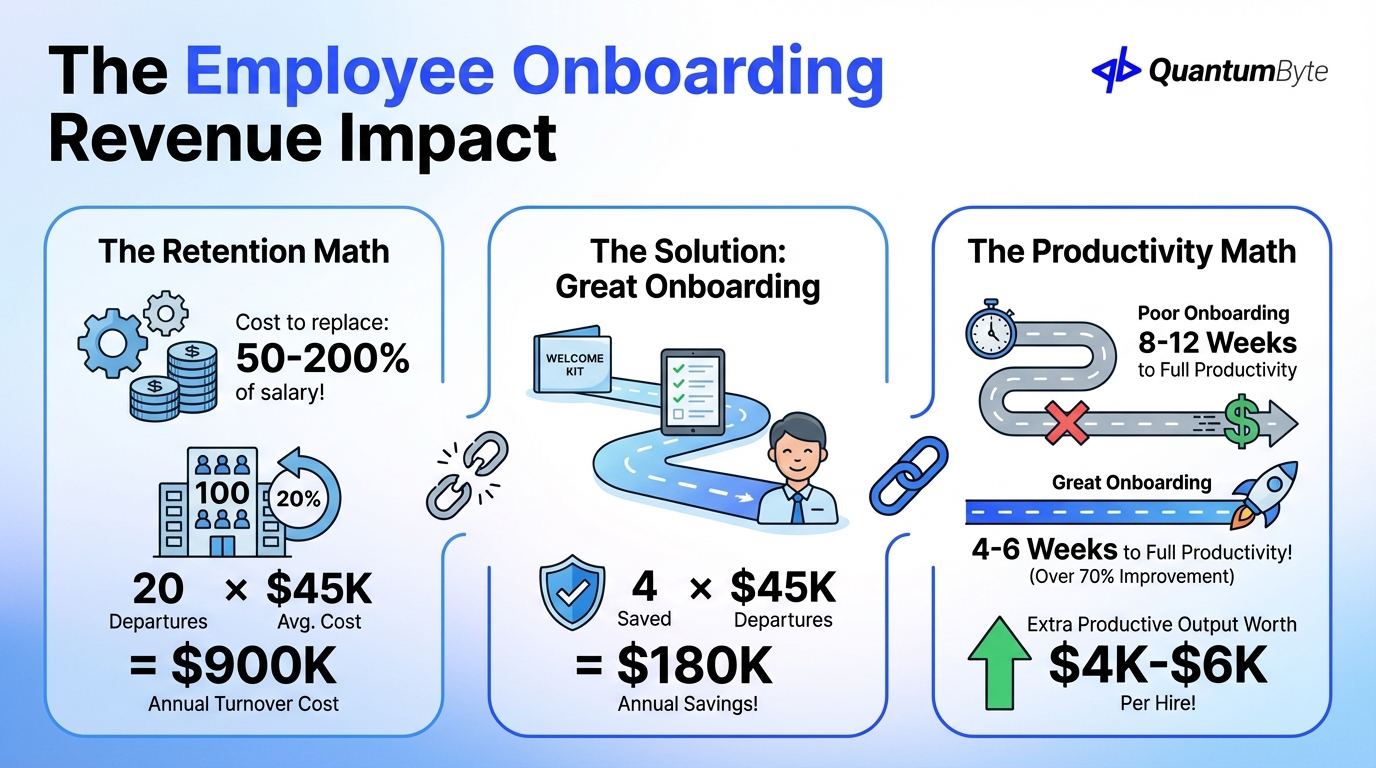
The retention math:
Cost to replace an employee: 50-200% of annual salary
For a 100-person company with 20% turnover and $60K average salary:
20 departures × 75% replacement cost × $60K = $900,000 annual turnover cost
If 4 of those departures (20%) happen in the first 45 days due to poor employee onboarding, and great onboarding could prevent them:
4 prevented departures × $45,000 replacement cost = $180,000 annual savings
The productivity math:
According to Harvard Business Review, organizations with strong onboarding processes improve new hire productivity by over 70%.
- Poor employee onboarding: 8-12 weeks to full productivity
- Great employee onboarding: 4-6 weeks to full productivity
For a $60K employee, that's 4-6 weeks of additional productive output worth $4,000-6,000 per hire.
The Cost of Poor Employee Onboarding
Manual, inconsistent employee onboarding creates measurable waste:
| Cost Component | Annual Cost (hiring 15/year) |
|---|---|
| HR time per new hire (20 hrs × $40) | $12,000 |
| Manager time per new hire (15 hrs × $60) | $13,500 |
| Early departures (3 per year × $45K) | $135,000 |
| Extended ramp time (4 weeks × 15 hires × $1K/wk) | $60,000 |
| Inconsistent experience issues | Hard to quantify |
| Total Annual Cost | $220,500 |
For a company hiring 15 people annually, poor employee onboarding wastes over $200,000, mostly hidden in turnover costs and slow productivity.
15 Employee Onboarding Processes to Automate
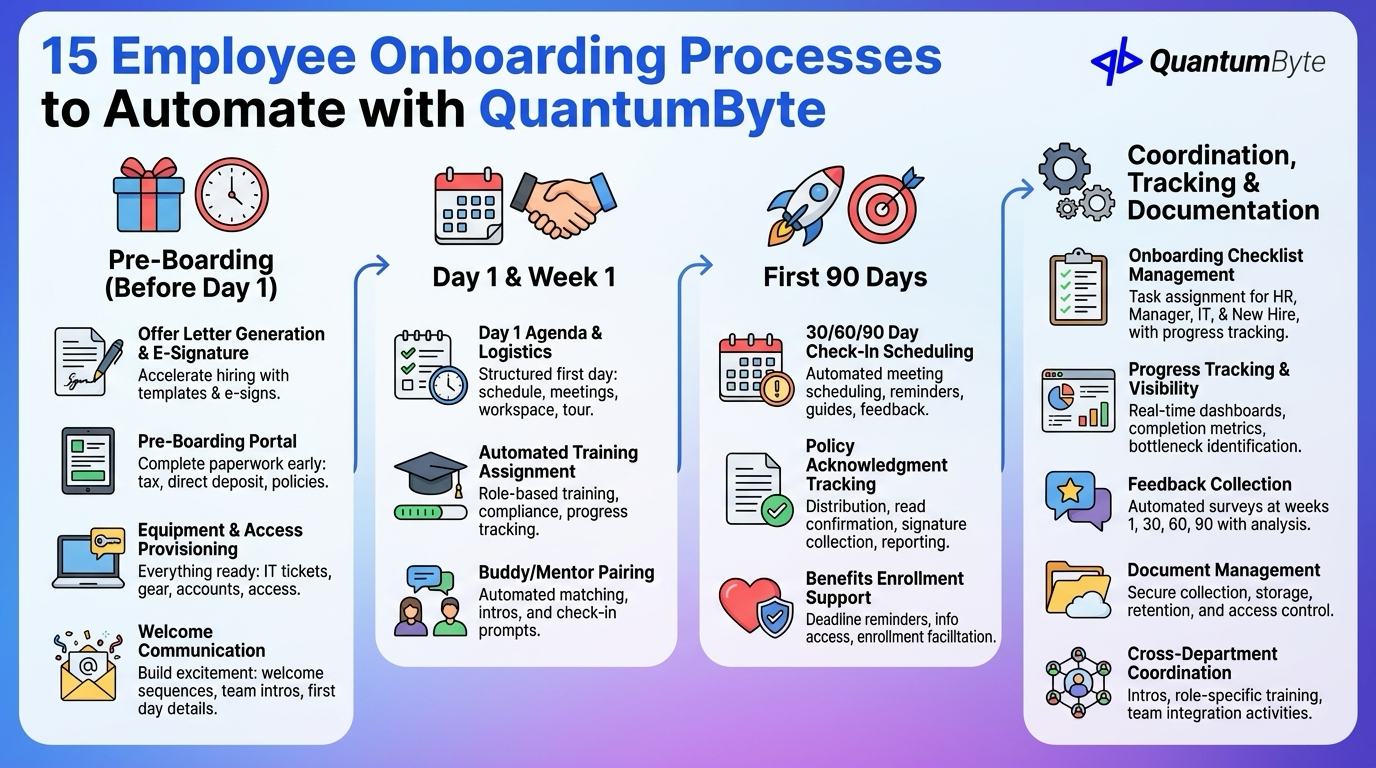
These employee onboarding processes deliver the highest impact when automated:
Pre-Boarding (Before Day 1)
1. Offer Letter Generation and E-Signature - Accelerate the final hiring step with letter generation from templates, compensation population, and e-signature integration.
2. Pre-Boarding Portal - Complete paperwork before arrival: tax forms (W-4, state), direct deposit setup, emergency contacts, policy acknowledgments, and benefits enrollment.
3. Equipment and Access Provisioning - Everything ready when they arrive: IT ticket creation, equipment ordering, account provisioning, building access setup, and software licensing.
4. Welcome Communication - Build excitement with welcome email sequences, manager introductions, team introductions, and first day logistics.
Day 1 and Week 1
5. Day 1 Agenda and Logistics - Structured first day with schedule delivery, meeting setup, workspace assignment, and tour coordination.
6. Automated Training Assignment - Role-based training assignment, compliance training enrollment, progress tracking, and completion verification.
7. Buddy/Mentor Pairing - Automated buddy matching, introduction facilitation, meeting scheduling, and check-in prompts.
First 90 Days
8. 30/60/90 Day Check-In Scheduling - Automated meeting scheduling, reminder delivery, discussion guides, and feedback collection.
9. Policy Acknowledgment Tracking - Policy distribution, read confirmation, signature collection, and audit reporting.
10. Benefits Enrollment Support - Deadline reminders, information access, enrollment facilitation, and confirmation documentation.
Coordination and Tracking
11. Onboarding Checklist Management - Task assignment across HR, Manager, IT, and New Hire with progress tracking and escalation for overdue items.
12. Progress Tracking and Visibility - Real-time progress dashboards, completion metrics, bottleneck identification, and manager visibility.
13. Feedback Collection - Automated surveys at week 1, 30, 60, and 90 days with analysis, trending, and action routing.
Documentation
14. Document Management - Document collection, storage and organization, retention compliance, and access control.
15. Cross-Department Coordination - Department introductions, training scheduling, role-specific orientation, and team integration activities.
Employee Onboarding Software Benefits
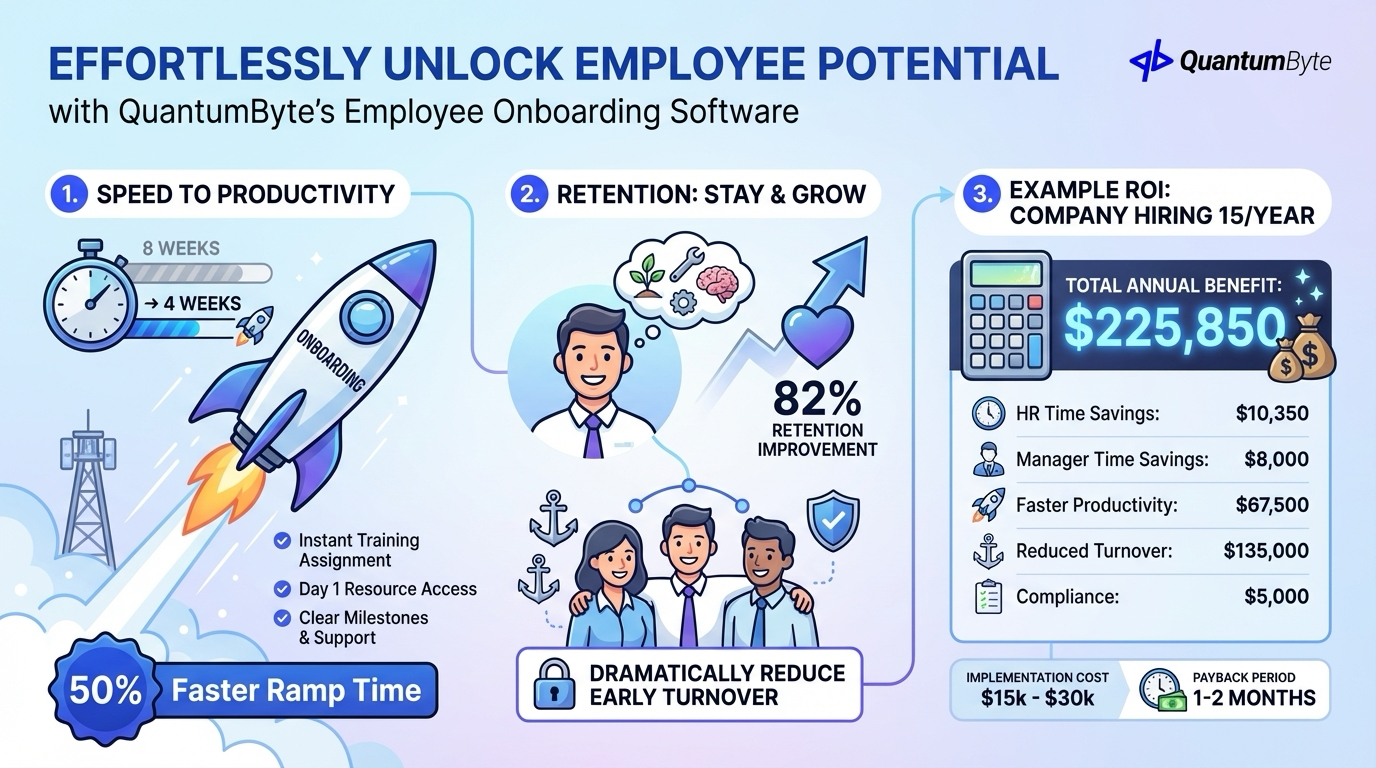
Speed to Productivity: 8 Weeks → 4 Weeks
SHRM shows structured employee onboarding accelerates ramp time by up to 50%:
- Training assigned immediately
- Resources accessible from day 1
- Clear milestones and expectations
- Support systems in place
Value: 4 weeks faster × 15 hires × $1,500/week = $90,000
Retention: 82% Improvement
Strong employee onboarding dramatically reduces early turnover. Strong DM shows organizations with strong onboarding improve new hire retention by 82%.
Preventing 3 early departures: 3 × $45,000 = $135,000
Example ROI: Company Hiring 15/Year
| Benefit Category | Annual Value |
|---|---|
| HR time savings | $10,350 |
| Manager time savings | $8,000 |
| Faster productivity | $67,500 |
| Reduced early turnover | $135,000 |
| Compliance/documentation | $5,000 |
| Total Annual Benefit | $225,850 |
| Implementation Cost | $15,000-30,000 |
| Payback Period | 1-2 months |
Creating an Exceptional Employee Onboarding Journey
The ideal new hire experience:
Pre-Boarding (Week -2 to Day 0)
Automated activities: Welcome email immediately after offer acceptance, pre-boarding portal invitation, paperwork completion prompts, benefits information, first day logistics, and manager introduction.
Human touches: Personal welcome call from manager, team welcome messages, thoughtful first-day preparation.
Day 1 and Week 1
Automated activities: Day 1 agenda delivery, badge/access provisioning, equipment notification, training queue, and welcome messages.
Human touches: Personal greeting, team introductions, workspace tour, lunch with team, manager 1:1.
Months 1-3
Automated activities: 30/60/90-day check-in scheduling, training completion tracking, feedback surveys, milestone recognition, and benefits enrollment reminders.
Human touches: Regular 1:1 meetings, performance feedback, career discussions, and full team integration.
Building Employee Onboarding Software with QuantumByte
QuantumByte develops custom employee onboarding apps that streamline your workflows:
Pre-Built Integrations
HRIS: BambooHR, Workday, SAP SuccessFactors
Communication: Slack, Microsoft Teams, Email
IT Systems: ServiceNow, Jira Service Management
Custom Workflows for Your Unique Process
Every organization has unique employee onboarding requirements: specific culture content, role-based paths, department customization, and values integration. Custom automation accommodates these rather than forcing generic processes.
Mobile-Friendly
- Native mobile apps for iOS and Android
- Responsive design for any device
- Offline capability
- Push notifications
Scalable from 10 to 1,000 Hires/Year
- No per-hire pricing that punishes growth
- Performance designed for scale
- Add capabilities as you need them
Conclusion: Invest in the First 45 Days
Employee onboarding is a strategic investment with measurable returns:
- 82% better retention through great experiences
- 70% faster productivity through structured support
- Reduced costs through consistency and automation
- Stronger culture through intentional integration
Every new hire is an opportunity to build engagement, demonstrate organizational capability, and set someone up for success. Great employee onboarding captures that opportunity.
The path forward:
- Audit your current onboarding: Where are the bottlenecks and inconsistencies?
- Calculate your opportunity: Use the formulas above to quantify potential gains
- Design your ideal journey: What should every new hire experience?
- Build for scale: Choose solutions that grow with you
Ready to transform your employee onboarding? Schedule a consultation to explore your specific automation opportunities.
Other Guides to Explore
- HR Automation Software: Reduce Admin Time and Improve Employee Experience
- Employee Scheduling Software: Optimize Labor Costs and Reduce Conflicts
- Payroll Automation: Reduce Errors and Save Time on Every Pay Run
- How to Automate Business Processes to Increase Revenue in 2025
Frequently Asked Questions (FAQ)
How long should employee onboarding last?
Effective employee onboarding extends beyond the first week. Research suggests 90 days as a minimum, with check-ins continuing through the first year. The most critical period is the first 45 days when turnover risk is highest.
What's the ROI of employee onboarding software?
Most implementations achieve 300-500% ROI. Primary returns come from: reduced early turnover (largest impact), faster productivity, and HR time savings. A company hiring 15 people annually can save $200,000+ through better employee onboarding.
How do I measure employee onboarding effectiveness?
Key metrics: new hire satisfaction (survey at 30/60/90 days), time to productivity (manager assessment), early turnover rate (departures within 90 days), training completion rate, and onboarding completion rate.
Can employee onboarding software work for remote employees?
Yes, arguably it's even more important for remote hires who lack in-person cues. Digital employee onboarding provides structure, self-service resources, virtual connections, and tracked progress that remote employees especially need.