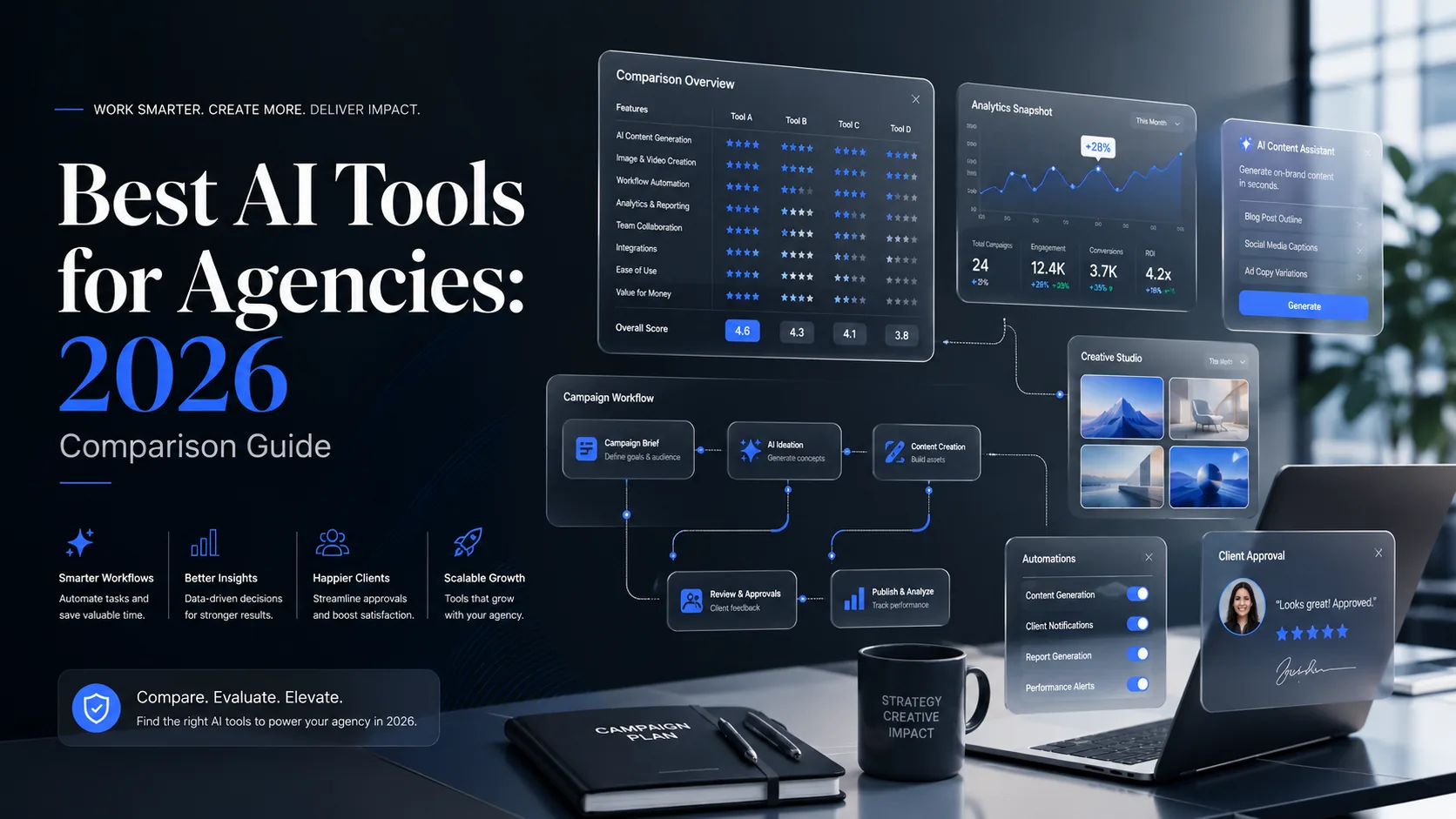
Artificial intelligence has become indispensable for agencies navigating fast-changing client demands and competitive digital landscapes. In 2026, the best AI tools empower agencies to automate operations, personalize customer experiences, and scale creative and analytical output without expanding overhead. Whether you're selecting developer frameworks for custom agent design or exploring no-code platforms for rapid deployment, this guide outlines the technologies reshaping agency workflows—and how to choose what fits your goals best.
Understanding AI Tools for Agencies in 2026
AI tools for agencies are software platforms using artificial intelligence to automate, optimize, or personalize key workflows such as client communication, analytics, and campaign execution. In 2025, the AI agent market reached $7.63B with nearly 50% year-over-year growth, signaling how rapidly automation has become not just useful but essential.
These tools enable what many call agentic AI—systems that handle repetitive work, conduct real-time research, and even manage multi-step campaign coordination autonomously. The gain for agencies is dramatic: more billable strategy time, higher personalization, and consistent client service quality.
Core agency areas now enhanced by AI tools include:
-
Client support and ticket resolution
-
Content creation and creative production
-
Market research and analytics
-
Campaign optimization and reporting
-
Lead qualification and customer engagement
Key AI Tool Categories That Empower Agencies
Agencies can now assemble their AI stacks from four main categories of tools, each supporting different skill levels and integration needs.
| Category | Primary Use Case | Skill Requirements | Integration Capacity |
|---|---|---|---|
| Developer Frameworks | Build multi-agent orchestration and custom workflows | High (technical teams) | Deep and flexible |
| No-Code/Visual SaaS | Rapid prototyping and automation for non-technical users | Low | Broad connector library |
| Enterprise Copilots | Embedded AI for omnichannel operations | Medium | Native to CRM and CX systems |
| Data Retrieval/RAG Specialists | Context-aware content and knowledge automation | Medium | Integrates with data lakes and knowledge bases |
Studies indicate multi-agent orchestration can reduce agency busywork by as much as 75% while tripling qualified lead output. Let's explore each category in turn.
Developer Frameworks for Custom AI Orchestration
Multi-agent orchestration—coordinating multiple AI agents to divide complex tasks into specialized subtasks—has become a hallmark of high-performance automation. Tools like LangGraph, CrewAI, and OpenAI SDKs let developers design directed graph-based workflows with detailed debugging support.
These frameworks offer:
-
Full control and predictability
-
Transparent, testable agent logic
-
Enterprise-grade scalability
| Framework | Notable Capability | Best For |
|---|---|---|
| LangGraph | Directed graph orchestration with time-travel debugging | Complex multi-agent systems |
| CrewAI | Role-based agent design and evaluation tools | Creative and production workflows |
| OpenAI/Claude SDKs | Easy model integration and hosting flexibility | Developers scaling internal copilots |
No-Code and Visual SaaS Platforms
No-code AI platforms allow agencies to design and deploy AI-driven workflows without needing programming skills. They're ideal for small to mid-sized teams needing velocity over custom depth.
Platforms can generate prototype agents in hours rather than weeks, opening AI adoption to all departments. Advantages include rapid testing, drag-and-drop workflow builders, and integrated connectors to CRMs or analytics.
However, agencies should verify data governance policies, as some no-code vendors may use training data for model improvement—an important privacy consideration.
Enterprise Copilots and Platform Agents
Enterprise copilots embed AI directly into productivity ecosystems, offering real-time automation across business tools and channels. They support omnichannel workflows where marketing, sales, and customer success all share insights seamlessly.
Microsoft Copilot Studio, IBM Watsonx, and NiCE are examples of advanced tools connecting deeply with CRM and CX systems. Klarna famously cited an 80% reduction in support time using similar orchestrated agents.
| Copilot | Channel Support | Native Integration | Security Strength |
|---|---|---|---|
| Microsoft Copilot Studio | Email, CRM, Office 365 | Deep | Enterprise-grade |
| IBM Watsonx | CX, Data Science | Moderate | High - model isolation |
| NiCE AI | Omnichannel, CX | Extensive | Proven compliance framework |
Data Retrieval and RAG Specialists
Retrieval-Augmented Generation (RAG) techniques blend large language model creativity with dynamic data retrieval, grounding responses in internal knowledge.
LlamaIndex stands out for supporting complex, knowledge-anchored agent workflows, while OpenRouter simplifies access to various model endpoints.
RAG tools excel in:
-
Automated research and reporting
-
Context-rich question answering
-
Knowledge-base indexing
Common platforms include:
-
LlamaIndex (proprietary & SaaS integrations)
-
OpenRouter (multi-model access)
-
Contextual AI hubs for live data retrieval
How to Choose the Best AI Tools for Your Agency
Choosing the right AI platform depends more on fit than feature lists. Agencies should map their business goals, integration needs, and governance requirements before committing.
Prioritize Use Cases and Business Goals
Start by identifying your top three pain points—perhaps support response time, lead quality, or campaign management. Then align measurable KPIs.
| Agency Use Case | Example Tool Type |
|---|---|
| Support automation | Enterprise copilot |
| Lead qualification | Multi-agent orchestration |
| Campaign optimization | No-code AI builder |
Evaluate Data Access and Integration Needs
Inventory your data systems—CRM, analytics, project management—and check if chosen tools include prebuilt connectors. Self-hosted workflow platforms like n8n offer broad flexibility when combining LLMs with API-based integrations.
Consider Governance, Privacy, and Security
AI governance tools ensure safe, auditable use. Look for built-in privacy options such as disabling model training on your data, role-based access, and transparent audit trails.
Checklist of must-have controls:
-
Model isolation and encryption
-
Human oversight mechanisms
-
GDPR and regulatory compliance verification
Balance Speed to Prototype vs. Custom Control
No-code visual agents deliver results quickly, while frameworks offer deeper, scalable control.
| Agency Type | Recommended Platform | Why |
|---|---|---|
| Startup | No-Code SaaS | Speed to proof-of-value |
| Scaling Agency | Hybrid stack | Mix of agility and customization |
| Enterprise | Developer frameworks | Strong governance and integration depth |
QuantumByte's Unique Approach to AI-Powered Agency Solutions
QuantumByte bridges the gap between generic no-code builders and complex custom systems. Through conversational AI and guided implementation, agencies can describe workflows naturally, and QuantumByte delivers tailored, production-ready applications that align with business context.
| Aspect | Conventional No-Code | QuantumByte |
|---|---|---|
| Who Builds | End users only | Guided by QuantumByte experts |
| Customization Level | Limited templates | Fully bespoke workflow mapping |
| Scalability | Basic tiered plans | Multi-branch, multi-client ready |
| Support | Self-service | End-to-end expert support |
QuantumByte's approach ensures agencies achieve rapid deployment speed without sacrificing deep personalization or governance control.
Building Your AI Tool Stack for Agency Success
A strong AI stack evolves with your agency's growth. Start lean, integrate systematically, and scale modularly.
Starter Tools for Rapid Prototyping and Deployment
Ideal initial combinations include:
-
QuantumByte for tailored conversational agent workflows
-
CrewAI or OpenAI Agents for quick prototypes
-
LlamaIndex for RAG and research automation
-
n8n for workflow orchestration
-
Enterprise copilots for omnichannel support
| Use Case | Recommended Tool |
|---|---|
| Rapid agent testing | CrewAI |
| Data context retrieval | LlamaIndex |
| CRM workflow automation | n8n |
| CX optimization | Copilot Studio |
Integrating AI for Workflow Automation and Customer Experience
AI can now simplify functions like ticket triage or automated insight generation. A sample process might include:
-
QuantumByte builds a client-intake agent.
-
The agent summarizes responses and updates the CRM.
-
Campaign briefs auto-generate and sync to analytics dashboards.
Scaling AI with Multi-Branch and Multi-Client Capabilities
As agencies expand, scalability and isolation matter. The best systems support:
-
Branch-level analytics and permission tiers
-
Data segregation by client account
-
Branded portals with unified governance
QuantumByte's architecture supports these needs natively, enabling secure expansion at agency scale.
Step-by-Step AI Implementation Checklist for Agencies
-
Define 1–3 use cases and measurable KPIs.
-
Map integration needs across data systems.
-
Choose platform type (visual, self-hosted, or custom).
-
Launch a small, controlled pilot.
-
Apply AI governance and compliance checks.
-
Iterate and expand use cases based on outcomes.
Define Priority Use Cases and Set Baselines
Establish pre-AI baselines like TTR, CSAT, or conversion rates.
Map Data Touchpoints and Integrations
Audit CRM, service tools, and data lakes for compatibility.
Choose the Right Architecture and Platform Type
Developer frameworks for control, visual builders for speed, self-hosted tools for privacy.
Launch Pilot Projects with Clear Success Metrics
Define measurable success indicators before scaling system-wide.
Establish AI Governance and Compliance Controls
Include audit logs, human review, and transparent reporting.
Iterate and Expand AI Capabilities
Continuously refine models, expand integrations, and measure ROI.
Maximizing ROI and Business Impact with AI Tools
Responsible AI adoption drives tangible returns—60% of firms in 2026 report improved efficiency and ROI after structured integration.
| Metric | Example KPI | AI Impact |
|---|---|---|
| Operational cost | Cost per project | -30% via automation |
| Client metrics | CSAT, retention | +20% personalization boost |
| Staff efficiency | Billable time | +40% freed strategy hours |
Overcoming Common Challenges in AI Adoption for Agencies
Typical barriers include unclear ownership, staff hesitancy, and integration complexities. Overcome these through:
-
Change management and training programs
-
Phased rollouts with measurable milestones
-
Partnering with expert-supported platforms like QuantumByte
Ultimately, AI should be viewed as augmentation, not replacement—enhancing team creativity and client confidence.
Frequently Asked Questions
What are the essential AI tools every agency should consider in 2026?
Agencies should invest in AI platforms for automation, analytics, and client experience management. QuantumByte's solutions provide adaptable options across these needs.
How can agencies measure the ROI of implementing AI tools?
Track measurable outcomes such as efficiency gains, cost reduction, and client satisfaction before and after implementation.
What steps should agencies take to implement AI responsibly?
Use transparent governance, ensure privacy compliance, and maintain human oversight at every stage.
How can AI improve agency workflows and client outcomes?
AI streamlines operational work and improves personalization, enabling agencies to deliver smarter, faster, and more accurate results.
Can non-technical teams effectively use AI-powered no-code platforms?
Yes. QuantumByte and other modern no-code AI platforms allow non-technical teams to build and deploy intelligent workflows through intuitive interfaces.
Related reading
Agency teams evaluating AI stacks should also compare Best AI Automation Vendors for Scalable Solutions in 2026, Best AI Platforms for Non-Technical Business Users in 2026, and Vibe Coding for Agencies: Workflow Guide. For client-facing systems, the QuantumByte platform can turn repeatable agency workflows into deployable tools.