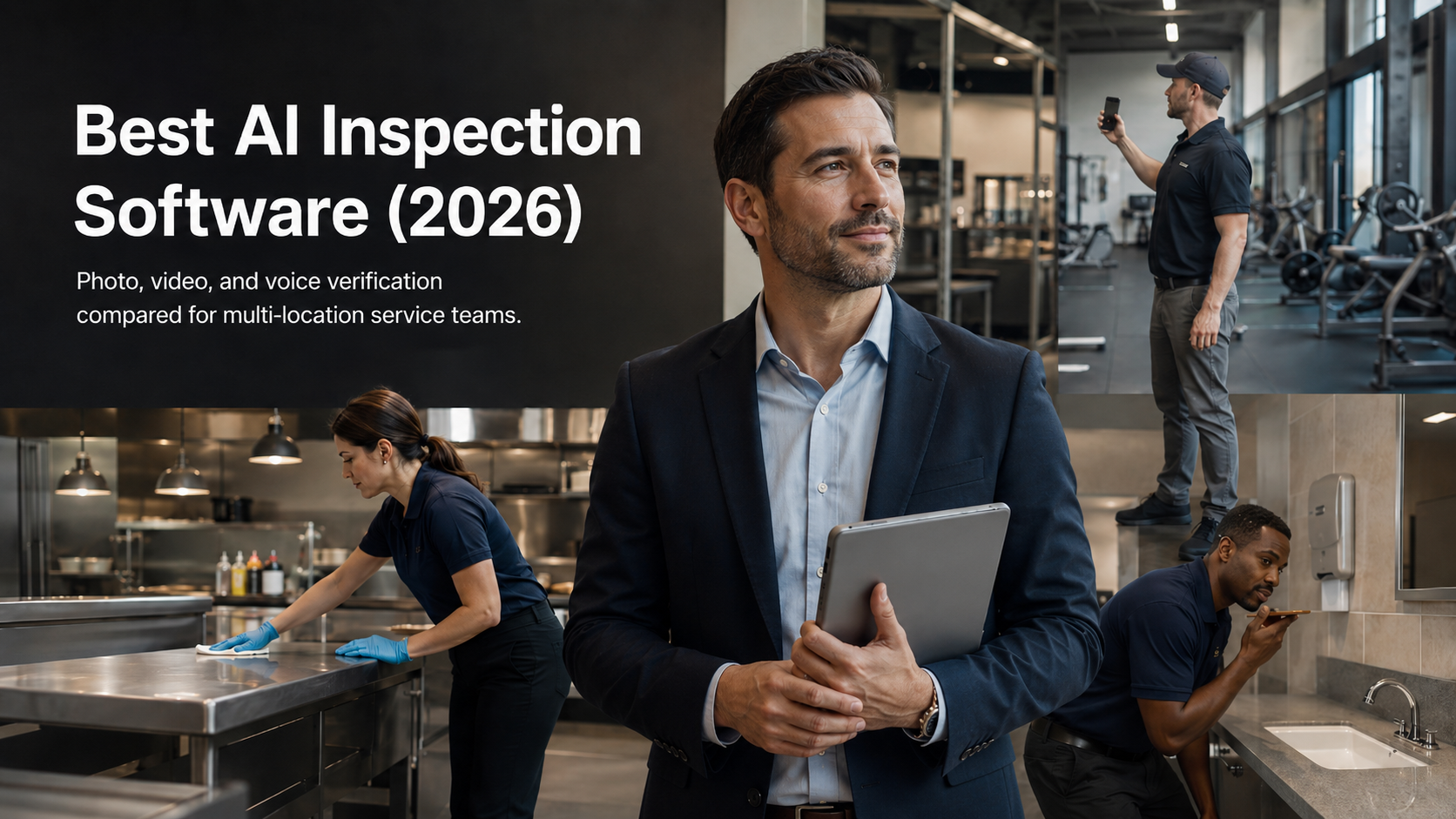
The best AI inspection software for multi-location service businesses uses photo, video, or voice evidence—scored by AI against your standards—to prove field work actually happened correctly. Unlike checkbox apps that simply record "done," these tools analyze submitted evidence and flag problems before customers complain. This guide compares the leading options for restaurants, gyms, cleaning companies, and field service teams.
The market for AI-powered inspection tools is expanding rapidly. According to GlobeNewswire, the global AI visual inspection system market reached approximately $24.1 billion by 2024 and is projected to hit $69.06 billion by 2029. For operations leaders managing 5–100 locations, choosing the right tool means the difference between reactive firefighting and proactive quality control.
Why Checkbox Inspections Fail Multi-Location Operations
Checkbox inspections fail because they verify task completion, not task quality—and human oversight alone cannot catch what matters at scale. When a location manager checks "kitchen cleaned" or "equipment sanitized," you have no proof the work met your standards.
The data confirms this gap. According to iFactory AI, human visual inspection misses 20–30% of defects under real conditions, with accuracy degrading 15–25% after just two hours of continuous observation. Inter-inspector agreement on defect severity sits at only 55–70%.
For a regional operations director overseeing 25 restaurant locations, this means your area managers are likely missing one in four compliance issues during walkthroughs. For a franchise owner with 12 fitness studios, it means daily opening checklists tell you nothing about whether equipment was actually wiped down or floors were properly mopped.
The core problem is accountability without evidence. Your teams check boxes. You assume compliance. Customers experience the reality. By the time complaints reach you, the damage is done—to your brand, your reviews, and your relationship with that customer.
This is why operations leaders are shifting from checkbox audits to AI-powered quality inspections that require visual proof before marking tasks complete.
How AI Inspection Software Verifies Field Work With Photo, Video, and Voice Evidence
AI inspection software verifies field work by requiring teams to submit evidence—photos, videos, or voice notes—that AI then analyzes against predefined standards before accepting the task as complete. This creates an auditable chain of proof that checkbox systems cannot provide.
Photo verification is the most common modality. Field teams capture images of completed work—a cleaned restroom, a stocked shelf, a sanitized prep station. The AI detection tool analyzes the image for specific criteria: Is the floor visibly clean? Are required items present? Does the photo match the expected location via metadata?
Video verification adds temporal context. A 15-second walkthrough of a gym floor shows equipment placement, cleanliness, and overall condition in ways a single photo cannot. Video is particularly valuable for inspections where sequence matters—like verifying a cleaning crew worked through an entire facility rather than spot-cleaning visible areas.
Voice verification enables hands-free documentation. Technicians completing HVAC repairs or cleaners working through a checklist can narrate their progress. AI transcribes and analyzes the content, flagging incomplete descriptions or missing steps.
The key distinction is scoring versus storage. Many apps let teams upload photos, but the images simply sit in a folder. AI inspection software actively evaluates submissions, generating pass/fail scores or flagging anomalies for manager review. According to iFactory AI, AI vision systems achieve 95–99% detection accuracy compared to an approximately 85% ceiling for rule-based systems.
For service businesses, this means catching a poorly cleaned location before the customer posts a one-star review—not after.
Best AI Inspection Software Compared: Features, Pricing, and Use Cases
Choosing the right AI inspection software depends on your industry, team size, and how much you need the AI to actively evaluate evidence versus simply store it. Below is an honest comparison of the leading tools for multi-location service operations.
| Software | AI Evidence Scoring | Photo/Video/Voice | WhatsApp Submission | Starting Price | Best For |
|---|---|---|---|---|---|
| SafetyCulture (iAuditor) | Limited (templates + analytics) | Photo, limited video | No | $24/user/mo | Large teams needing audit templates |
| GoAudits | No (checklist-based) | Photo | No | ~$20/user/mo | Basic audit documentation |
| Xenia | No (task management focus) | Photo | No | Free tier available | Facility task tracking |
| Operandio | No (SOP-focused) | Photo | No | Custom pricing | Training + SOP compliance |
| Jolt | No (checklist-based) | Photo | No | Custom pricing | Restaurant checklists |
| QuantumByte | Yes (AI scores against HQ standards) | Photo, video, voice | Yes | Free / $29/mo Pro | Multi-location evidence verification |
SafetyCulture (iAuditor)
SafetyCulture is the most established name in inspection software, offering extensive template libraries and analytics dashboards. According to Capterra, SafetyCulture's Premium plan starts at $24 per user per month (billed annually), which falls below the average SMB spend of $50–$100 per user per month on maintenance management tools.
The platform excels at structured audits with photo capture and corrective action workflows. However, its AI capabilities focus on analytics and reporting rather than real-time evidence scoring. Photos are stored and organized, but the system does not actively evaluate whether a submitted image meets your quality standards.
Best for: Large organizations with dedicated compliance teams who need robust audit trails and template libraries.
GoAudits
GoAudits provides straightforward checklist-based inspections with photo documentation. The interface is clean and adoption is typically fast for non-technical teams.
The platform lacks AI evidence scoring—photos serve as documentation rather than verification. Pricing starts around $20 per user per month, making it accessible for smaller operations.
Best for: Teams transitioning from paper checklists who need basic digital documentation without complex features.
Xenia
Xenia positions itself as a facility and team management platform with inspection capabilities built in. The free tier makes it attractive for budget-conscious operators, and the task management features help coordinate work across locations.
Photo capture is available, but AI scoring is not a core feature. The platform is stronger for task assignment and tracking than for evidence-based quality verification.
Best for: Operations teams who need combined task management and basic inspection documentation. Those evaluating broader operations platforms may also want to compare Jobber vs Housecall Pro for field service needs.
Operandio
Operandio focuses on standard operating procedures and training compliance. The platform helps ensure teams know what to do and can demonstrate they followed procedures.
Photo documentation supports SOP verification, but the system does not use AI to score evidence quality. Pricing is custom-quoted based on organization size.
Best for: Organizations prioritizing training documentation and SOP adherence alongside inspections.
Jolt
Jolt is widely used in restaurants for digital checklists, temperature logging, and task management. The platform replaces paper logs and provides accountability for task completion.
Photo capture is available for documentation, but Jolt does not offer AI-powered evidence scoring. The system verifies that someone submitted a photo, not that the photo demonstrates acceptable work quality.
Best for: Restaurants and food service operations needing digital checklists and temperature compliance logs.
QuantumByte
QuantumByte takes a different approach: custom AI apps that score submitted evidence against your specific standards. Field teams submit photos, videos, or voice notes—including via WhatsApp—and AI evaluates whether the work meets HQ requirements before marking tasks complete.
The differentiator is active verification rather than passive storage. When a cleaner submits a photo of a finished restroom, the AI assesses whether it actually looks clean according to your criteria. When a technician records a voice note describing completed repairs, the system checks for required steps.
Pricing: Free tier available, Prototype at $6/month, Pro at $29/month, Enterprise by contact.
Best for: Multi-location service businesses—restaurants, gyms, cleaning companies, field service—who need proof that work meets standards, not just proof that someone checked a box.
Which AI Inspection Tool Fits Your Industry: Restaurants, Gyms, Cleaning, and Field Service
The right AI inspection tool depends on your industry's specific verification needs and how your teams work in the field.
Restaurants and food service require temperature logging, food safety compliance, and cleanliness verification across prep areas, dining rooms, and restrooms. Jolt handles the checklist and temperature logging well. For operations leaders who need visual proof that cleaning actually happened to standard, QuantumByte's AI scoring adds a verification layer that checklist tools lack.
Gyms and fitness studios need daily equipment checks, facility cleanliness verification, and opening/closing procedure compliance. Xenia's task management works for coordination, but franchise owners wanting to hold location managers accountable with visual proof benefit from AI evidence scoring that flags substandard submissions before members complain.
Cleaning companies face a unique challenge: crews work unsupervised at client sites, and quality issues surface only when clients complain. An AI photo verification system that evaluates job-completion photos before the crew leaves—and flags problems for review—prevents complaints rather than reacting to them. QuantumByte's WhatsApp submission channel reduces adoption friction for non-technical cleaning crews. For related workflow considerations, see this HVAC dispatch software implementation guide.
Field service and trades need verification that technicians completed work correctly at customer sites. Photo documentation proves presence; AI scoring proves quality. Operations managing equipment rentals and fleet inspections or auto repair shops benefit from tools that verify work quality, not just work completion.
According to SnapInspect, approximately 21% of property managers already use AI, with another 28% planning to adopt it. Service businesses across verticals are following the same trajectory.
What to Look for in an AI Photo Verification and Quality Inspection App
The most important feature in an AI photo verification app is whether it actively scores evidence or simply stores it—this single distinction separates tools that catch problems from tools that document them after the fact.
Evidence scoring vs. evidence storage: Ask whether the AI evaluates submitted photos against your standards or just organizes them in folders. Storage helps with disputes after complaints. Scoring prevents complaints.
Multi-modal support: Can teams submit photos, video, and voice? Different tasks require different evidence types. A 15-second video walkthrough reveals more than a single photo.
Submission flexibility: Will your teams actually use it? WhatsApp submission eliminates app downloads and training for non-technical crews. Dedicated apps offer more features but create adoption friction.
Custom standards: Can you define what "acceptable" looks like for your operation? Generic AI models help, but the ability to train scoring against your specific requirements—your brand standards, your cleanliness criteria—delivers more relevant results.
Pricing transparency: According to QuoteIQ, AI inspection software pricing in 2026 ranges from free tiers through $50/month budget options to $109/month for premium tools. Understand per-user vs. flat-rate pricing and how costs scale with your team size.
Integration with operations workflows: Inspection data is most valuable when it connects to your broader operations. Consider how the tool integrates with scheduling, dispatch, and billing verification workflows.
According to Körber (citing Gartner), over 50% of manufacturing companies will have integrated AI into quality control by 2025, with a 30% improvement in defect detection rates. Service businesses adopting similar AI verification tools can expect comparable gains in catching issues before they reach customers.
Stop Chasing Complaints—Start Catching Problems Before Customers Do
The shift from checkbox inspections to AI-verified evidence changes how multi-location operations work. Instead of assuming compliance and reacting to complaints, you verify quality in real time and address issues before customers notice.
According to Checkfirst, companies using AI inspection scheduling typically experience a 35 percentage-point increase in resource utilization and a 20–25% decrease in travel expenses, with payback periods of 3–6 months. The ROI comes from preventing problems, not just documenting them.
For operations leaders managing restaurants, gyms, cleaning companies, or field service teams across multiple locations, the question is no longer whether to adopt AI inspection software. The question is whether you want a tool that stores evidence or one that scores it.
QuantumByte builds custom AI apps that let field teams submit photos, video, and voice evidence—including via WhatsApp—while AI scores submissions against your HQ standards. The result is proof that work meets your requirements, not just proof that someone checked a box.
Ready to see how AI evidence scoring works for your operation? Explore QuantumByte Enterprise for multi-location service businesses.
Frequently Asked Questions
What is AI inspection software and how does it work?
AI inspection software uses artificial intelligence to analyze evidence—photos, videos, or voice recordings—submitted by field teams and evaluate whether completed work meets predefined quality standards. Unlike traditional checklist apps that simply record task completion, AI inspection tools actively score submissions, flag anomalies, and alert managers to potential issues before they become customer complaints.
What's the difference between AI inspection software that scores evidence versus software that just stores photos?
Software that stores photos creates documentation you can reference after a complaint. Software that scores evidence uses AI to evaluate each submission against your standards in real time, flagging substandard work before customers notice. The difference is reactive documentation versus proactive quality control—catching a dirty restroom before the review, not after.
Can field teams submit inspection evidence via WhatsApp or mobile without a dedicated app?
Yes, some AI inspection platforms like QuantumByte support WhatsApp submission, allowing field teams to send photos, videos, or voice notes directly without downloading a dedicated app. This reduces adoption friction significantly for non-technical crews like cleaners or technicians who resist installing new software on personal devices.
What should multi-location service businesses look for in AI inspection software?
Multi-location service businesses should prioritize AI evidence scoring over simple storage, multi-modal support for photos and video and voice, submission flexibility including WhatsApp, customizable quality standards matching your brand requirements, transparent pricing that scales with team size, and integration capabilities with existing operations workflows.
Is there free AI inspection software for small multi-location operations?
Yes, several options offer free tiers. Xenia provides a free plan for basic facility management. QuantumByte offers a Free tier for teams starting with AI evidence verification. According to QuoteIQ, Inspector Toolbelt also offers free starter access for limited inspections. Evaluate whether free tiers include AI scoring or just photo storage.
How does AI photo and video verification reduce compliance failures across locations?
AI photo and video verification reduces compliance failures by requiring visual proof of completed work and automatically evaluating that proof against your standards. Instead of trusting checkbox confirmations, managers receive AI-scored evidence showing whether each location actually met requirements—catching the 20–30% of issues that human inspection typically misses.
Which AI inspection software works best for restaurants, gyms, and field-service teams?
Restaurants often use Jolt for checklists and temperature logging, though it lacks AI scoring. Gyms benefit from Xenia's task management or QuantumByte's evidence verification. Field-service teams need photo proof of completed work—QuantumByte's AI scoring and WhatsApp submission fit crews working at customer sites. SafetyCulture suits larger organizations with dedicated compliance teams.