
If you have been searching for the vibe coder meaning, here is the clean definition: a vibe coder builds software by describing what they want in plain English and letting an AI write most of the code, often without reading every line. It is fast, creative, and dangerous if you ship it like a real product without guardrails.
Vibe coder meaning
A "vibe coder" is someone who uses AI as the primary way to create software, leaning on prompts instead of manual coding.
In practice, vibe coding looks like this:
-
Describe outcomes, not implementation: You say "add a checkout page with Stripe and email receipts" instead of writing the full code yourself.
-
Iterate by feel and behavior: You run the app, notice what feels off, then ask the AI to change it.
-
Skip full code review: The focus is speed and momentum, not deep understanding.
IBM summarizes vibe coding as prompting AI tools to generate code rather than writing it manually, and notes that AI-generated code is often skipped in traditional review processes in real teams.
Where the term came from (and why it caught on)
The term "vibe coding" was popularized by Andrej Karpathy and spread quickly because it names something many builders were already doing: using a Large Language Model (LLM) to translate intent into working code.
Simon Willison captures the sharpest version of the idea: vibe coding is building software with an LLM without reviewing what it writes. That framing matters, because it draws a line between "AI-assisted development" and "I shipped it because the demo worked once."
Vibe coding vs software development
Vibe coding can produce value quickly, but it is not a replacement for professional engineering discipline.
| Topic | Vibe coding | Production software development |
|---|---|---|
| Primary goal | Move fast and get a working result | Ship reliably, securely, and maintainably |
| How changes happen | Prompt → accept output → run app | Design → implement → review → test → deploy |
| Quality control | Light, often manual spot checks | Repeatable tests, code review, security checks |
| Best fit | Prototypes, experiments, internal tools | Customer-facing apps, regulated workflows, long-term systems |
| Main risk | Hidden bugs, security holes, fragile logic | Slower at first, but stable and scalable |
A helpful mental model: vibe coding is a great way to discover the product. Engineering is how you keep it alive.
When vibe coding is a smart move for founders
If you are a business owner or solopreneur, vibe coding is most useful when you are trying to buy speed and clarity.
Common high-leverage use cases:
-
Idea validation: You can turn "I think this could work" into a clickable prototype and get real feedback before you spend months building.
-
Internal automation: You can prototype a lightweight tool for intake, quoting, scheduling, and reporting before you commit to a full build. (If this is your goal, start with a clear workflow map. This pairs well with guides like automate business processes.)
-
Sales demos: A working demo beats a slide deck. Vibe coding helps you show the "before and after" of your offer.
-
Productizing a service: If you deliver a repeatable service, vibe coding can help you prototype the software layer that makes it scalable.
If you already know you want an "idea to app" workflow, it helps to understand what an AI app builder is doing behind the scenes. This breakdown is a good baseline: how an AI app builder works.
The real risks
Vibe coding fails in predictable ways. It often looks fine until it is in front of customers.
-
Security blind spots: AI can generate code that "works" but quietly mishandles authentication, authorization, secrets, or input validation.
-
Brittle behavior: A small change in one place can break something else because the code structure was generated without a clean architecture.
-
Data and privacy mistakes: It is easy to log sensitive data, store it incorrectly, or build flows that violate your own privacy promises.
-
No ownership of the system: If you cannot explain the system, you cannot debug it quickly under pressure.
-
Hidden maintenance cost: What is fast today can turn into slow, expensive changes later.
IBM explicitly warns that AI-generated code is often excluded from code reviews and security checks, which can lead to vulnerabilities going unnoticed.
A responsible vibe coding workflow you can actually follow
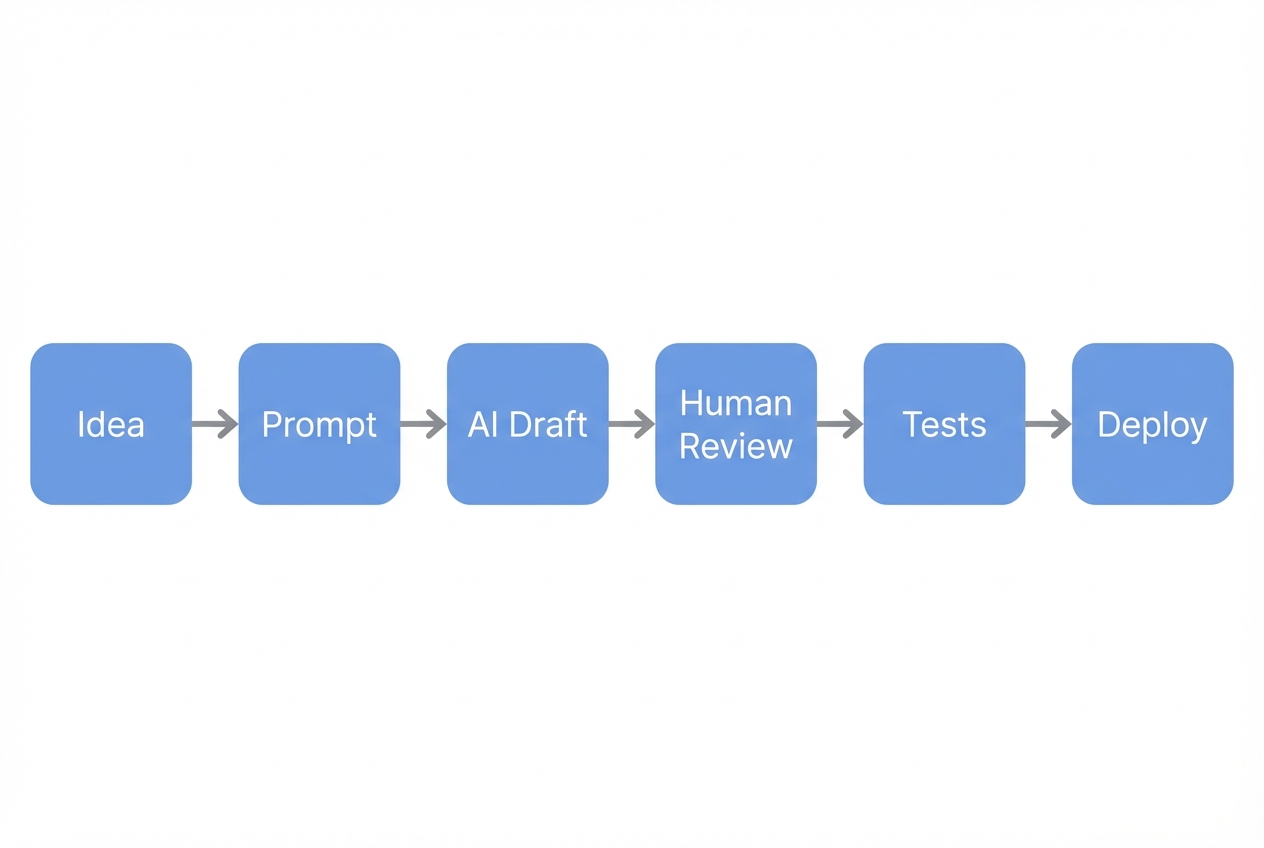
You do not need to abandon speed to avoid chaos. You need a tighter loop.
1) Start with constraints, not features
Before you prompt the AI, write a short "operating box" for your app:
-
Who it is for: Name the user type and what they are trying to accomplish.
-
What data you store: List the key fields and where they live.
-
What must never happen: Examples include "users can see other users’ data" or "payment status can be edited manually."
2) Prompt for an architecture plan first
Ask for a plan before asking for code. This keeps the AI from inventing a spaghetti structure.
-
Modules: Request a backend, database layer, and frontend boundaries.
-
API design: API means Application Programming Interface. It is the contract between parts of your app.
-
Error handling: Require clear error messages and fallback behavior.
3) Generate the smallest working slice
Build one thin workflow end-to-end. Example: "create account → create record → view record."
-
Keep scope small: Smaller scope makes it easier to verify.
-
Lock down permissions early: Basic authorization should exist from day one.
4) Add tests that match your real business risk
Even simple tests raise your floor.
-
Smoke tests: Confirm key pages load and core actions work.
-
Access tests: Confirm users cannot access each other’s data.
-
Input tests: Confirm forms reject bad or unsafe inputs.
5) Review before you ship
You can vibe code the draft, but shipping without review is where most pain starts.
-
Read the diffs: At minimum, scan what changed and why.
-
Run a security pass: Look for exposed keys, unsafe queries, and missing authorization.
-
Document the system: A short README saves you later.
If you are deciding between building, buying, or hybrid approaches, this framework helps you set expectations early: custom business software development: build vs buy.
Prompt patterns that produce better results
Most vibe coding frustration is prompt ambiguity. Fix the prompt, and the output improves.
Use these patterns as templates.
-
Plan-first prompting: Ask for a step-by-step plan first, wait, then ask for code. This reduces random architecture.
-
Options with tradeoffs: Request 2 to 3 approaches and ask the AI to compare them for speed, security, and maintenance.
-
Acceptance criteria: Define what "done" means in testable terms (inputs, outputs, edge cases).
-
Maintainability explanation: Require a short explanation of how the code works and where to change things later.
Example prompt you can copy:
- "Propose an architecture for a simple customer portal (login, dashboard, invoices). Include data model, API routes, and permission rules."
- "Now implement only login and the dashboard skeleton. Add tests for: unauthenticated access, wrong password, user sees only their data."
- "List the top 10 security issues in this codebase and fix the top 3."
Tooling options: chat, agents, and AI app builders
There is a spectrum here. The tool you pick should match the stakes.
-
Chat-based coding: Great for learning and small scripts. Risk rises when you turn it into an app with users.
-
Agent-based builders: Tools that plan and execute multi-step changes can move faster, but they can also make larger mistakes faster.
-
AI app builders: These aim to turn plain language into structured app pieces, which can reduce chaos for non-engineers.
Replit describes vibe coding as instructing AI agents using natural language prompts, and points to Replit Agent as an example workflow.
If your real goal is "I want an app that matches my business, without hiring a full team," an AI app builder approach is often a better fit than raw prompting. QuantumByte is built for that path: you describe what you need, generate a prototype fast, then you can bring in expert developers when you hit the hard parts that AI cannot reliably finish.
This is also where the "hiring vs tools" decision becomes practical instead of philosophical. Use this comparison to pressure-test your plan: hiring a developer vs no-code.
Turning a vibe prototype into a real product (without losing momentum)
Most founders get stuck here. The prototype proves value, but shipping requires reliability.
A clean handoff looks like this:
-
Freeze the scope: Lock the "version 1" workflows before you add more features.
-
Write down key business rules: Pricing rules, permissions, refund logic, notifications. These should not live only in prompts.
-
Add observability: Basic logging and error monitoring so you can see failures fast.
-
Harden the edges: Auth, rate limits, backups, data migration, and permission checks.
If you want a structured way to move from idea → spec → prototype, QuantumByte's pricing guide is designed for exactly that. Start here when you are ready to turn vibes into a build plan.
Once you have a working prototype, you can also take a hybrid route: keep building quickly with AI where it is safe, then use a professional team to lock down security, performance, and maintainability. That is the moment where QuantumByte’s in-house development team tends to pay for itself.
Key takeaways for builders
Vibe coder meaning, in one line: you are prompting software into existence, prioritizing speed and iteration over deep code ownership.
What this article covered:
-
What vibe coding is: A prompt-first approach to building, often with limited code review.
-
Why it is useful: It helps you prototype, validate offers, and build internal tools faster.
-
Where it breaks: Security, maintainability, and reliability become problems when you ship without guardrails.
-
How to do it responsibly: Use constraints, generate a plan first, add tests, and review before release.
-
How to graduate to production: Document business rules, harden the system, and consider a hybrid path when stakes rise.
If your next step is building something customers will rely on, start with a structured prototype and a clear spec. You will move faster and sleep better.
Frequently Asked Questions
Is vibe coding the same as using AI autocomplete?
No. Autocomplete helps you write code faster, but you still drive the architecture and review what gets committed. Vibe coding usually means the AI writes large chunks and you judge the result by running it, not by reading every line.
Can a non-technical founder be a vibe coder?
Yes. In fact, many vibe coders are founders who know the business problem deeply and use AI to get to a working prototype. The key is adding guardrails before you ship anything customer-critical.
Is vibe coding safe for production apps?
It can be, but only if you add real engineering checks: code review, testing, security validation, and monitoring. The "ship it because it runs" version of vibe coding is not a safe production strategy.
What is the fastest way to turn a vibe-coded prototype into a real SaaS?
Treat the prototype as discovery, then convert it into a build plan: define workflows, data models, and business rules, then harden security and reliability. If you want a guided path, start here to turn an idea into structured documentation that AI can build from.
How do I know when to stop vibe coding and bring in developers?
Bring in developers when any of these become true: you handle payments, store sensitive customer data, have multiple user roles, need integrations you cannot afford to break, or your app is becoming hard to change without new bugs. That is the point where professional engineering discipline protects your momentum.