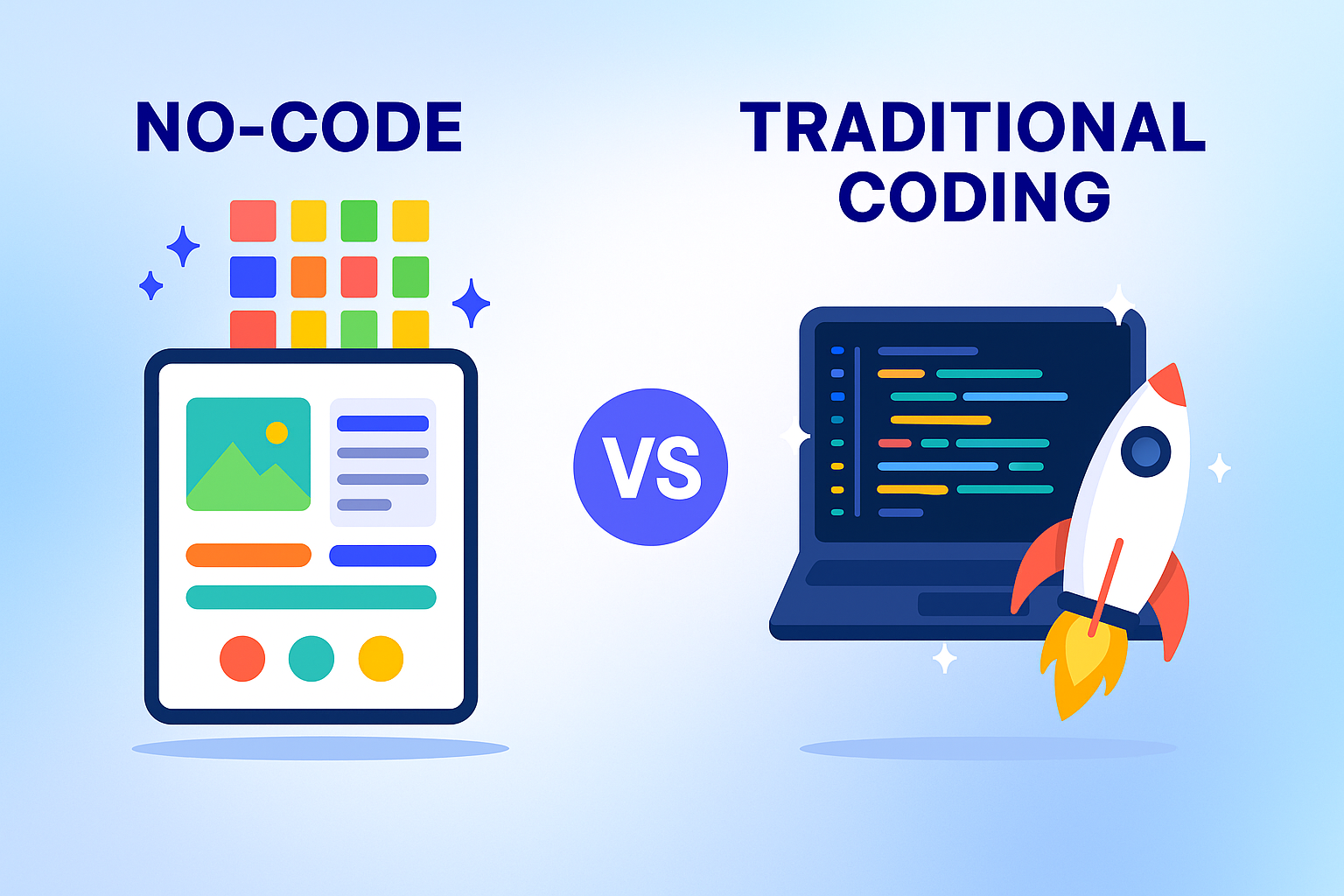
You know the power of a great idea. But bringing that idea to life as a digital product often hits a wall. "Do I need to learn to code? Or is there another way?"
The choice between traditional coding and no-code platforms can feel daunting. Conflicting advice everywhere. Steep learning curves on both paths.
This guide cuts through the noise. It offers a clear comparison of no-code vs traditional coding. You'll confidently choose the best development path. You can launch your next digital product. You can turn your expertise into products. You can scale your income. You'll understand the nuances of no-code vs traditional coding in 2025.
No-Code vs. Traditional Coding: Understanding the Core Differences
The debate around no-code vs traditional coding centers on control versus accessibility.
Traditional coding offers ultimate flexibility. But it demands deep technical skill. It takes significant time. No-code hides the complexities of programming. It makes app development accessible to more people.
Understanding these core definitions is crucial. Any entrepreneur weighing options needs this knowledge. This section breaks down what each approach involves. It explains their underlying philosophy.
| Feature | Traditional Coding | No-Code |
|---|---|---|
| Core Method | Manual writing of code using programming languages (Python, Java, Java Script, C++). | Visual development using pre-built components, drag-and-drop interfaces, or conversational AI. |
| Skill Required | Deep programming knowledge, understanding of syntax, data structures, algorithms. | Business logic understanding, design sense, ability to articulate needs; no coding required. |
| Output | Custom, highly optimized, and unique source code. | Functional application built within a platform's ecosystem, often generating underlying code automatically. |
| Control Level | Full, granular control over every aspect of the application's behavior and appearance. | High control over features and design within the platform's capabilities; less direct control over underlying code. |
The table above shows the foundational differences. Traditional coding builds from the ground up. No-code assembles and configures.
Traditional Coding: The Custom Build Approach
Traditional coding means writing instructions line-by-line. You use specific languages. Python. JavaScript. Java. Developers use special tools (IDEs) and frameworks. They build applications from scratch.
This custom development allows for amazing precision. You get unique features. But it's a craft. It requires years of learning. It needs continuous practice to master. The result is a custom solution. It's tailored to exact specifications.
No-Code: The Visual & Conversational Revolution
No-code is an approach to app building. You create apps without writing any code.
It usually uses visual builders. You drag and drop pre-built elements. You configure them through simple interfaces. The latest evolution is conversational AI app building. You describe your app idea in natural language. The AI builds it for you.
This revolution opens app creation to everyone. Entrepreneurs can bring their ideas to life. Non-technical people can build. It removes the steep technical barrier. You focus on business logic and user experience instead.
Speed & Time-to-Market: Launching Your Idea Faster
For entrepreneurs, speed is everything. Validate an idea faster? You can adapt or scale quicker.
This section compares the time needed for no-code vs traditional coding. Time-to-market can mean the difference between success and failure. Understanding how each approach impacts your timeline is crucial for rapid MVP development.
| Stage | Traditional Coding (Est. Time) | No-Code (Est. Time) |
|---|---|---|
| Idea & Planning | 1-4 weeks | 1-3 days |
| Design (UI/UX) | 2-6 weeks | 3-7 days |
| Development (MVP) | 8-24 weeks | 1-4 weeks |
| Testing & Iteration | 4-8 weeks | 3-10 days |
| Deployment | 1-2 weeks | 1-3 days |
| Total (MVP) | 16-41 weeks | 2-7 weeks |
The contrast in timelines is stark. No-code cuts the development cycle significantly. You get quicker market entry. You get faster validation. This speed is a game-changer for entrepreneurs.
No-Code: From Idea to App in Days (or Minutes)
No-code cuts development time drastically. This is especially true with advanced AI. You can go from a raw concept to a working prototype fast. Much faster than traditional methods.
This rapid prototyping is invaluable. You can test market demand. You can gather user feedback quickly. Visual no-code platforms already cut development time. But the next evolution—conversational AI app building—offers even more speed.
Conversational AI platforms let you describe your app idea in natural language. The AI generates a working app in minutes. Not weeks. Learn more about conversational AI app development and explore the pros and cons of no-code platforms. This opens software creation to everyone. It unlocks the power of no-code for true agile iteration.
Traditional Coding: The Iterative & Resource-Intensive Journey
Traditional coding involves a longer journey. It's more iterative. Each stage takes significant time. Planning. Design. Development. Testing. You often need specialized teams.
Development cycles can span months. Even for an MVP. Writing custom code is complex. This means longer time-to-market. This journey needs patience. It needs substantial investment.
Cost & Resources: Budgeting Your Entrepreneurial Venture
Budget is often the biggest constraint for entrepreneurs. The money side of choosing between no-code and traditional coding is huge. It impacts everything. Initial investment. Long-term maintenance.
This section gives you a clear cost comparison. You'll see where your money goes with each approach. Understanding these costs helps you make an informed decision about your development budget. You'll also see how no-code opens access by cutting financial barriers.
| Cost Factor | Traditional Coding | No-Code |
|---|---|---|
| Initial Development | High (Developer salaries, infrastructure setup, custom design). | Low to Moderate (Platform subscription, potentially template purchase). |
| Developer Salaries | Very High (Full-time or contract developers, average developer salaries [EXTERNAL-LINK-PLACEHOLDER: Average developer salaries] are significant). | None (You are the developer) or very low (hiring a no-code specialist). |
| Maintenance & Updates | High (Ongoing developer time for bug fixes, feature additions, security patches). | Low to Moderate (Platform handles infrastructure, updates included in subscription, minor configuration changes from you). |
| Hosting/Infrastructure | Moderate to High (Servers, databases, cloud services, Dev Ops). | Low (Included in platform subscription). |
| Scalability Costs | Variable, can be high (Infrastructure upgrades, more developers). | Variable, often moderate (Higher tier subscriptions, add-ons). |
| Total Cost (Year 1) | Tens to hundreds of thousands of dollars. | Hundreds to a few thousand dollars. |
The table shows this clearly. The cost difference is huge. No-code is a much more affordable entry point for app development.
The Financial Advantage of No-Code Platforms
No-code platforms offer a big financial advantage. Instead of huge upfront costs, you pay a manageable monthly or annual subscription. You don't need expensive developer salaries. You can turn your expertise into products without massive spending.
AI-powered tools cut development costs significantly. They eliminate the need for expensive developers. This makes app creation accessible to entrepreneurs and small businesses. Every dollar counts. Software creation is now open to everyone.
Understanding Traditional Coding's Investment
Traditional coding requires a big investment. Mostly in people. Developer salaries. Project managers. Quality assurance specialists. All of this adds to high overhead.
Beyond salaries, there are more costs. Infrastructure. Specialized tools. Ongoing maintenance. Long-term maintenance is expensive. Bug fixes. Security updates. Feature enhancements. You need continuous financial commitment.
This approach needs a strong budget. You must be willing to invest heavily over time. This often puts software creation out of reach for many.
Flexibility & Scalability: Adapting Your Digital Product
Entrepreneurs need their digital products to adapt and grow. This section looks at flexibility and scalability. No-code vs traditional coding.
It addresses common concerns about no-code limits. It shows how much customization each approach offers. Modern no-code platforms are evolving. But you need to understand their boundaries compared to raw code. This is essential for long-term planning.
| Aspect | Traditional Coding | No-Code |
|---|---|---|
| Customization Depth | Unlimited; any feature or design can be built from scratch. | High within platform's framework; limited by available components/integrations. |
| Integration Capabilities | Unlimited; can integrate with any API or custom system. | High; usually offers native integrations and custom API connectors. |
| Performance Optimization | Full control over code for maximum speed and efficiency. | Relies on platform's optimization; generally good, but less granular control. |
| Database Flexibility | Full control over database design and management. | Utilizes platform's database structure; often flexible but abstracted. |
| Scalability Potential | Unlimited, but requires significant infrastructure and Dev Ops effort. | High, typically handled by platform; may have tier-based limits. |
| Vendor Lock-in | Minimal (code is portable), but specific frameworks can create dependencies. | Moderate to High (application lives within the platform's ecosystem). |
The matrix above clarifies the trade-offs. Traditional coding offers ultimate control. No-code provides strong capabilities within its structured environment.
No-Code's Evolving Customization & Integration Capabilities
Modern no-code platforms are far more powerful than older ones. They offer extensive customization through visual editors. They can integrate with thousands of external services via APIs.
This allows for complex workflows and data exchanges. No-code apps aren't limited to simple templates anymore. The platform's scalability is often handled by the vendor. This removes the burden of infrastructure management from you.
While not "unlimited" like custom code, the capabilities are often more than enough for a growing business.
Traditional Coding: Unrestricted Control, Complex Management
Traditional coding gives you unrestricted control. Every single line of code. Every aspect of the app. This power allows for highly specialized features. Unique algorithms. Custom user experiences.
But this control comes with complex management. You must manage infrastructure. Deployment pipelines. Security. Technical debt. While theoretically infinite, the practical flexibility of custom code is often limited. You're limited by the resources available to manage its complexity.
Learning Curve & Accessibility: Empowering the Non-Technical Entrepreneur
The biggest barrier for many entrepreneurs is simple. They think they need technical skills.
This section contrasts the learning curve of programming with no-code accessibility. It focuses on empowering people without a technical background. It shows how different approaches enable different types of creators.
Many promising ideas fail. Why? Slow execution caused by a steep learning curve. The emphasis here is on how accessible app building is becoming.
| Factor | Traditional Coding | No-Code |
|---|---|---|
| Required Skill Set | Computer science, programming logic, specific language syntax, problem-solving. | Business acumen, design thinking, logical flow, ability to articulate ideas. |
| Time to Proficiency | Months to years | Days to weeks |
| Barrier to Entry | Very High (Formal education, self-study, significant practice). | Very Low (Intuitive interfaces, guided tutorials, natural language). |
| Technical Jargon | Extensive and complex | Minimal, focused on business logic |
| Learning Resources | Textbooks, online courses, bootcamps, documentation. | In-platform tutorials, community forums, video guides. |
| Empowerment for Non-Tech | Limited without significant time investment. | High, enables direct creation and iteration. |
The table above shows this clearly. No-code dramatically lowers the barrier to entry for app development. This shift empowers a new generation of creators.
The Entrepreneur's Path: Building Without Code
For the non-technical entrepreneur, no-code offers a direct path to app creation. You don't need to master complex programming languages. You can focus on your business idea.
This approach enables rapid experimentation and validation. This is crucial for early-stage ventures. The true opening of software creation comes with tools that remove the learning curve entirely.
Imagine building an app just by talking through your vision. This is the promise of conversational AI platforms. They refine your ideas. They translate them into a complete digital product. App creation becomes accessible to anyone with an idea. Technical background doesn't matter.
You can build the life you want. Turn your expertise into scalable apps. Learn about productization strategies and productising consulting services.
The Developer's Journey: Mastering Programming Languages
Becoming proficient in traditional coding is a big undertaking. You need to master programming languages. You need to understand complex frameworks. You need to continually update skills.
This journey demands years of dedication. Often formal education. Or intensive bootcamps. While rewarding for those passionate about software engineering, it's a huge time investment. It's a huge intellectual investment too.
For an entrepreneur focused on business growth? This can be too much. This is a path for specialized technical expertise. Not necessarily for rapid product launch.
Which is Better for You? Making the Strategic Choice
The question "which is better" doesn't have one answer. No-code vs programming? It depends on your specific project needs. Your resources. Your long-term vision.
This section gives you a framework. It helps you make a strategic decision for your venture. Consider your priorities carefully. Choose the best development path.
The "better" choice is the one that aligns with your business goals and constraints.
| Project Need | Best Fit | Why |
|---|---|---|
| Rapid MVP Validation | No-Code | Fastest time-to-market, low initial cost for testing ideas. |
| Internal Tools/Workflows | No-Code | Quickly automate processes, improve efficiency without dedicated dev team. |
| Simple Mobile/Web Apps | No-Code | Cost-effective for apps with standard features and integrations. |
| Unique/Complex Logic | Traditional Coding | Requires highly specialized algorithms or deep system-level control. |
| Full IP Ownership/Portability | Traditional Coding | Source code ownership, no vendor lock-in concerns. |
| High Performance/Scale (extreme) | Traditional Coding | Granular optimization for massive user bases or real-time processing. |
| Limited Budget/Time | No-Code | Significantly reduces financial and time investment. |
The decision matrix above gives you a quick reference. Match your project's characteristics to the approach that best supports them.
When No-Code is Your Strategic Advantage
No-code is your strategic advantage when certain things matter most. Speed. Cost-efficiency. Accessibility.
It's ideal for rapid validation of new ideas. Building internal tools. Creating customer-facing apps with standard features. Entrepreneurs and startups can use no-code to launch quickly. Gather feedback. Iterate without big upfront investment.
Need to test a concept quickly? Don't want to commit to a full development team? No-code is often the better choice. It helps you turn your expertise into products. It helps you scale your income. Explore digital product categories to understand what you can build.
When Traditional Coding Remains Essential
Traditional coding remains essential for some projects. Highly unique features. Deep system-level integrations. Custom algorithms that no-code platforms can't support.
Does your business model hinge on proprietary technology? Extreme performance? Do you need absolute control over the codebase for security or regulatory reasons? Then custom development is necessary.
No-code is powerful. But it's not perfect for every scenario. Sometimes the investment in traditional coding is a necessary foundation. But for most business applications, no-code opens software creation effectively.
Conclusion
The choice between no-code and traditional coding isn't about one being "better." It's about alignment with your unique goals.
For most entrepreneurs, no-code offers a powerful and accessible path. Especially if you're focused on rapid validation. Cost-efficiency. Independent creation. You can bring ideas to life without becoming a programmer.
The landscape of app development is evolving rapidly. No-code and conversational AI platforms are empowering a new generation. Entrepreneurs can bring their ideas to life faster. More affordably than ever before.
Software creation isn't reserved for the few anymore. It's now accessible to everyone with vision and drive. The tools are ready. The question is: what will you build?
Frequently Asked Questions (FAQ)
Is no-code truly scalable for a growing business?
Yes, modern no-code platforms offer strong scalability. They use integrations and optimized backends. Early no-code had limits. But today's platforms can handle significant user growth and complex data. Many integrate with external services via APIs. Your app can evolve with your business needs.
Can I switch from a no-code platform to traditional coding later?
It depends on the platform. But often, migrating a no-code app to custom code involves a near-complete rebuild. No-code platforms generate code in their own environments. You might export some data or logic. But the underlying structure usually isn't directly transferable to a custom-coded project.
It's often more practical to treat a no-code app as an MVP. Validate your idea. Then rebuild from scratch if a custom solution becomes absolutely necessary.
What are the security implications of no-code vs. custom code?
Both have security considerations. No-code relies on the platform's security. Custom code requires the developer to implement all security measures.
With no-code, you trust the platform provider. They maintain a secure environment. They handle updates. With custom code, the responsibility falls on your development team. Implementing robust security protocols. Managing vulnerabilities. Performing regular audits.
How does AI-powered app building fit into the no-code vs. traditional coding debate?
AI-powered app building is an evolution of no-code. It makes development even more accessible and faster. It bridges the gap. It uses AI to interpret natural language descriptions. It generates functional app components. You don't even need visual drag-and-drop.
This approach pushes boundaries. Non-technical creators can do more. The lines between concept and executable product are blurring.
What kind of apps can I build with no-code platforms?
You can build many types of apps with no-code platforms. Internal tools (CRMs, project management). Simple e-commerce stores. Membership sites. Community platforms. Mobile apps (event apps, directories). Web applications (portfolios, booking systems).
The key? These apps typically rely on standard features and integrations.
Is no-code just for simple apps, or can it handle complex logic?
No-code platforms can handle complex logic more and more. They use advanced workflows. Conditional actions. Robust API integrations.
Traditional coding offers limitless complexity. But modern no-code tools can manage intricate business processes. Multi-step user journeys. Sophisticated data manipulations. They've moved far beyond just "simple apps."