
If you are searching for micro saas examples that make money, you are really searching for proof that a small, focused product can create recurring revenue without a big team, a big budget, or a giant feature list. The good news: the pattern is real. The hard part is picking the right narrow problem and shipping the smallest paid version fast.
What micro SaaS is
Software as a Service (SaaS) is a model where customers access software that runs on the provider’s infrastructure, typically through a browser or an interface, without managing servers themselves. That is the core concept behind SaaS in the National Institute of Standards and Technology (NIST) definition.
Micro SaaS is simply SaaS scaled down on purpose. A micro SaaS product usually:
-
Solves one problem for a niche: It targets a tight customer group and a specific workflow.
-
Runs lean: It is often built and operated by a solo founder or a small team.
A clear working definition: a micro SaaS business “solves one problem for a niche market” with minimal resources, and is centered on a very specific audience and use case, as described in Stream’s glossary entry on micro SaaS.
Making money is not a vibe. For a micro SaaS, it means:
-
Your price supports the work: Revenue covers tools, hosting, and support, and still leaves margin.
-
Customers stay long enough: If users churn quickly, you are rebuilding your revenue every month.
-
Support does not crush you: A micro SaaS that requires constant hand-holding stops being “micro” fast.
If you want real revenue stories to study, start with this article listing 10 apps making $10K+ a month and reverse-engineer what those products did right.
The traits shared by micro SaaS examples that make money
The best micro SaaS examples are not “cool ideas.” They are focused machines that convert a painful workflow into a repeatable subscription.
-
One clear buyer with urgency: If you cannot name who swipes the card and why this week matters, you will struggle to sell.
-
A painful, repeating workflow: Monthly subscriptions work best when the problem returns every month.
-
A fast path to value: Your product should deliver a win quickly, not after a long setup.
-
Distribution built into the niche: Winning micro SaaS often lives inside existing communities, marketplaces, or job roles.
-
Low support by design: Great onboarding, sane defaults, and guardrails reduce your support load.
-
Simple integrations: Connecting to tools people already use (email, calendar, spreadsheets, customer relationship management (CRM) tools) increases stickiness.
-
Pricing that matches the outcome: Users pay for the result, not your feature count.
If you are building from expertise you already sell, you will move faster. This ties directly into productizing consulting, where you turn what you already know into a scalable product.
A fast idea-picking checklist
Run your idea through this checklist before you write a single line of code.
-
Who is the user and who is the payer: In small businesses, they are often the same person. In teams, they are not.
-
What happens if they do nothing: If the consequence is mild, you will fight pricing forever.
-
How often the problem happens: Weekly or monthly pain is subscription-friendly.
-
What they do today: If the current solution is “a spreadsheet plus three tabs open,” you have a real shot.
-
What data you need: If success depends on a partner application programming interface (API) you cannot access, the risk goes way up.
-
How you will reach the first 20 customers: If the only answer is “ads,” pause and rethink.
Micro SaaS examples that make money (by niche)
These are proven micro SaaS patterns. The exact feature set varies, but the monetization logic holds.
| Example | Best buyer | Core outcome | Typical pricing shape | Best first distribution |
|---|---|---|---|---|
| Review request + reputation inbox | Local service owners | More reviews with less chasing | Per location per month | Local business groups, agencies |
| Proposal and scope builder for a single niche | Freelancers in one vertical | Faster proposals, fewer scope fights | Per seat per month | Templates, YouTube, communities |
| Job applicant tracker for a niche role | Small hiring teams | Fewer lost candidates | Per company per month | HR communities, LinkedIn |
| Auto-generated client reporting portal | Agencies | Retainer stickiness | Per client or tiered | Agency owners, white label |
| Subscription dunning assistant | Small SaaS founders | Recover failed payments | % of recovered or flat | Founder communities |
| Calendar-based scheduling with intake forms for one profession | Clinics, coaches, contractors | Fewer no-shows, better prep | Per practitioner | Partnerships, SEO |
| Invoice follow-up and accounts receivable nudges | Service businesses | Faster payments | Per company | Bookkeepers, accountants |
| Compliance checklist tracker for a narrow requirement | Regulated small firms | Less risk, fewer misses | Per site | Associations, newsletters |
| Lightweight inventory for makers and small brands | Ecommerce microbrands | Fewer stockouts | Tiered by SKUs | Shopify ecosystem, forums |
| Meeting notes to action items for one team type | Ops, customer success | Faster follow-through | Per seat | Community-led growth |
| Quote generator for a trade | Trades and home services | Faster quotes, higher close rate | Per user | Trade groups, referrals |
| Niche analytics dashboard (one platform, one goal) | Creators, sellers | One KPI view that matters | Tiered | Platform-specific SEO |
Five patterns worth stealing (because they sell cleanly)
-
Review request + reputation inbox: Owners pay because reviews map to revenue. Keep it simple: one inbox, one automation flow, one weekly summary.
-
Proposal and scope builder for a single niche: Selling speed and clarity is easier than selling “project management.” Your wedge is fewer revisions and fewer disputes.
-
Auto-generated client reporting portal: This is a retention tool disguised as reporting. Agencies keep clients longer when clients can see progress.
-
Invoice follow-up nudges: You sell shorter time-to-cash. Focus the product on invoice import, polite follow-ups, and clear paid status.
-
Quote generator for a trade: Trades want faster quoting on mobile, with consistent pricing logic and clean follow-up.
A simple validation path you can run in 7 days
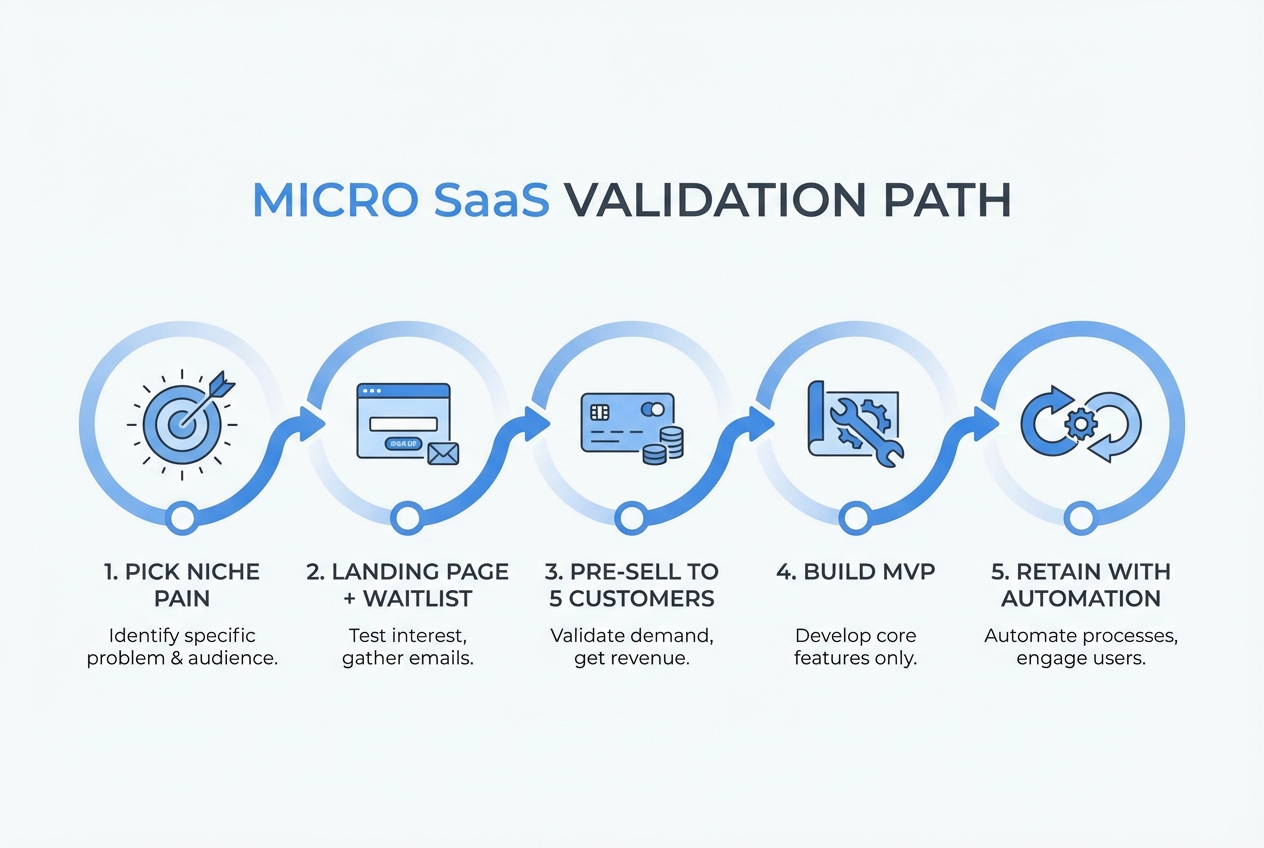 Micro SaaS validation path: pick a niche pain, test demand, pre-sell, build the MVP, then retain with automation.
This is the fastest way to avoid building a “nice-to-have.”
-
Pick a narrow niche and write the promise: One sentence: “I help X do Y without Z.”
-
Talk to 10 target users: Ask what they do today, what breaks, and what it costs them.
-
Write a one-page landing page: Include the promise, 3 outcomes, and a “Book a demo” or “Join waitlist” form.
-
Pre-sell to 3 to 5 customers: You want commitment, not compliments. Even a small paid pilot changes the conversation.
-
Define the Minimum Viable Product (MVP): An MVP is the version that lets you learn the most with the least effort, as defined by Eric Ries in The Lean Startup resources on what an MVP is.
-
Build the smallest paid workflow: One job-to-be-done, end to end.
-
Automate the retention loop: Weekly summary emails, alerts, and reminders keep your product “alive” without extra support.
If you are non-technical, speed matters even more. QuantumByte’s AI app builder is designed to help you go from a plain-English spec to a working app in days, not months. The best mental model is “prototype fast, then harden what works.” For the mechanics, see how does an ai app builder work?
MVP scope ideas for each example
You can ship a strong MVP without 20 features. Focus on one workflow that produces a clear win.
-
Review request + reputation inbox: One customer list import, one message template, one follow-up rule, one dashboard.
-
Proposal and scope builder: A guided form, a PDF or shareable page output, and a “send + track” log.
-
Applicant tracker: A pipeline board, reminders, and a simple scorecard.
-
Reporting portal: Two data sources, three charts that matter, and a weekly client email.
-
Dunning assistant: Failed payment detection, two retry emails, and a recovery report.
-
Scheduling with intake forms: Booking page, intake form, and automated reminders.
-
Invoice follow-up nudges: Invoice import, follow-up sequences, and “paid/unpaid” tracking.
-
Compliance checklist tracker: Checklist templates, due-date reminders, and an audit log.
-
Lightweight inventory: SKU list, low-stock alerts, and a simple purchase order flow.
-
Meeting notes to actions: Capture notes, extract actions, assign owners, send recap.
-
Quote generator: Inputs, pricing rules, branded quote output, follow-up reminders.
-
Niche analytics dashboard: One platform integration, one KPI goal, and trend alerts.
Pricing models that work for micro SaaS
Good pricing does two things: it is easy to explain, and it scales with the value you deliver.
| Model | Best for | Why it works | Risk to watch |
|---|---|---|---|
| Flat monthly subscription | Simple, single-workflow tools | Easy to buy, easy to budget | Can undercharge power users |
| Tiered pricing | Tools with clear usage bands | Matches value to customer size | Too many tiers confuse buyers |
| Per seat | Team tools | Grows with adoption | Seat friction can limit rollout |
| Per client/location | Agency tools, multi-location businesses | Aligns to revenue model | Needs clear definitions |
| Usage-based | API-heavy or volume-driven products | Fair at scale | Can feel unpredictable |
| One-time setup + monthly | Tools with onboarding work | Covers your time and deters churn | Setup can scare small buyers |
A practical rule: if you are doing any manual work, charge for it. You can always remove friction later.
Distribution channels that punch above your budget
Micro SaaS wins by being specific. That makes distribution easier, not harder, because you can show up where your buyers already are.
-
Templates and lead magnets: Give away a checklist, calculator, or proposal template that matches your niche.
-
Partnerships: Bookkeepers, agencies, and consultants already have your audience’s trust.
-
Platform-specific SEO: Build around “{platform} + {outcome}” searches that have high intent.
-
Community-first selling: Niche Slack groups, forums, and newsletters convert when you teach, then offer.
-
Outbound with proof: A simple video audit or teardown works better than cold pitches.
If your distribution plan is “go viral,” you are gambling. Pick one channel you can execute weekly.
When to switch from DIY to custom development
Most founders hit a wall in one of three places: reliability, integrations, or ownership of the product.
-
You need an app, not a pile of tools: When your workflow spans multiple tools, the seams start to show.
-
You need safer data handling: Customers will ask where data lives and who can access it.
-
You need custom logic: Rules, permissions, approvals, and edge cases are where generic tools struggle.
A good way to think about the build path:
-
Start lean: Validate the workflow with the smallest version you can sell.
-
Then build durable: Invest once you have paying users and a clear retention story.
If you are weighing options, our article on hiring a developer vs using no-code tools lays out the tradeoffs clearly.
QuantumByte fits well at the “start lean, then build durable” point. You can generate a first version with AI, then bring in the in-house team when you need deeper integrations, better user experience (UX), or more complex permissions.
Common failure modes
Most micro SaaS failures are avoidable. They happen when founders build wide instead of deep.
-
Building for “everyone”: You lose message clarity and you lose distribution. Pick a niche that can say “this is for me.”
-
Shipping a dashboard before a workflow: Dashboards look impressive but do not create outcomes. Start with the action.
-
Pricing like a commodity: If you charge too little, you cannot afford support and improvement. Price to the problem.
-
Waiting too long to charge: Free users give feedback. Paying users give direction.
-
Ignoring churn signals: If customers cancel because setup is hard, fix onboarding before building more features.
Build your first paid micro SaaS without friction
If your next step is “I need something real I can show and sell,” the fastest move is to build a narrow MVP and put it in front of buyers.
QuantumByte’s pricing guide is designed for exactly this: turning a plain-English idea into a working app you can demo, iterate, and charge for. You can start small, then upgrade into custom development when you hit real demand.
If you are also thinking about selling through agencies, a white-label approach can be a strong multiplier.
Wrap-up: turn one narrow pain into recurring revenue
You now have a practical set of micro SaaS examples that make money because they solve one repeating problem for one clear buyer. You also have a simple validation path: talk to the niche, pre-sell, build a tight MVP, then automate retention.
Do not aim for a “perfect” product. Aim for a paid workflow that creates a win fast. Once that is real, you can expand with confidence.
Frequently Asked Questions
What is the best micro SaaS to start as a solo founder?
The best first micro SaaS is the one where you already understand the buyer, the workflow, and the language they use. In practice, that is often a tool tied to your current service work, like reporting portals, proposal builders, or invoice follow-ups.
How do I know if my micro SaaS idea will make money?
You know it can make money when you can pre-sell it. Get 3 to 5 buyers to pay for a pilot, even if the first version is manual behind the scenes.
How much should I charge for a micro SaaS?
Start with pricing that covers your time and makes the product worth prioritizing for the customer. Flat monthly or tiered pricing is usually easiest. If onboarding requires manual work, add a setup fee.
Do I need to build a full app before selling?
No. Use a landing page and paid pilot to confirm demand. Then ship an MVP. Eric Ries defines an MVP as the version that gives maximum validated learning with the least effort, in his explanation of what an MVP is.
Is micro SaaS the same as SaaS?
Micro SaaS is a focused form of SaaS. SaaS is the delivery model, where users access provider-hosted software, as described in the NIST definition of SaaS. Micro SaaS is about scope, team size, and niche focus.