
Subscription apps that make the most money focus on one thing: a painful, repeating problem that keeps showing up every week. When you deliver a clear win fast, then keep delivering that win monthly with low effort from you, subscriptions stop feeling like "recurring billing" and start feeling like dependable cash flow.
This guide shows you how to design, price, and build a subscription app that can become a real revenue engine, even if you are starting as a solo operator.
How the subscription apps that make the most money actually win
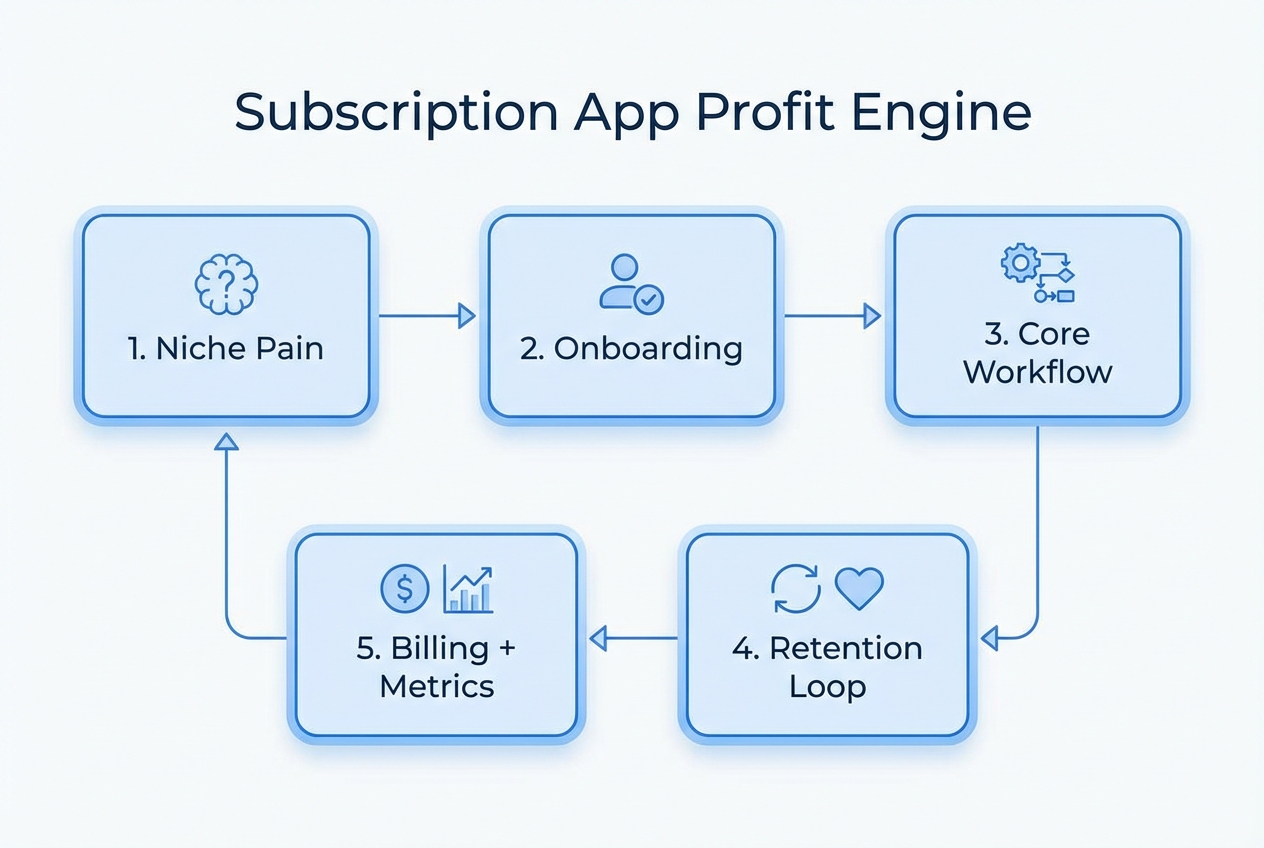
The highest earning subscription apps usually share four traits:
-
They replace a recurring task: If the customer needs to do the job weekly or monthly, a subscription feels natural.
-
They shorten time-to-value: Users get a win in minutes, not days. This lowers churn.
-
They attach to a system of record: The app becomes where the customer stores client data and project history. It can also hold inventory, plans, and compliance evidence.
-
They have a clear value metric: Pricing tracks with value. Not with your effort.
A simple target: build an app your customer would be genuinely annoyed to lose because it holds their workflows and history.
Step 1: Pick a subscription model that matches how your customer buys
Your model decides everything else: onboarding, pricing tiers, and even what “success” means.
Here are the most common subscription app models that scale well.
| Model | Best for | How it makes money | What you must get right |
|---|---|---|---|
| B2B SaaS (Business-to-business software) | Operators, teams, agencies, clinics, trades | Monthly or annual plans per seat or per account | Onboarding, retention, integrations, reporting |
| Prosumer / creator tools | Freelancers, creators, consultants | Tiered plans with feature unlocks | Simple user experience (UX), templates, strong referrals |
| Consumer subscriptions | Fitness, education, lifestyle | Low-priced monthly with high volume | Trust, habit formation, mobile-first |
| Usage-based (metered) subscriptions | AI tools, data tools, automation | Base fee + pay for usage | Clear usage tracking and guardrails |
If you are building for mobile app stores, remember that subscriptions are implemented as recurring entitlements. Google describes a subscription as “a recurring transaction that grants specific entitlements to users” in its Google Play subscriptions documentation.
Step 2: Choose a niche where the pain repeats weekly
The easiest subscription to sell removes a repeating headache.
Start by choosing one niche and one primary job-to-be-done (the core job the user hires your app to do). In my opinion, a focused app beats a generic app most of the time, especially early, because it is easier to explain, easier to onboard, and easier to price.
Strong niche patterns include:
-
Operational chaos: Think scheduling, follow-ups, and handoffs.
-
Compliance and documentation: If proof matters, software sticks.
-
Revenue collection: Invoicing, reminders, subscription management for their customers.
-
Customer-facing portals: A place where clients submit requests, view status, and pay.
Practical niche examples you can validate quickly:
-
Local services: A booking + quote + follow-up system for one trade (for example, cleaners or landscapers).
-
Agencies: A client portal that turns deliverables into a repeatable workflow with approvals.
-
Clinics and wellness providers: Forms, scheduling, plan adherence, and messaging.
-
Back-office teams: Intake, routing, and status tracking for internal requests.
If you are still deciding, spend a few minutes on the QuantumByte Manifesto to reset your mindset around building tools that make real work easier.
Step 3: Validate demand with a paid pre-sell
Most subscription apps fail because they are built in isolation.
Validation is about urgency. You want proof that someone will pay for the outcome, even before the app is perfect.
A clean approach:
- Write a one-page promise: Describe who it is for, what hurts, and what outcome they get. Keep it plain, specific, and easy to repeat. The outcome you want is a page you can use in conversations without constantly re-explaining your idea.
- Offer a founding plan: Give early adopters a simple deal, like a discounted annual plan or a locked-in monthly price. This creates a real decision, and it filters out people who like ideas but do not buy.
- Run 10 conversations: Use these calls to map the current workflow: what tools they use now, where they get stuck, and what they pay for today. The outcome you want is a short list of repeating phrases you can mirror in your landing page and onboarding.
- Ask for a card, not feedback: Feedback is cheap. Payment is proof. The outcome you want is a paid commitment, even if it is small, that tells you the positioning and problem are strong enough to build.
Listen for language like “I need this” and “when can I get it?” That is what demand sounds like.
Step 4: Design pricing that increases as value increases
Pricing is part of the product.
A subscription app that earns well usually prices around one of these value drivers:
-
Per seat: Good when the tool is used by multiple team members.
-
Per account: Good when value is tied to a business, not individual users.
-
Per workflow volume: Good when customers process a countable unit (requests, jobs, invoices).
-
Per outcome tier: Good when customers want a simpler choice (Starter, Growth, Scale).
A simple tier strategy that keeps you flexible:
-
Tier 1 (Starter): Gets a solo user to their first win.
-
Tier 2 (Growth): Unlocks collaboration, automations, and integrations.
-
Tier 3 (Scale): Adds advanced reporting, permissions, and priority support.
If you sell through mobile app stores, understand how subscription revenue share works. Apple explains that auto-renewable subscriptions renew until canceled. During a subscriber's first year of paid service, “you receive 70%” of the subscription price. Apple also says “your net revenue increases to 85%” after one year of paid service on its App Store subscriptions page.
If you bill on the web, you want subscription infrastructure that supports trials, billing cycles, and usage models. Stripe describes these building blocks in its Stripe Subscriptions documentation.
Step 5: Build the minimum lovable subscription app
Your first build should be small, clear, and complete.
Aim for an app that solves one core workflow end-to-end, collects payment cleanly, and gives users a reason to come back next week.
A strong build sequence:
- Map the core workflow (7 steps or less): Short workflows are easier to adopt and easier to debug. The outcome you want is a flow you can explain in one breath, then build screens around without adding “just one more thing.”
- Define the data you must store: Think customers, jobs, requests, sessions, invoices, assets. Keep it tight. The outcome you want is a simple data model that supports your workflow and reporting, without turning into a messy spreadsheet in disguise.
- Design onboarding around a first win: Skip the tour. Drive to a saved result inside the app in the first session. The outcome you want is a user who can say, “This already helped me,” within minutes.
- Add billing after the workflow works: Charging for a broken flow burns trust fast. The outcome you want is a workflow that feels stable before you put a paywall in front of it.
If you want to move fast from idea to working app, QuantumByte fits this phase well. You describe the workflow in plain English, then iterate until it matches reality. If you want the mechanics behind this approach, How does an AI app builder work? breaks it down.
Step 6: Reduce churn with onboarding and retention loops
Churn is lost compounding. A small leak gets expensive when your whole business runs on recurring revenue.
Recurly defines churn as when a customer discontinues their subscription, either voluntarily or involuntarily, in its churn rate guide. That distinction matters because you are fighting both cancellations and failed payments.
Retention systems that work:
-
Bold onboarding: Your onboarding must drive to a first saved outcome. Not a tour. Not a tutorial.
-
Trigger-based reminders: Build reminders around real events (a due date, a new request, a missed step). Notifications should feel helpful, not noisy.
-
Progress visibility: Show what is done, what is next, and what is at risk. Users return when they can see the system working.
-
Templates and defaults: Make starting easy. A blank state kills momentum.
-
Involuntary churn protection: Use card update emails, dunning (retry logic), and a clear billing portal so failed payments do not silently cancel value.
If you only build one retention loop, build this: the app should create a small new piece of useful history every time it is used (a log, a report, a plan, a record). That history becomes the reason people stay.
Step 7: Instrument the metrics that predict profit
Your dashboard should answer one question: are you building an engine or a leak?
Track a small set of metrics consistently:
-
Monthly Recurring Revenue (MRR): The recurring revenue you can expect each month based on active subscriptions.
-
Activation rate: The percent of new signups who reach the first meaningful outcome (your “first win”).
-
Retention: Whether users return and keep using the core workflow over time.
-
Logo churn: The number of customers that cancel in a period.
-
Revenue churn: The amount of recurring revenue lost from cancellations and downgrades.
-
Expansion: Additional recurring revenue from upgrades, add-ons, or usage growth.
Use these metrics for decisions, not vanity. They help you spot what to fix next, fast.
Step 8: Know when AI building is enough, and when you should go custom
Many profitable subscription apps start with a fast build, then add custom work as the business proves itself.
A practical decision rule:
-
Stay in fast-build mode when: Your workflow is clear, the user interface is straightforward, and your biggest risk is demand.
-
Move to custom development when: You need complex permissions, advanced integrations, performance guarantees, or compliance requirements.
This is where QuantumByte's model is genuinely useful. You can prototype quickly, then bring in an expert team to take specific features across the finish line when the return on investment (ROI) is clear.
If you are building for a larger organization with multiple departments, data sources, and approvals, review QuantumByte Enterprise to see what an operational-grade build path looks like.
Step 9: Launch and get your first 100 subscribers
A great app without distribution becomes a side project.
You need a launch plan you can sustain without burning out.
A solo-founder friendly plan:
- Choose one channel you can repeat weekly: Outbound to a niche list, partnerships, or content that targets a single job-to-be-done all work. The outcome you want is consistency, because consistent input creates predictable learning and leads.
- Offer a tight onboarding call: Early on, high-touch onboarding speeds up feedback and retention. The outcome you want is a smooth “first win” path you can later turn into self-serve onboarding.
- Turn objections into product decisions: If you hear the same objection five times, treat it as a signal. It might mean a feature, a pricing change, or clearer positioning. The outcome you want is fewer repeated blockers in sales conversations.
- Publish customer outcomes: Even small wins count. Share before-and-after workflows, saved time, reduced errors, faster turnaround. The outcome you want is credibility that makes the next sales conversation easier.
- Add a referral path early: Make it easy to invite a teammate or share the tool with a partner (like an accountant or operations manager). The outcome you want is growth that does not rely only on you doing more outreach.
You do not need to win every segment. You need to become the obvious choice for one narrow group.
Key takeaways to keep you moving
Subscription apps that make the most money are built on repeatable value and strong retention.
You now have a full path:
-
Choose your model and niche: Pick a buyer, then pick a weekly pain you can remove.
-
Validate with a paid pre-sell: Use paid commitments to prove urgency before you invest months of build time.
-
Price around value: Tie pricing to seats, accounts, volume, or outcomes so revenue grows as customers get more value.
-
Build the minimum lovable workflow: Deliver an end-to-end core workflow, then layer billing and upgrades after it is stable.
-
Reduce churn with retention loops: Drive a first win, create useful history, and protect against failed payments.
-
Track profit-predicting metrics: Use MRR, activation, retention, churn, and expansion to decide what to fix next.
-
Go custom when the ROI is clear: Move beyond fast-build tooling when permissions, integrations, performance, or compliance demand it.
Build it well and you get something rare: recurring revenue that compounds while you focus on the next lever.
Frequently Asked Questions
What types of subscription apps are most profitable?
The most profitable subscription apps typically attach to a recurring workflow and become a system of record. Examples include operational tools (scheduling, intake, approvals), compliance and documentation tools, and customer portals that centralize communication and status.
Is it better to build a subscription app for businesses or consumers?
Business-to-business (B2B) subscriptions are often easier to price higher because they tie directly to revenue, risk, or time saved. Consumer subscriptions can still win, but they usually require stronger habit formation and higher volume.
How do I price a subscription app if I do not know my value yet?
Start with simple tiers that map to clear usage or outcomes, then learn from real customers. Your first pricing goal is clarity and willingness to pay, then you refine as you see retention and expansion patterns.
Do I need to launch on the App Store and Google Play to make serious money?
No. Many high-performing subscription apps are web-based software-as-a-service (SaaS) products. If you do go mobile, understand subscription entitlements and platform economics through the official documentation for Apple subscriptions and Google Play subscriptions.
What is the fastest way to build and test a subscription app idea?
The fastest path is to validate demand with paid commitments, then build a minimum lovable workflow that delivers a first win quickly. Tools like the QuantumByte AI builder can help you move from a plain-English workflow to an app prototype faster, so you spend less time guessing and more time learning from users.